The Secret in the Stands
On the afternoon of October 7, 1945, a photographer named Maurice Terrell slipped into Lane Field and quietly took pictures of a baseball player warming up. The player was Black. The league was white. And the man who had arranged this session, Brooklyn Dodgers executive Branch Rickey, needed proof that Jackie Robinson could hold himself together under pressure before the most consequential announcement in baseball history.
Built in Two Months
Lane Field was itself a product of urgency. The Works Progress Administration constructed the ballpark in 1936 in just two months — a Depression-era speed record — giving the San Diego Padres of the Pacific Coast League a proper home on the downtown waterfront near the Santa Fe railroad depot. It seated around 8,000 and opened in time for the 1936 season.
The location put the ballpark in the heart of a city that was transforming itself through military expansion and civic ambition. Sailors and soldiers on liberty filled the bleachers. The Padres were part of San Diego's texture in those years, a working-class entertainment in a city that was quickly becoming a military boomtown.
Ted Williams Learned His Craft Here
Before Ted Williams became Ted Williams — before the .406 season, the two interrupted careers for military service, the Hall of Fame — he was a Padres outfielder. Williams played for San Diego from 1936 to 1937, developing the swing mechanics and the relentless work ethic that would eventually make him the last major league player to hit over .400 in a season.
Lane Field was where Williams first learned what professional baseball actually demanded. He was seventeen when he arrived. The PCL was serious competition, and the ballpark on the waterfront was where he proved to himself that he could hit at this level. He left for Boston after his second season and never played minor league ball again.
The Photograph That Changed Baseball
The October 1945 visit by Branch Rickey's photographer was not announced. Rickey was secretly evaluating Robinson for the Brooklyn Dodgers — specifically, for the project that would become the breaking of Major League Baseball's color barrier. Robinson had been playing for the Kansas City Monarchs of the Negro Leagues, and Rickey needed to see him in person, under observation, before committing to the integration plan.
Terrell's photographs showed Robinson fielding grounders, taking batting practice, moving around the diamond with the composure and athleticism that Rickey had been seeking. The session at Lane Field became part of the evidentiary record of that extraordinary decision. Six days after the photographs were taken, Rickey signed Robinson to the Montreal Royals, the first step toward the moment in April 1947 when Robinson walked onto Ebbets Field and changed what American sports could be.
A Ballpark's Life
Lane Field served the Padres through the 1957 season, twenty-one years of Pacific Coast League baseball on the waterfront. The stadium was demolished in 1958 as San Diego's downtown shifted its ambitions. The land became part of the harbor development that remade this section of the waterfront into something more commercial and less intimate than the old ballpark had been.
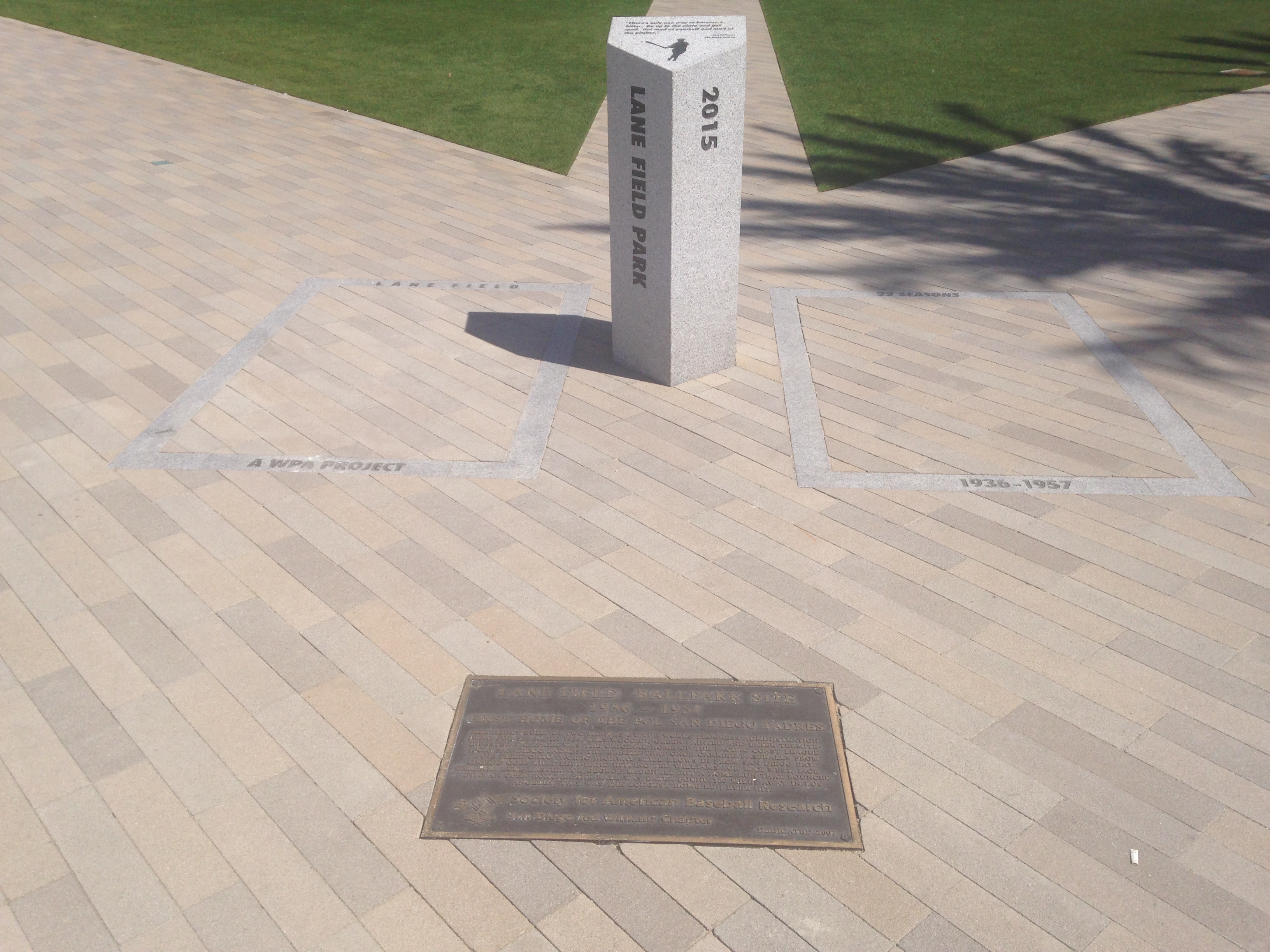
Today a marker commemorates the site near the waterfront. The harbor itself has been built up around it, and the Navy's Broadway Complex occupies the adjacent land. But the coordinates where those photographs were taken in October 1945 — where a young man demonstrated, in the quiet of an off-season afternoon, that he was ready — remain fixed, invisible beneath the pavement, part of the permanent record of what this city witnessed.
From the Air
The former Lane Field site sits along the San Diego waterfront near the Santa Fe Depot and Broadway Pier, visible from lower altitudes as part of the developed harbor district.