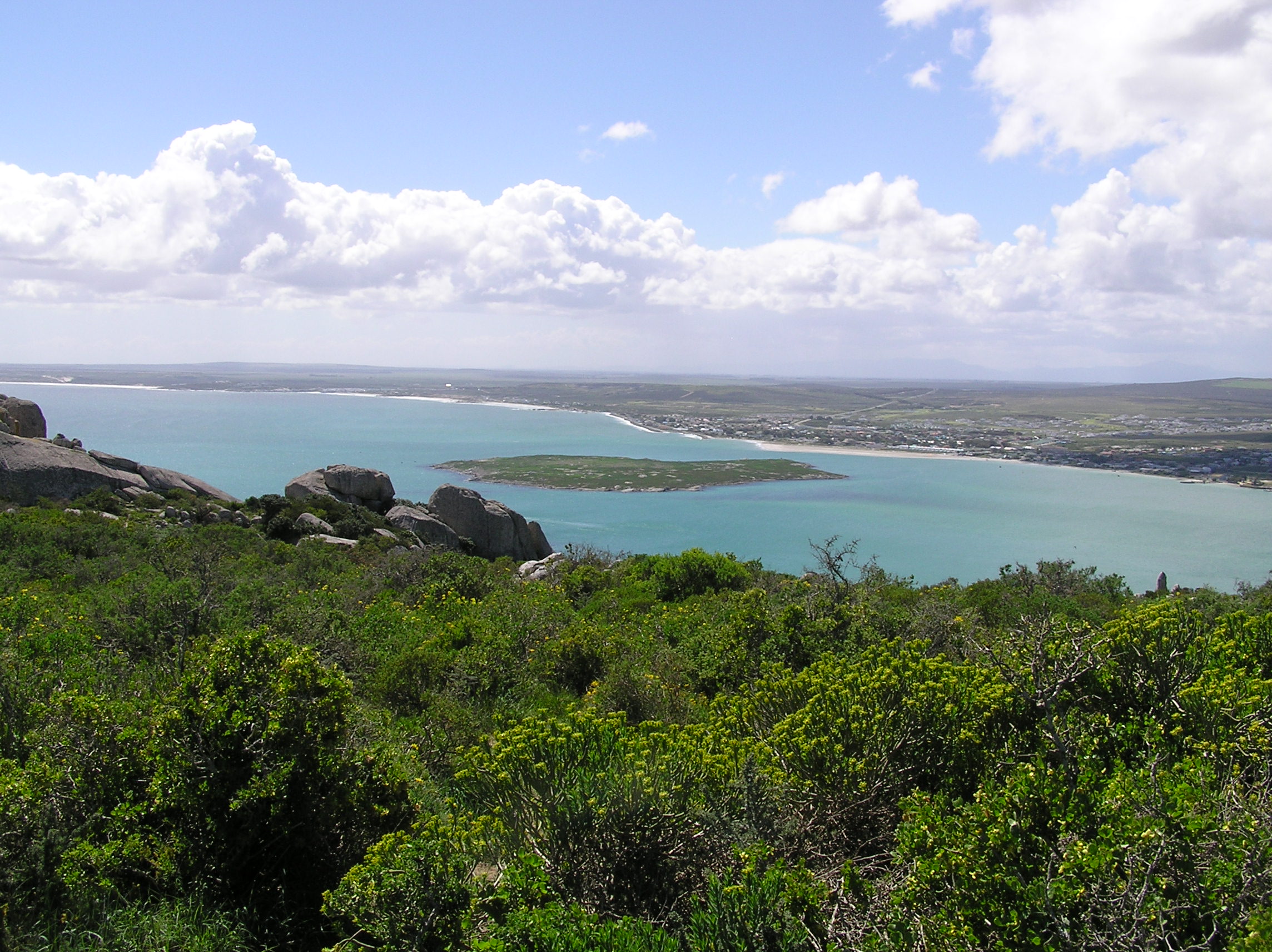
Langebaan
Langebaan made a decision that most coastal towns never consider: it said no. No to factories, no to industrial development, no to the economic logic that turns fishing villages into port cities. The town's founding principle, still enforced, is that no industries are permitted within its boundaries. What Langebaan chose instead was its lagoon, a body of water so improbably clear and calm that first-time visitors routinely compare it to the Mediterranean, overlooking the fact that the Atlantic Ocean feeding it rarely climbs above 17 degrees Celsius.
The Lagoon That Chose a Town
Langebaan Lagoon is the southern extension of Saldanha Bay, a natural harbor on South Africa's West Coast. The lagoon stretches south from the bay in a long, narrow curve, its shallow waters warmed slightly by sun-heated sand and sheltered from the open ocean's swells by the Postberg peninsula. The result is a body of water with the visual characteristics of a tropical lagoon and the temperature of the South Atlantic: beautiful to look at, bracing to enter. White sand beaches line the eastern shore, and the water shifts through shades of turquoise and emerald depending on the depth and the angle of the light. For a town of 8,300 people situated about 90 minutes' drive from Cape Town along the R27, the lagoon is both identity and economy. Everything Langebaan does revolves around it.
Wind, Kites, and Festival Mussels
The same southeaster wind that drives Capetonians indoors during summer is what pulls kitesurfers to Langebaan. The lagoon's flat, sheltered water and reliable afternoon wind make it one of the best kitesurfing locations in South Africa, and several schools operate along the waterfront. Sailing, kayaking, and fishing round out the water sport calendar. On land, Club Mykonos Resort anchors the town's events scene, hosting triathlons, cycling races, car gymkhanas, and art exhibitions throughout the year. A monthly craft market showcases local artists. The social calendar peaks during the first weekend of October, when the annual Langebaan Mussel Festival draws crowds from Cape Town and beyond. The festival is an exercise in West Coast hospitality: mussels steamed in white wine, community stalls, live music, and the kind of outdoor eating that the lagoon's setting was designed to frame.
Fisher-Folk and Guardians
Behind the tourism brochure language, Langebaan's identity rests on a fishing culture that predates the holiday homes and kite schools. The West Coast's heritage fishing villages are defined by a tangibly strong connection between the people and the sea that supports them. Small wooden fishing boats, painted in faded primaries, are pulled up on the beach or anchored in the shallows. The fishermen who operate them work seasonal rhythms that have changed less than the town around them suggests. This culture is under pressure from development and rising property values, but it persists in the harbor, in the restaurants that serve what was caught that morning, and in the community events that still center on the church bazaar rather than resort programming. Langebaan's ban on industry was, at its core, a decision to protect this way of life.
Gateway to the West Coast
Langebaan functions as the southern anchor of a string of West Coast communities, each with its own character. Saldanha Bay, to the north, is the industrial counterpart Langebaan refused to become, with an iron ore terminal and naval base. Paternoster, further up the coast, is a whitewashed fishing village that has become a weekend destination for Cape Town residents seeking even greater quiet. Port Owen and St Helena Bay continue the chain northward. Cape Town itself is just over an hour's drive south, close enough for day trips but far enough to feel like a different world. The West Coast's dramatic coastline, changeable seas, white sandy beaches, and wide skies constitute a landscape that grows on visitors gradually, less immediately spectacular than the Winelands or Garden Route but more lasting in its effect, the kind of place that creeps under your skin through repetition rather than spectacle.
From the Air
Located at 33.09S, 18.03E on the eastern shore of Saldanha Bay, Western Cape, South Africa. Langebaan Lagoon is clearly visible from altitude as a turquoise body of water extending south from the larger bay. Saldanha Bay (FASS) has a military airfield. Cape Town International Airport (FACT) is approximately 120 km to the south. The West Coast National Park borders the town to the south and west. The Postberg peninsula encloses the lagoon's western shore. Best viewed at 3,000-6,000 ft AGL following the R27 coastal route north from Cape Town.