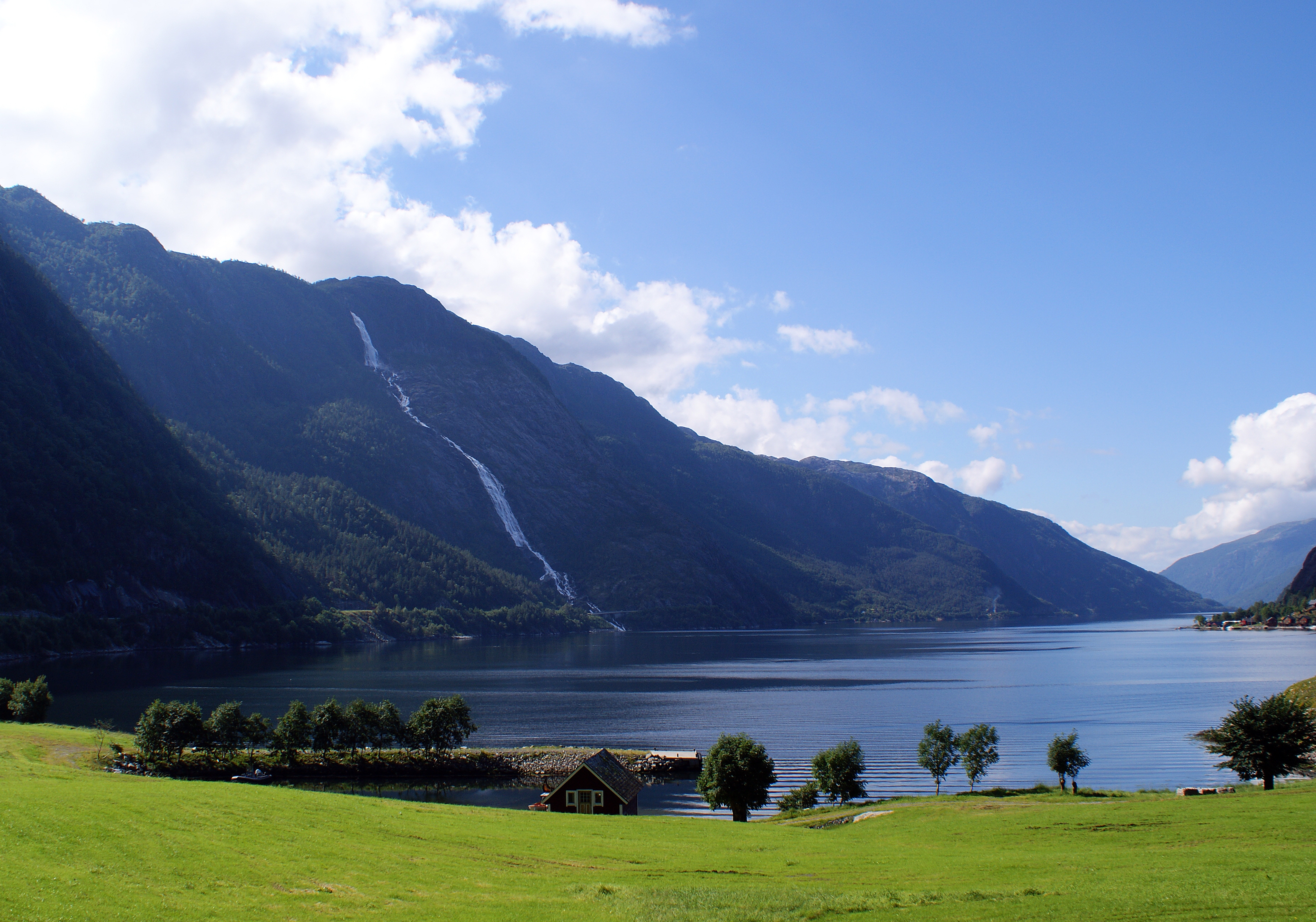
Langfossen
Most of Norway's great waterfalls have been put to work. Turbines replaced tourists at cascade after cascade during the twentieth century, as hydroelectric power became the country's dominant energy source. Langfossen refused that bargain. Dropping 612 meters from the mountain uplands into the Akrafjord in Etne Municipality, this is one of the few major waterfalls in Norway that still flows in its natural state -- no diversion, no dam, no turbine house at the base. In 2006, the World Waterfall Database named it the most beautiful waterfall in the world. In 2011, CNN listed it among the ten most beautiful. Both recognitions pointed to the same quality: Langfossen looks the way Norway's waterfalls used to look before the engineers arrived.
The Slide, Not the Plunge
What distinguishes Langfossen from the classic postcard waterfall is its angle. Rather than plunging vertically over a cliff edge, the water glides down the mountainside in a long, slanting descent, maintaining contact with the rock face for most of its 612-meter journey. The effect is less dramatic than a sheer drop but more hypnotic -- a silver ribbon laid against dark stone, shifting width and intensity with the seasons. In late spring, when snowmelt swells the stream from its mountain basin, Langfossen broadens into a wide sheet that polishes the rock to a gleaming finish. By midsummer the flow narrows to a slender thread, but the long diagonal line remains unmistakable against the cliff. At its base, the waterfall does something remarkable: it flows directly into the Akrafjord, sliding off the mountainside and into salt water without any intervening pool or riverbed.
Shaped by Deep Time
The landscape that frames Langfossen was sculpted during the last Ice Age, when glaciers carved the Akrafjord and its surrounding valleys into the bedrock. The waterfall itself owes its distinctive spreading shape to geology. The upper rock face is composed of hard, erosion-resistant stone that has maintained its steep angle over millennia. Below that layer, softer rocks have worn away more readily, creating the wide, fan-like profile that catches sunlight so effectively. The fjord at the base was cut when glaciers melted and their meltwater scoured deep channels through the mountains, revealing the rugged terrain visible today. The coastal climate keeps the area mild and wet, with heavy rainfall throughout the year feeding the stream above. In winter, portions of the waterfall freeze into elaborate ice formations that cling to the rock face like crystallized architecture.
The Road That Changed Everything
For centuries, Langfossen was simply part of the local landscape -- familiar to the residents of Etne but largely unknown beyond the region. That changed when the E134 highway was routed along the opposite shore of the Akrafjord, placing the waterfall in direct view of passing motorists. No hike required, no boat trip necessary. Drivers rounding a bend suddenly confronted the full 612-meter cascade sliding down the mountainside across the water. Several viewpoints along the highway now offer unobstructed panoramas, and the waterfall appears in travel guides precisely because of this accessibility: a world-class natural wonder visible from a car window. For those who want more than a roadside view, hiking trails climb the slope beside the falls, with stone steps placed by local volunteers to reduce erosion from the increasing foot traffic.
Kept Wild on Purpose
Langfossen's survival as a free-flowing waterfall is not an accident of geography but a conscious choice. Local authorities and environmental organizations have implemented protections for the site and its surroundings, regulating human activity to limit pollution and erosion. Vehicle access near the base is restricted. Educational signage promotes environmental awareness. The growing international recognition -- from the World Waterfall Database in 2006 and CNN in 2011 -- has strengthened the case for conservation even as it brings more visitors. The result is a careful balance: Langfossen serves as both a natural attraction and a demonstration that not every waterfall in Norway needs to generate electricity to justify its existence. Some justify themselves simply by continuing to fall.
From the Air
Located at 59.84N, 6.34E in Etne Municipality, Vestland county. The waterfall is a bright silver diagonal line on the south side of the Akrafjord, clearly visible from altitude. The E134 highway runs along the opposite (north) shore. Nearest airports include Haugesund Airport Karmoy (ENHD), approximately 60 km west, and Bergen Airport Flesland (ENBR), approximately 100 km north. Recommended viewing altitude 3,000-8,000 feet to see the full cascade and its relationship to the fjord.