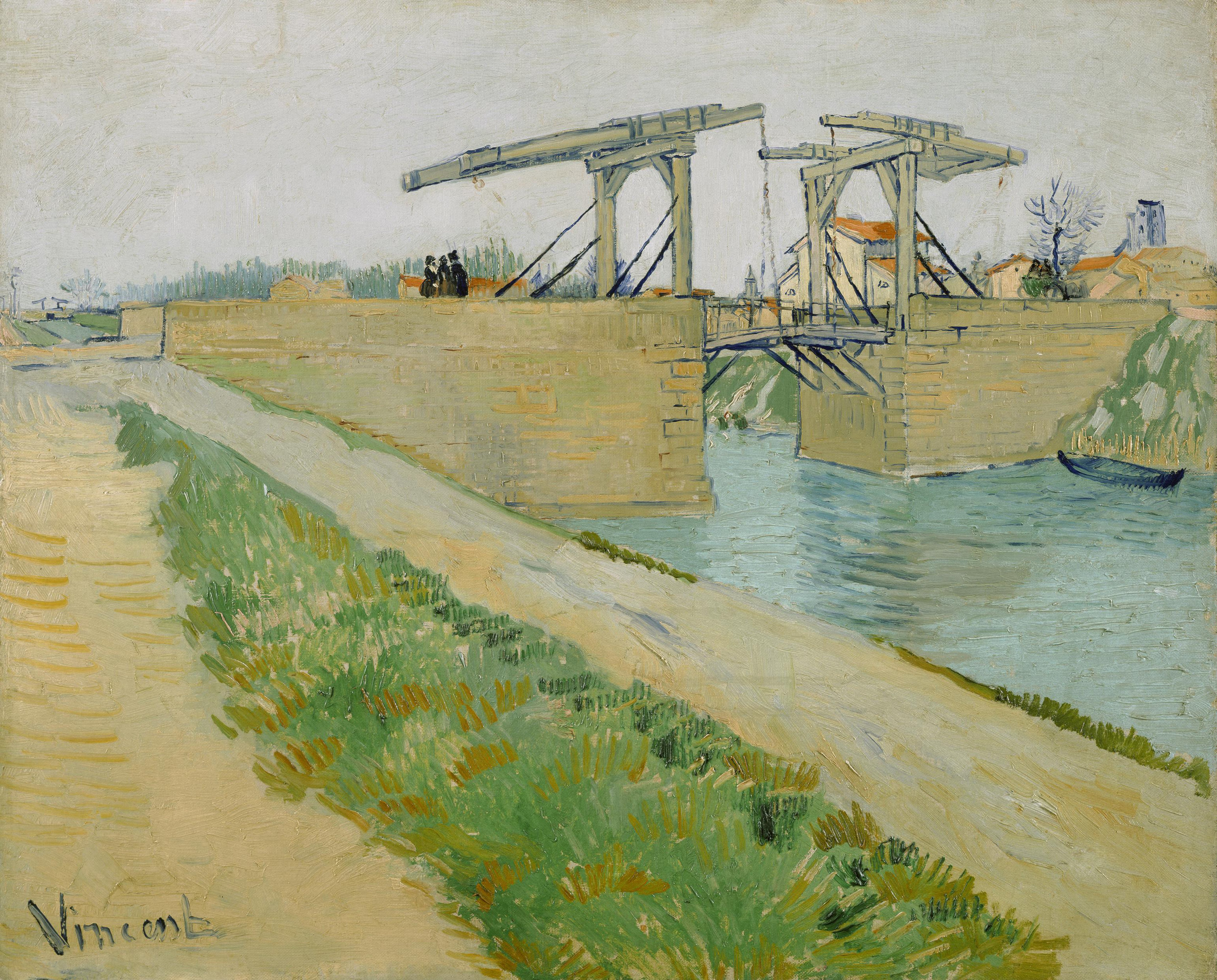
Langlois Bridge at Arles
In a letter to his friend Emile Bernard, Vincent van Gogh sketched a drawbridge silhouetted against a huge yellow sun and described how the town of Arles projected its strange shapes against the Provencal sky. He was thirty-five years old, living in southern France at the height of his powers, and a simple canal bridge had become an obsession. Between March and May of 1888, van Gogh produced four oil paintings, one watercolor, and four drawings of the Langlois Bridge -- a double-beam drawbridge on the Arles-to-Bouc canal that reminded him, with its machinery and its flat canal landscape, of the Netherlands he had left behind.
A Dutchman in Provence
Van Gogh arrived in Arles seeking the bright sun and vivid colors that Paris could not provide. What he found was a countryside of canals, drawbridges, windmills, and thatched cottages that uncannily echoed the Dutch landscapes of his youth. In less than fifteen months, he would produce more than 200 paintings, about 100 drawings, and write more than 200 letters -- one of the most astonishing bursts of creativity in art history. The Langlois Bridge caught his eye almost immediately. Officially the Pont de Reginel, it was known locally by its keeper's surname, and Van Gogh began studying it around mid-March 1888, painting women washing clothes on the canal bank beneath its wooden beams.
Japan in the Midi
The bridge reminded van Gogh of Hiroshige's woodcut print Sudden Shower on the Great Bridge, and he deliberately set out to fuse Japanese techniques with his Provencal subjects. He simplified his palette into blocks of contrasting color -- blue sky against yellow bridge, green bank against orange-red grass -- using fewer shades but multiple subtle variations within each tone. Outlines suggested movement rather than defining form. The result was a series of paintings that feel both precisely observed and emotionally heightened, the drawbridge rendered with mechanical accuracy while the colors vibrate with an intensity that owes nothing to nature and everything to artistic will. In a letter to Bernard, van Gogh wrote that Japanese art was continuing in France, and these paintings were his proof.
The Perspective Frame Returns
Van Gogh was not working from instinct alone. In Arles, he returned to a perspective frame he had built years earlier in The Hague, a viewing device used for outdoor sightings to compare the proportions of near and distant objects. Some of the Langlois Bridge works were made with its aid, and its use deepened his exploration of the drawbridge as a mechanism -- the hardware, iron supports, braces, and chain pulleys rendered with surprising precision even in watercolor. He asked his brother Theo to send him a copy of Armand Cassagne's Guide to the Alphabet of Drawing, wanting to return to foundational practices. The first masterpiece of his Arles period, The Langlois Bridge at Arles with Women Washing, now at the Kroller-Muller Museum, shows the bridge with a yellow cart crossing it while women in multicolored caps wash linen on the shore -- common life elevated by uncommon seeing.
The Bridge After Van Gogh
The original Langlois Bridge was replaced by a concrete structure in 1930, which was blown up by retreating Germans in 1944 along with every other bridge on the canal except one at Fos-sur-Mer. That surviving bridge was dismantled in 1959 with the intention of reassembling it on the original site, but structural problems forced its installation several kilometers away at Montcalde Lock. It was renamed Pont Van-Gogh. The paintings, meanwhile, scattered across the world -- to the Kroller-Muller Museum in the Netherlands, the Van Gogh Museum in Amsterdam, the Wallraf-Richartz Museum in Cologne, and private collections. Arthur C. Clarke placed the bridge painting in the mysterious hotel suite at the end of 2001: A Space Odyssey. Argentine musician Luis Alberto Spinetta referenced it in what is considered the greatest album in Argentine rock history. A sliding-puzzle version appeared on The Amazing Race. The simple canal bridge that reminded a lonely Dutchman of home became one of the most recognized images in art.
From the Air
Located at 43.657N, 4.621E along the Arles-to-Bouc canal, just south of Arles. The reconstructed Pont Van-Gogh is at Montcalde Lock, a few km from the original site. The flat canal landscape is visible from altitude. Nimes-Ales-Camargue-Cevennes Airport (LFTW) lies 35 km northwest. Best viewed from 1,500-2,500 ft AGL.