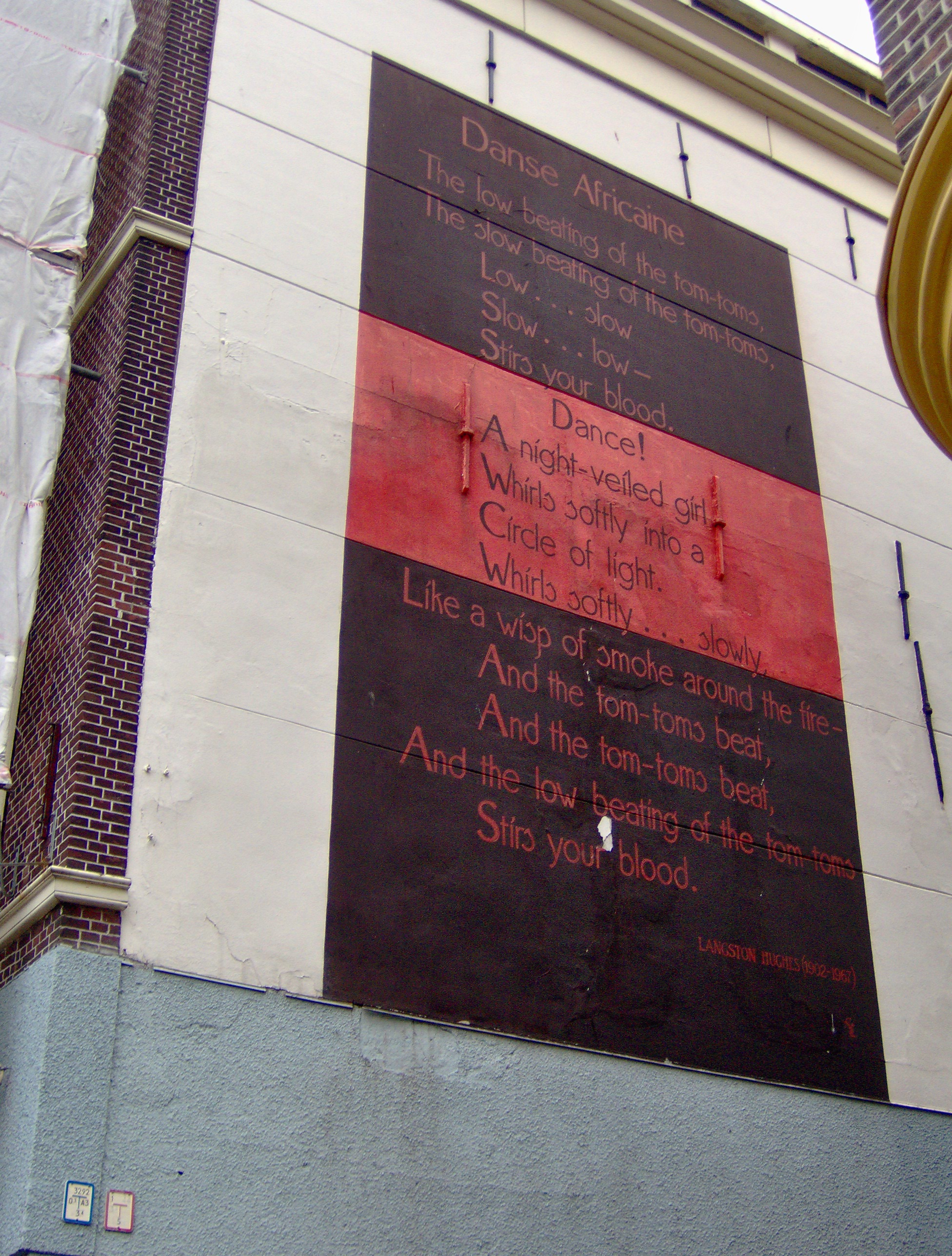
Langston Hughes
"I've known rivers," Langston Hughes wrote at seventeen, riding a train to Mexico. "I've known rivers ancient as the world and older than the flow of human blood in human veins." The poem, "The Negro Speaks of Rivers," was published in The Crisis magazine in 1921 and became his signature work -- the first ripple of a literary career that would define the Harlem Renaissance and echo across the African diaspora for generations. Hughes arrived in New York in 1921 to attend Columbia University, but Harlem pulled harder than the classroom. He dropped out after a year, drawn to the neighborhood's vibrant cultural life, its jazz clubs and rent parties and the voices of ordinary Black people whose stories he believed deserved the dignity of art. He would make 20 East 127th Street his home, and Harlem his subject, for the rest of his life.
Books Began to Happen to Me
Hughes was born in Joplin, Missouri, on February 1, 1901, into a family shaped by both racial pride and racial grief. His maternal grandmother, Mary Patterson, had been among the first women to attend Oberlin College. Her first husband, Lewis Sheridan Leary, died in John Brown's raid on Harpers Ferry in 1859. Through the Black American oral tradition, she instilled in her grandson what he later described as a lasting sense of racial pride. But the boy's childhood was lonely. His father left for Mexico to escape American racism. His mother traveled constantly seeking work. Raised mostly by his grandmother in Lawrence, Kansas, Hughes found refuge in the only place that offered it. "Then it was that books began to happen to me," he wrote in his autobiography The Big Sea, "and I began to believe in nothing but books and the wonderful world in books -- where if people suffered, they suffered in beautiful language, not in monosyllables, as we did in Kansas."
Free Within Ourselves
His first poetry collection, The Weary Blues, appeared in 1926. That same year, he published what amounted to a manifesto for his generation in The Nation: "The Negro Artist and the Racial Mountain." The essay declared the independence of young Black artists from white approval and middle-class respectability alike. "We know we are beautiful. And ugly, too," Hughes wrote. "We build our temples for tomorrow, strong as we know how, and we stand on top of the mountain free within ourselves." Where other writers of the Harlem Renaissance navigated between the expectations of white publishers and Black bourgeois taste, Hughes aimed for something rawer. He wrote about washerwomen, jazz musicians, Harlem streetscapes, and the blues -- the "low-life" of Black America, as critics dismissively called it. Hughes saw nothing low about it.
A People's Poet
For twenty years, from 1942 to 1962, Hughes wrote a weekly column for the Chicago Defender, one of the most influential Black newspapers in America. In it he created Jesse B. Semple -- "Simple" -- an ordinary Black man from Harlem who dispensed wisdom, humor, and pointed social commentary from a barstool. Simple became one of the most beloved characters in Black literature, speaking truths about race and class in a voice that sounded like the man next door. Beyond journalism, Hughes's output was staggering: novels, short story collections, plays, children's books, anthologies, a two-volume autobiography. His 1930 novel Not Without Laughter won the Harmon Gold Medal for literature. He co-wrote the play Mule Bone with Zora Neale Hurston. He mentored a generation of writers, among them Alice Walker, and was known for his generosity with younger artists. Loften Mitchell observed: "You never got from him, 'I am the Negro writer,' but only 'I am a Negro writer.'"
Rivers and Revolutions
Hughes traveled widely and restlessly. He shipped out on the S.S. Malone in 1923, spending six months traveling to West Africa and Europe. He lived briefly in Paris. In 1932, he traveled to the Soviet Union as part of a group invited to make a film about African American life -- a project that was quietly shelved when the Soviets won diplomatic recognition from the United States. He visited China, Japan, and Korea. In 1937, he covered the Spanish Civil War as a correspondent for the Baltimore Afro-American, broadcasting live from Madrid. His political sympathies drew him toward communism as an alternative to a segregated America, though he later distanced himself from the movement after being called before Senator Joseph McCarthy's committee. He was rebuked by the radical left for backing away and by the right for having been there at all -- a position he occupied with characteristic quiet resolve.
My Soul Has Grown Deep
Hughes died on May 22, 1967, at the age of sixty-six, from complications after abdominal surgery related to prostate cancer, at the Stuyvesant Polyclinic in New York City. His ashes are interred beneath a floor medallion in the foyer of the Schomburg Center for Research in Black Culture in Harlem, at the entrance to an auditorium bearing his name. The design on the floor is an African cosmogram titled Rivers, after his first published poem. At its center is the line: "My soul has grown deep like the rivers." The house at 20 East 127th Street received New York City Landmark status in 1981, and the block was renamed Langston Hughes Place. His influence traveled far beyond Harlem -- to Jacques Roumain in Haiti, Nicolas Guillen in Cuba, Leopold Sedar Senghor in Senegal, and Aime Cesaire in Martinique, all of whom drew from Hughes's example in building their own literary movements of Black pride and cultural nationalism.
From the Air
Located at 40.81N, 73.94W in Harlem, Manhattan. The Langston Hughes House at 20 East 127th Street is a New York City Landmark. The Schomburg Center for Research in Black Culture, where Hughes's ashes are interred, is at 515 Malcolm X Boulevard. The Apollo Theater on 125th Street is nearby. The Harlem street grid is clearly identifiable from altitude. Nearby airports: LaGuardia (KLGA) approximately 6 nm east. Best viewed at 1,500-2,500 ft AGL.