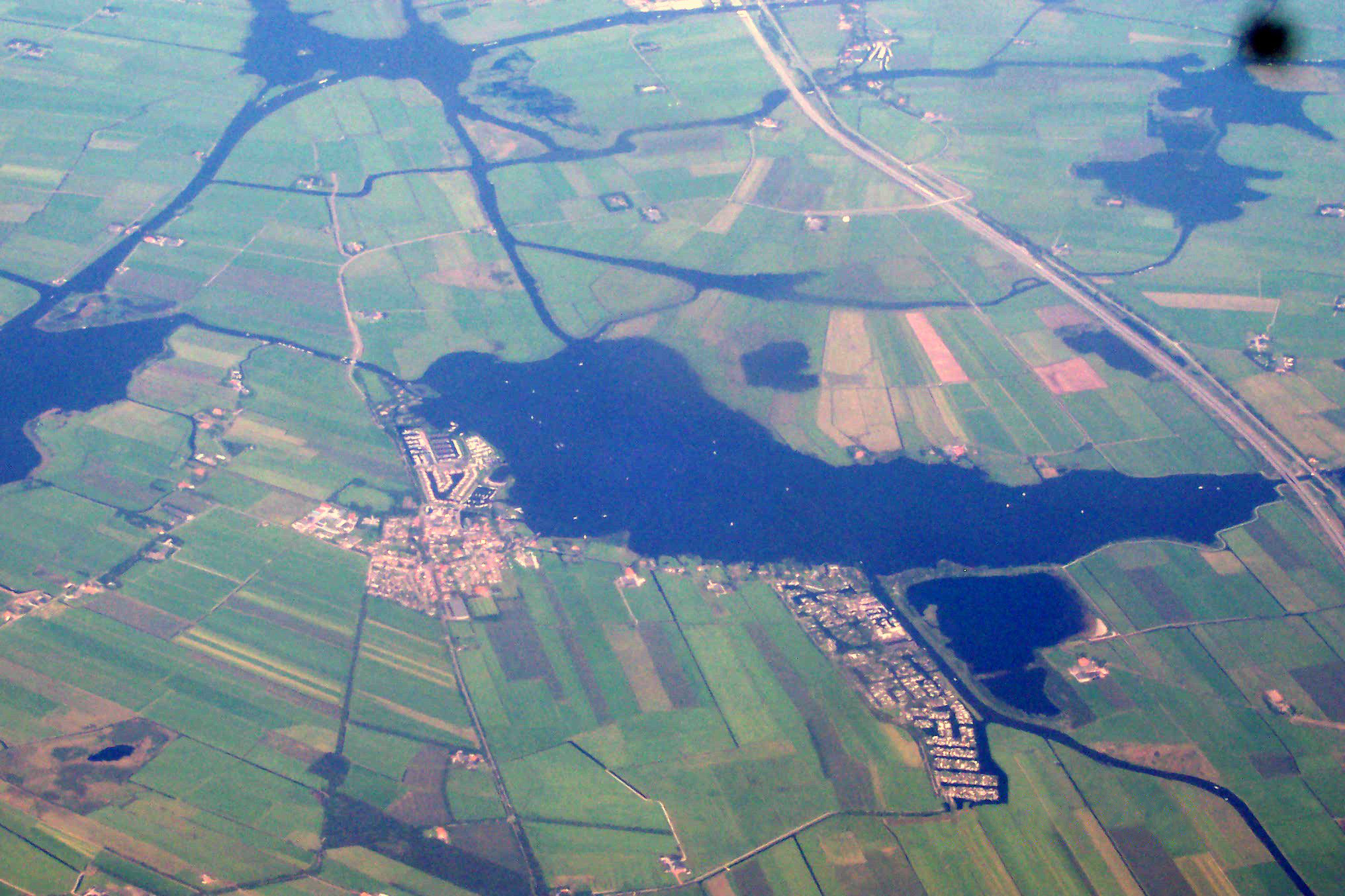
Langweer
In 1860, someone finally pushed open the door of the old town hall in Langweer. It had been locked since 1829, when Schelte Hessel Roorda van Eysinga — the last grietman, or rural mayor, to live there — closed up the building and walked away. For three decades nobody had been inside. When the door swung wide, the visitors found clothes lying on the floor exactly where they had fallen, cups still set out on the table. A whole life paused mid-sentence, preserved by nothing more elaborate than a locked door and the courtesy of strangers.
The Long Lots
Langweer takes its name from the Frisian word Langwar — war being the old term for a parcel of land, related to the English ward. Long lots, in other words, named for the shape of the paddocks that ran down to the lake. The village was founded in 1256 and for most of its history could only be reached by boat. Swampland walled it off from the rest of Friesland. Not until 1856 did a real road, the Brédyk, connect Langweer to the outside world via Sint Nicolaasga, a project organized by Johan Vegelinsoord of Claerbergen and accompanied by a campaign of tree planting and drainage that finally tamed the surrounding bog.
Swans on the Spire
The village symbol is a swan, possibly inherited from the medieval right of farmers in this area to shoot the birds — a privilege that translated, somewhere along the way, into a heraldic device. A swan tops the spire of the Hervormde Kerk, the Dutch Reformed church built in 1777 on the site of three earlier churches. The interior is unusually decorated for its era, and houses one of the finest organs in Friesland: a Lambertus van Dam instrument from 1784. The five-paneled pulpit is older still, carved in 1684 by Benedictus Jans and preserved when the previous church came down. Across the village the windmill De Sweachmermolen, a combined corn mill and drainage mill, has been restored to working order. It is held in reserve for emergencies — and serves the rest of the time as a holiday rental.
Skutsjesilen
Since the 1990s Langweer has become a favorite town of summer visitors, mostly for its picturesque streets and its position on the Langwarder Wielen — one of the open lakes in the Frisian chain. The defining event each year is Skutsjesilen, the traditional regatta in which crews race skûtsjes, the iron-hulled cargo barges that once carried peat and dairy across these waters. Watching a skûtsje race is unlike modern sailing: the boats are heavy, the leeboards crash down audibly, the rigs are enormous, and the crews work the deck like nineteenth-century stevedores. Langweer is one of fourteen villages on the rotating Skûtsjesilen circuit, and the week the fleet comes to its waters, the lake fills with brown sails.
What the Village Kept
Plenty of Langweer has been lost. Douma State, the sixteenth-century farmhouse on the west side of town, was demolished in 1845; its companion buildings were burned by Burgundian soldiers in 1517. The Orangerie, a farmhouse renowned for its exotic plants, is gone. The Wymerts canal that once cut through the village has been filled in. The Van der Leij grass-drying and oil-pressing factory operated from 1907 to 1965, then closed, then became a cafe, then a service center, then disappeared entirely in the 1990s to make way for a waterside housing development. What endures is the older fabric: the Weversstreek, where the weavers lived in one-room cottages; De Waag, the weigh house where farmers brought their cheese and butter until 1906; the Regt Huys courthouse built around 1600, repurposed in the 2000s as a library. The lake is unchanged. The swan still presides.
From the Air
Coordinates 52.9578°N, 5.7228°E, in the heart of the Frisian lakes between Sneek and Heerenveen. From the air, look for the cluster of dark roofs against the silver of the Langwarder Wielen on the village's east side. Recommended viewing altitude 1,500-2,500 feet. Drachten (EHDR) is about 18 nautical miles northeast; Lelystad (EHLE) 35 nautical miles southwest across the IJsselmeer.