Lanquin
Every evening, just before sunset, something happens at the mouth of the Grutas de Lanquin that stops people mid-sentence. A low rumble builds inside the cave, and then the bats come -- not dozens or hundreds but millions, streaming out in a spiral column that corkscrews into the darkening sky like smoke from a chimney that will never go out. The spectacle lasts for nearly an hour. For the ancient Maya, this cave was a gateway to Xibalba, the underworld. For modern travelers who make the rough journey to this small town in Guatemala's northern lowlands, it remains a place where the boundary between the ordinary and the extraordinary feels genuinely thin.
Gateway to the Underworld
The Grutas de Lanquin is a gigantic limestone cave system that extends deep beneath the jungle-clad mountains of Alta Verapaz. The Maya used these caves for mystical ceremonies to connect with the underworld, and their sacred significance persists in the local imagination. Inside, paved walkways and electric lights penetrate about 400 meters, but beyond that point the caves stretch into unmapped darkness -- local guides report venturing as far as three kilometers before turning back, and no comprehensive survey of the system has ever been completed. Stalactites crowd the ceilings, shaped by millennia of dripping water into forms that guides liken to animals and human figures. The larger chambers carry names and legends. The Altar of the Picota marks where the ancient Maya are said to have performed their underworld rituals. Then there is Kings Fall Bridge, named for an incident in 1958 when King Baudouin of Belgium reportedly visited the caves and the bridge beneath him collapsed, sending the royal party tumbling into the water below. Somewhere in the cave's depths, the Lanquin River is born, emerging from the rock face in a pale blue current.
The Turquoise Staircase
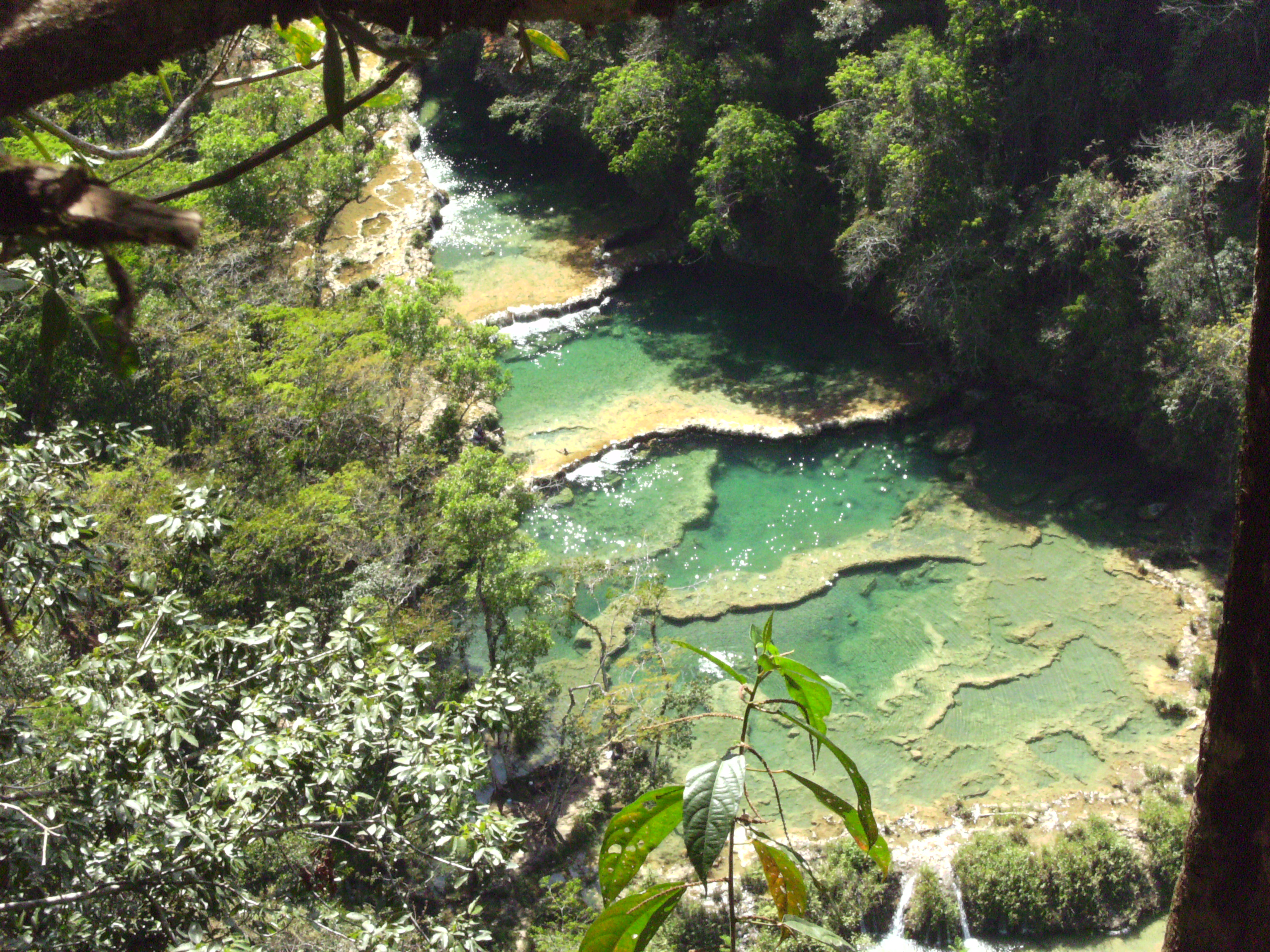
Seven kilometers outside town along a rough road -- itself a work in progress being paved, one stretch at a time -- lies Semuc Champey, a natural formation that seems engineered to astonish. A series of tiered limestone pools, ranging from jade green to deep turquoise, cascade down through the jungle canopy. Beneath them, the Cahabon River disappears entirely, roaring through a subterranean tunnel while the pools above sit in eerie stillness. A trail climbs steeply to a mirador that reveals the full scope of the formation: a 300-meter limestone bridge with pools arranged like a staircase, surrounded by unbroken jungle. Swimming in the pools feels otherworldly -- the water is cool and impossibly clear, and the rock ledges between levels invite both careful descent and reckless jumping. The full Semuc Champey tour, typically run out of local guesthouses, begins with a candlelight exploration of the Grutas de Las Marias, an underground river navigated by swimming, wading, and climbing waterfalls in near-total darkness, followed by a nine-meter bridge jump and a float downriver.
Valley Life at River Pace
Lanquin itself is a small town nestled in a deep, hot valley between the mountains of Guatemala's northern lowlands. Walking is the primary mode of transport -- everything is reachable within twenty minutes -- supplemented by tuk-tuks that buzz along the streets as late as eleven at night. The town's annual festival honoring St. Augustine runs from August 24 through 28, filling the streets with parades, carnival rides, regional food, and music. Beyond the festivities, daily life revolves around the river. Travelers rent inner tubes for a leisurely float down the Lanquin River to El Retiro, a guesthouse and social hub on the riverbank where communal dinners require signing a list and late nights bring dancing and what the guidebooks diplomatically call ribaldry. At Comedor Champey, near the bridge and school, a hand-painted sign in Hebrew hints at the eclectic community of travelers who have passed through, and the schnitzel is unexpectedly excellent.
Where the Road Runs Out
Getting to Lanquin is part of the experience. Most travelers arrive from Coban by minibus, a journey that involves frequent stops to pick up locals along increasingly narrow mountain roads. The landscape shifts from highland chill to lowland humidity as the road descends into the valley, and the green deepens from pine forest to tropical jungle. From Lanquin, shuttle connections reach Antigua, Flores, and Rio Dulce -- though travelers headed to Rio Dulce should be prepared for the possibility of finishing the journey in the back of a pickup truck. The town's remoteness is its protection. Unlike more accessible destinations in Guatemala, Lanquin has not been smoothed into tourist uniformity. The caves remain sacred as well as spectacular. The pools at Semuc Champey are managed but not manicured. And the bat exodus at dusk continues as it has for thousands of years, indifferent to whether anyone is watching, though once you have seen it, the idea of not watching seems impossible.
From the Air
Lanquin is located at 15.57N, 89.97W in the deep valleys of Guatemala's Alta Verapaz department. From the air at 5,000-8,000 feet AGL, the town is visible as a small clearing in dense tropical jungle, nestled between steep mountain ridges. The Lanquin River is a prominent feature, emerging pale blue from the cave system on the valley's edge. Semuc Champey is visible 7 km to the south as a lighter patch of water amid the forest canopy. The nearest significant airport is Coban (CBV), roughly 60 km to the southwest. La Aurora International Airport (MGGT) in Guatemala City is the nearest major facility. Expect turbulence over the mountain terrain and frequent low cloud in the valleys.