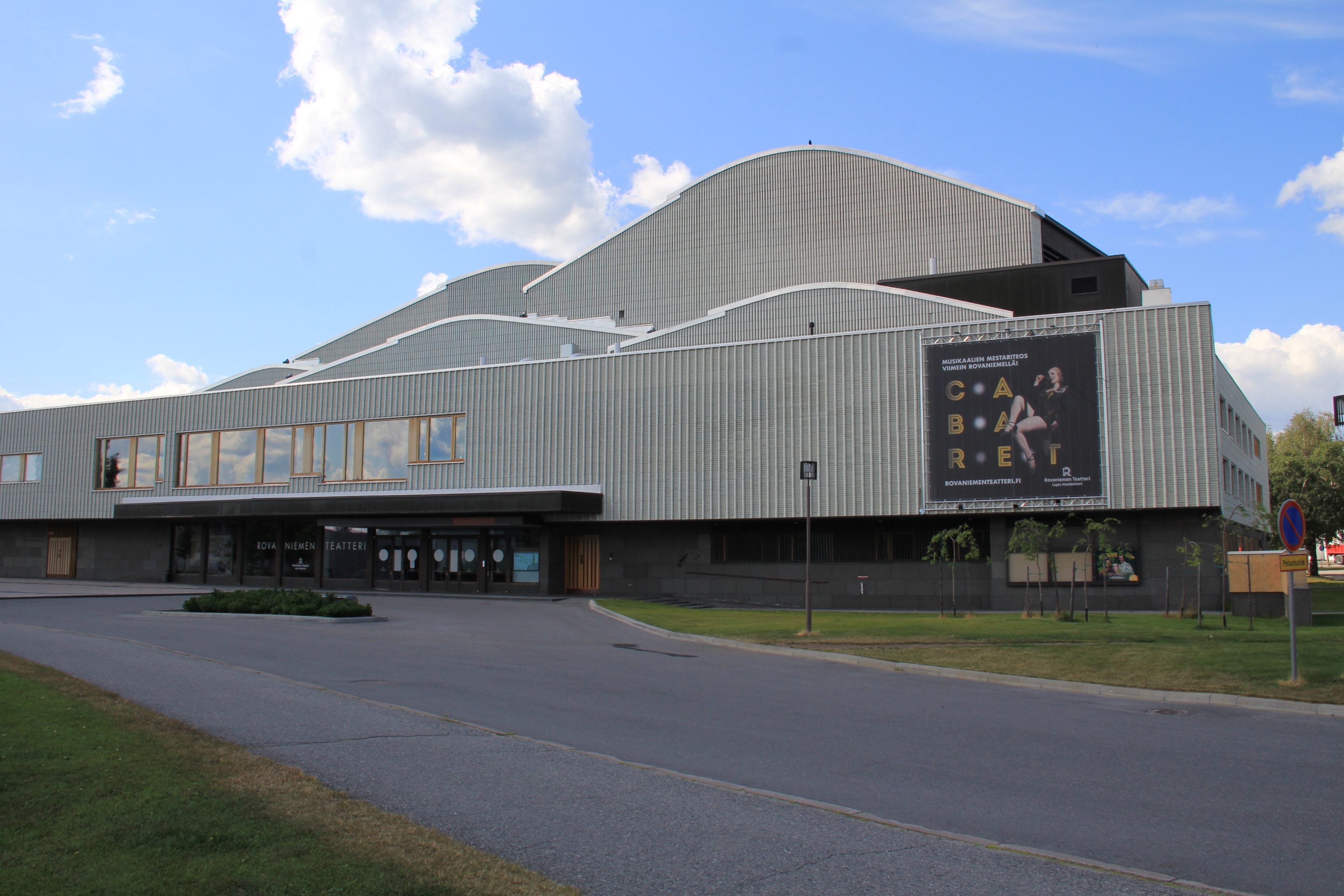
Lappia Hall
Alvar Aalto did not simply design buildings for Rovaniemi. He redesigned the city itself. After German forces burned Finland's Arctic capital to the ground in 1944, Aalto drew up a new urban plan shaped like a reindeer's antlers -- a nod to the Sami culture of Lapland embedded in the very street grid. Lappia Hall, completed in its first phase in 1961, sits at the heart of that plan. It was the last building Aalto saw finished before his death in 1976, and it remains the defining architectural statement of a city that rose from total destruction to become the cultural capital of Finnish Lapland.
A Master's Final Work
Lappia Hall was constructed in phases, a rhythm that matched both the city's gradual recovery and the architect's evolving vision. The first phase, completed in 1961, housed the regional office of Finland's public broadcaster Yle and the Lapland Music Institute. A second phase added the Rovaniemi Theatre in 1971. Aalto continued refining the design for years, but by the time of his death in 1976, Lappia Hall was the last of his buildings he had seen through to completion. It stands as a kind of architectural testament -- the final built expression of one of the twentieth century's most influential designers, situated not in Helsinki or any world capital, but in a small Arctic city that had given him the rare opportunity to shape an entire community from the ground up.
The Aalto Centre Takes Shape
Lappia Hall does not stand alone. It forms the centerpiece of the Aalto Centre, a cluster of civic buildings that together define Rovaniemi's public core. The adjacent Rovaniemi Library was completed in 1965, its undulating walls and natural light wells carrying Aalto's signature organic modernism. The Rovaniemi City Hall followed in 1988, more than a decade after Aalto's death but faithful to his vision. Walking between these buildings, you move through a coherent architectural landscape -- one man's sustained attempt to prove that modernism could be warm, humane, and rooted in the specifics of place. The Aalto Centre is not a monument to abstract design principles. It is a monument to the idea that a burned city could be reborn with grace.
Modernism at the Arctic Circle
What makes Lappia Hall distinctive among Aalto's works is its context. This is a performing arts venue and conference centre operating just south of the Arctic Circle, where winter darkness lasts months and temperatures plunge far below freezing. Aalto's modernist design -- clean lines, natural materials, generous use of light -- was not merely aesthetic here. It was functional, creating interior spaces that compensated for the extreme environment outside. The building has hosted everything from theatrical productions to international conferences, serving as proof that cultural life not only survives at these latitudes but thrives. In a city of roughly 65,000 people, Lappia Hall punches far above its weight, attracting visitors who come for the architecture as much as for whatever is showing inside.
Rising from the Ashes
The story of Lappia Hall is inseparable from the story of Rovaniemi's destruction. In October 1944, during the Lapland War, retreating German troops executed a scorched-earth policy that left the city in ruins. Nearly every building was destroyed. The reconstruction effort that followed was one of the most complete urban rebuilding projects in Nordic history, and Aalto was at its center. His reindeer-antler street plan gave the new Rovaniemi a distinctive identity, and his public buildings -- the library, the city hall, Lappia Hall -- gave it cultural ambition. Today, walking through the Aalto Centre, you see no trace of the destruction. What you see instead is the stubborn optimism of a community that chose to rebuild not just its infrastructure but its soul.
From the Air
Located at 66.50N, 25.72E in central Rovaniemi, just south of the Arctic Circle. Lappia Hall sits within the Aalto Centre complex near the Rovaniemi Library and City Hall, visible as a cluster of modernist buildings along the river. Rovaniemi Airport (EFRO) is approximately 8 km northeast. The city sits at the confluence of the Ounasjoki and Kemijoki rivers, making it easy to identify from the air. Best viewed at 2,000-4,000 feet to appreciate the civic centre layout.