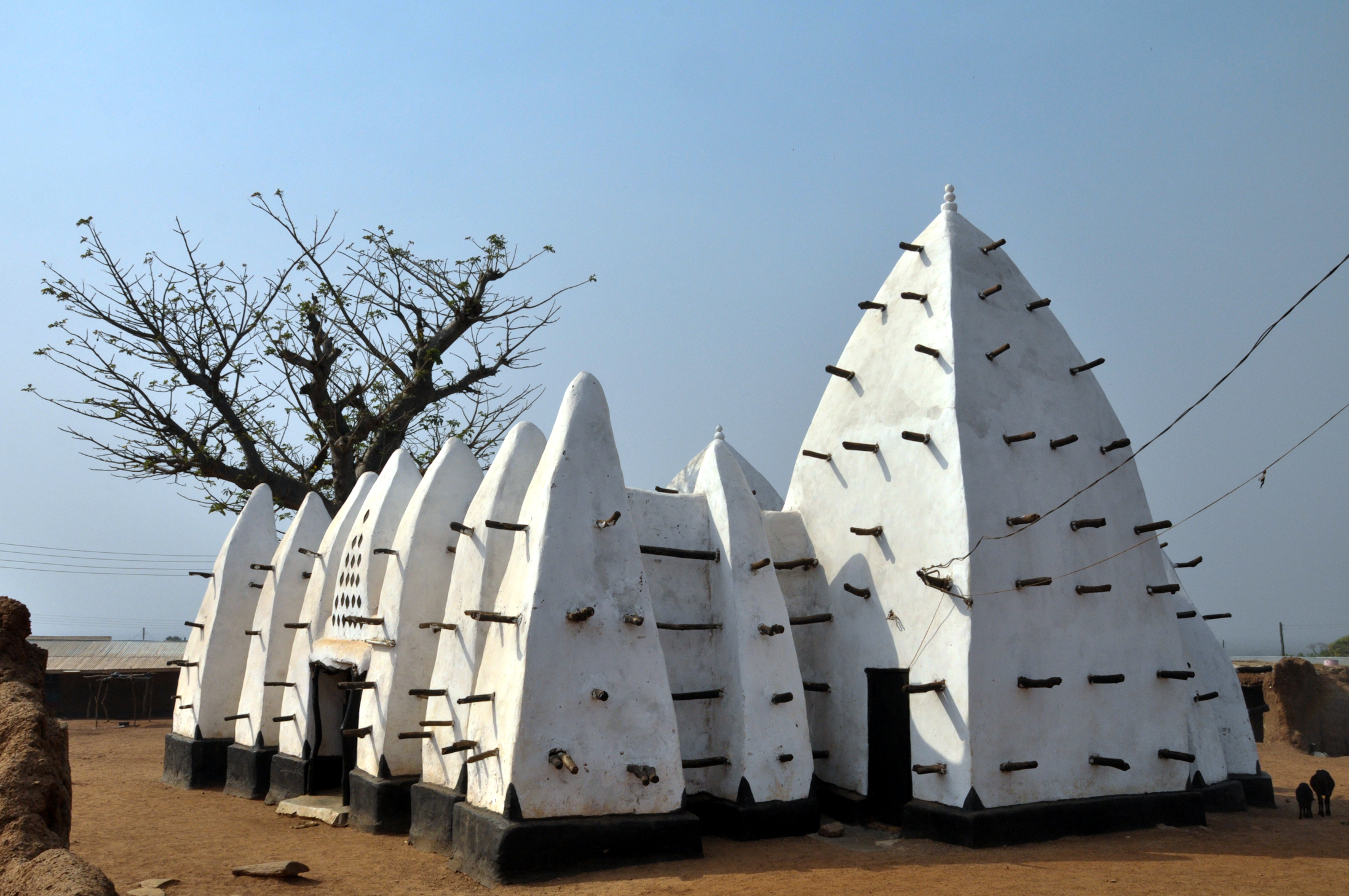
Larabanga Mosque
A trader named Ayuba stopped to rest near a mystic stone in 1421 and dreamed he was told to build a mosque. When he woke, the foundations were already in place. So goes the founding legend of the Larabanga Mosque, Ghana's oldest and one of the oldest in all of West Africa. Whether the foundations appeared overnight or were laid by human hands, the result has endured for six centuries: a small, whitewashed adobe structure with pyramidal towers that the faithful call the Mecca of West Africa. Beside the mosque stands a baobab tree said to mark Ayuba's grave, its massive trunk a living monument as old as the building it shadows.
A Dream and a Stone
Larabanga sits in Ghana's Savannah Region, about 15 kilometers north of Damongo and just 4 kilometers from the entrance to Mole National Park. The village's Islamic heritage runs deep. According to tradition, the trader Ayuba was traveling through the area when he encountered a stone of unusual properties, known locally as the Larabanga Mystic Stone. He camped nearby, and in his sleep received divine instruction to build a mosque on the spot. The discovery of ready-made foundations upon waking transformed the practical into the miraculous. Ayuba completed the mosque and, before his death, left instructions that he be buried beside it, with the promise that a baobab tree would sprout from his grave within three days. The ancient baobab that stands next to the mosque today is revered as proof of that promise fulfilled.
The Quran That Fell From Heaven
Inside the mosque rests a Quran that the community believes appeared miraculously in 1650, given as a gift from heaven to Yidan Barimah Bramah, the Imam of Larabanga at the time. The story holds that Bramah's prayers were so devoted that the holy book materialized in response. Whether one accepts the supernatural explanation or imagines a more earthly provenance, the Quran's presence underscores Larabanga's centuries-long role as a center of Islamic learning in a region where the faith arrived with Mande traders pushing south from the Mali Empire. The manuscript is carefully preserved and remains a point of deep reverence for the local community, drawing pilgrims and visitors who come to see a text that has survived the same storms and seasons as the building that shelters it.
Adobe Against the Elements
The mosque measures roughly 8 meters by 8 meters, a compact footprint for a building of such significance. Two pyramidal towers define its profile: one housing the mihrab, the prayer niche oriented toward Mecca on the eastern facade, and the other serving as a minaret at the northeast corner. Twelve conical buttresses line the external walls, reinforced by horizontal timber elements. The architectural style is sometimes called flat-footed adobe architecture, a branch of the Sudano-Sahelian tradition that spans from Timbuktu to the Ghanaian savanna. All surfaces receive a white wash that gleams against the surrounding red earth. But adobe is fragile in the face of West African weather. Prevailing winds and seasonal rains constantly erode the walls, and repeated restorations over the centuries have altered the mosque's exterior details. In September 2002, a severe storm destroyed both the mihrab and the minaret.
Rescue and Revival
The 2002 storm prompted the World Monuments Fund to place the Larabanga Mosque on its World Monuments Watch list, designating it one of the 100 Most Endangered Sites worldwide. The restoration that followed brought together international conservation expertise and local artisans who understood the building from the inside out. Rather than modernizing the structure with cement or steel, the project emphasized reviving traditional adobe maintenance techniques that had been fading as younger generations left for cities. Local workers relearned the art of mixing mud, applying plaster, and reading the building's seasonal needs. A handicraft and tourism initiative was launched alongside the physical restoration, generating income for the community while creating an economic incentive to maintain the mosque. The building underwent further restoration in 2023. Six centuries after Ayuba's dream, Larabanga remains what it has always been: a small white mosque at the edge of the savanna, asking its community to keep it standing.
From the Air
Located at 9.22°N, 1.87°W in the village of Larabanga, Savannah Region of Ghana, approximately 4 km south of Mole National Park entrance. The mosque is a small whitewashed structure with two pyramidal towers visible against the red-earth village surroundings. Tamale International Airport (ICAO: DGLE) is the nearest major airport, approximately 130 km to the east. The landscape is dry savanna transitioning to the gallery forests of Mole National Park to the north. Best viewed at low altitude where the white-washed adobe and pyramidal towers contrast with the surrounding vegetation and laterite soil.