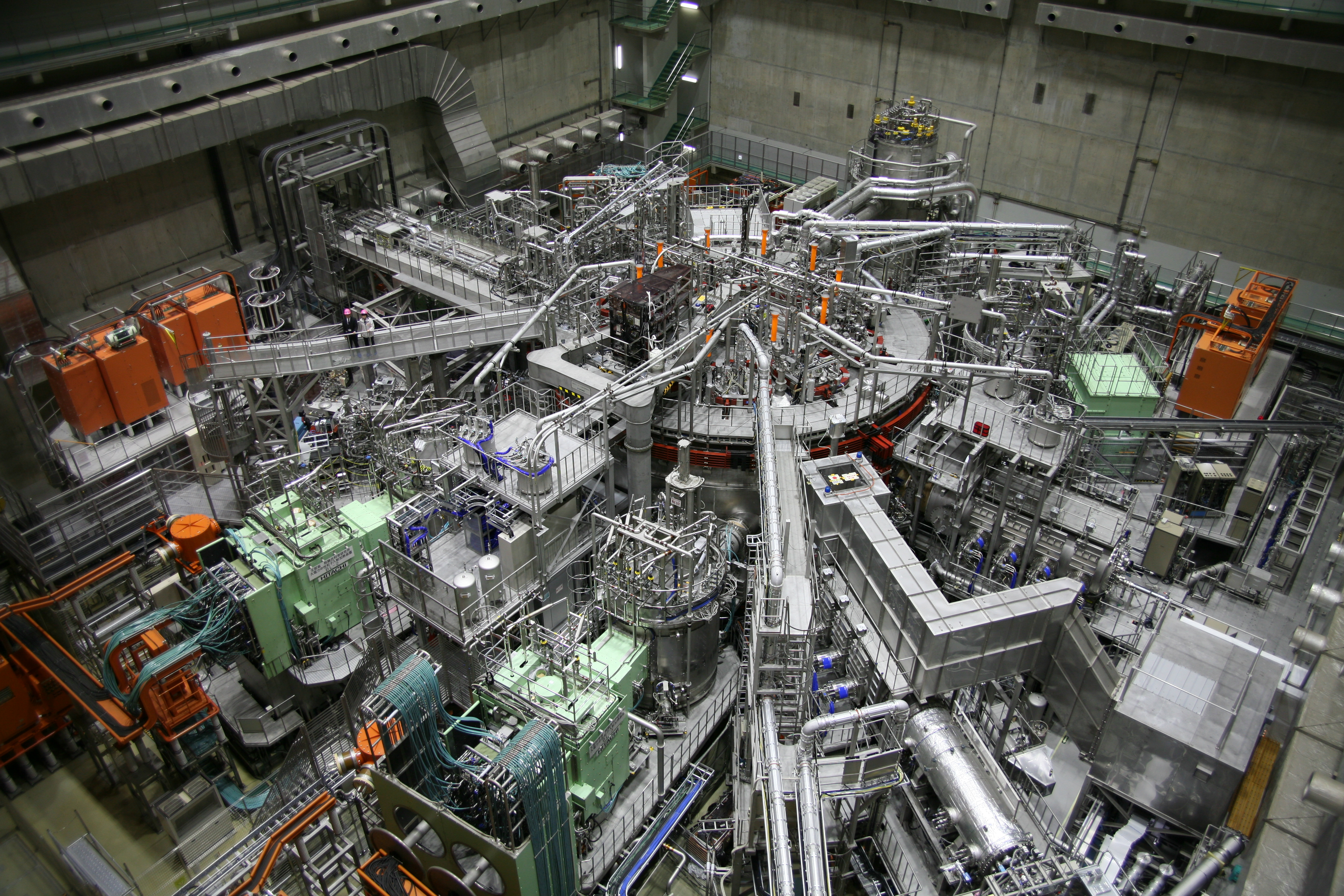
Large Helical Device
In the quiet city of Toki, surrounded by the ceramic workshops and forested hills of Gifu Prefecture, sits a machine designed to recreate the physics of a star. The Large Helical Device is not a tokamak -- the doughnut-shaped reactor that dominates most fusion headlines -- but a stellarator, a fundamentally different approach to containing superheated plasma using twisted magnetic fields generated entirely by external coils. As the world's second-largest superconducting stellarator after Germany's Wendelstein 7-X, the LHD represents Japan's distinctive contribution to the global quest for fusion energy. And in 2017, it achieved something remarkable: an ion temperature of 120 million degrees Celsius, one of the threshold conditions for a working fusion reactor.
The Twisted Path to Fusion
Most people who have heard of fusion reactors think of tokamaks -- the Russian-invented design that uses a combination of external magnets and electrical current running through the plasma itself to create a confining magnetic field. Stellarators take a radically different approach. Instead of relying on plasma current, they use elaborately twisted external coils to generate the entire confining field from outside the reactor. The result is inherently more stable -- no sudden disruptions from plasma current loss -- and capable of running continuously rather than in pulses. The trade-off is complexity: the coils must be shaped with extraordinary precision. The LHD employs a heliotron configuration, a variant of the stellarator concept originally developed in Japan, where two massive helical coils spiral around the plasma vessel like intertwined snakes.
Eight Years of Construction
The LHD's design was finalized in 1987, and construction began in 1990 at the National Institute for Fusion Science campus in Toki. Eight years of precision engineering followed, assembling superconducting coils cooled to near absolute zero, a vacuum vessel to hold the plasma, and heating systems capable of injecting enormous energy into hydrogen gas. First plasma was achieved in 1998. By 1999, the device was already using 3-megawatt neutral beam injection to heat its plasma. The machine uses three different heating methods -- neutral beam injection, ion cyclotron radio frequency, and electron cyclotron resonance heating -- a versatile toolkit that allows researchers to probe plasma behavior under varied conditions. To address public concerns about safety, engineers designed a dedicated exhaust system to capture and filter the trace amounts of radioactive tritium produced during deuterium experiments.
Breaking Stellarator Records
The LHD holds all major performance records for stellarators. In 2005, it maintained a stable plasma for 3,900 seconds -- over an hour of continuous operation, demonstrating the steady-state capability that gives stellarators their theoretical edge over pulsed tokamaks. A new helium subcooling system installed in 2006 enabled further long-duration experiments, and by 2018 ten extended-operation campaigns had been completed. The landmark achievement came in 2017 during a 100-day experimental campaign that produced over 13,000 plasma shots. Using high-power deuterium beams to heat deuterium plasma, the team reached an ion temperature of 120 million degrees -- the first time a helical plasma device had crossed the hundred-million-degree threshold. The LHD's performance now approaches that of similarly sized tokamaks, validating decades of stellarator research.
A Star in the Countryside
There is something striking about the contrast between the LHD's surroundings and its mission. Toki is a small city of about 60,000 people, better known for Mino ware pottery than particle physics. The forested hills of eastern Gifu Prefecture give no hint that behind the walls of the National Institute for Fusion Science, superconducting magnets are generating fields strong enough to contain matter hotter than the core of the sun. The LHD's legacy extends beyond its own experiments. Helical Fusion, a Japanese startup, is now developing a commercial fusion reactor based directly on the stellarator expertise accumulated at the LHD over more than 25 years of operation. From a quiet campus in rural Japan, the twisted magnetic fields of the Large Helical Device continue shaping the future of energy on Earth.
From the Air
Located at 35.326N, 137.169E in Toki, Gifu Prefecture. The NIFS campus and LHD facility are situated in the hills east of central Toki. From the air, look for the large institutional campus surrounded by forested terrain. Nearest major airport: RJGG (Chubu Centrair International Airport) approximately 80km south. RJNA (Nagoya Airfield/Komaki) is about 55km southwest. The facility sits in the Tono region of eastern Gifu, with the ceramic town of Tajimi nearby to the west.