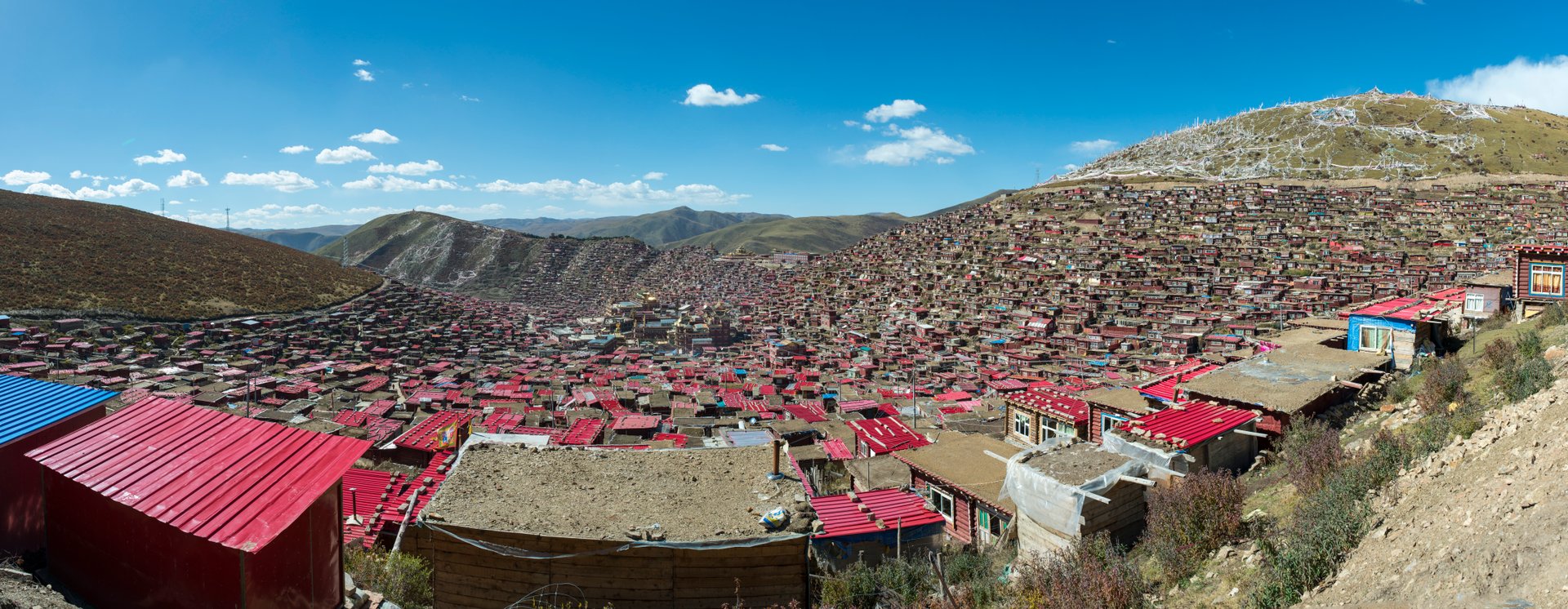
Larung Gar Buddhist Academy
The first prophecy came from the first Dodrupchen Rinpoche, who described a place and named a founder centuries before either existed. In the summer of 1980, Khenchen Jigme Phuntsok -- a Nyingma lama who had survived the Cultural Revolution by retreating into these mountains with a small band of loyal monks -- took over an old hermitage in the Larung Valley of Sertar County, Sichuan, and began teaching. He had fewer than a dozen students. Within two decades, nearly ten thousand monks, nuns, and lay practitioners would pack the valley in a sea of maroon-roofed wooden dwellings that became one of the most extraordinary religious communities on Earth.
An Ecumenical Experiment
What made Larung Gar remarkable was not simply its size but its openness. Khenchen Jigme Phuntsok welcomed students from all traditions of Tibetan Buddhism -- Nyingma, Kagyu, Sakya, Gelug -- at a time when sectarian boundaries were typically firm. The 10th Panchen Lama officially named the institution the Serta Larung Five Science Buddhist Academy in 1987, recognizing its curriculum that ranged across the five traditional fields of Buddhist scholarship. The Academy trained both monks and nuns to the highest levels. Hundreds of khenpos -- male holders of doctoral-level degrees -- graduated from the Academy after 1980. More groundbreaking still, the curriculum allowed nuns to earn the Khenmo degree for the first time in Tibetan history. Khenpo's niece, Jetsunma Muntso, was recognized by the 14th Dalai Lama as a tulku and headed the nunnery. By 2001, the student body included approximately 4,000 monks, 4,500 nuns, and over 1,000 Chinese lay students, making the majority of residents women -- itself a quiet revolution.
A City of Maroon Rooftops
The valley filled organically. Students arrived from across Tibet, China, Mongolia, and other Asian countries, building their own small wooden dwellings on the hillsides above the teaching halls. The result was a settlement unlike anything else in the Buddhist world: thousands of identical maroon structures cascading down the slopes toward a central complex anchored by a golden Garuda statue. Four institutions organized the community. Ngarig Nangten Lobling served the monks. Pema Khandro Duling Nunnery served the nuns. Lektso Charbeb Ling trained lay vow-holders and tantric practitioners. The International Religious Committee oversaw students from across China and abroad, roughly ten percent of whom were ethnic Han Chinese, attending classes in Standard Chinese while the larger classes were taught in Amdo Tibetan. English, computer studies, and modern subjects sat alongside the traditional non-sectarian curriculum. The khenpos and khenmos who graduated were authorized to establish their own Buddhist centers and monasteries, seeding Larung Gar's ecumenical vision across Tibet and beyond.
Demolition and Defiance
The Chinese government's relationship with Larung Gar was adversarial from the start. In 2001, after Sichuan authorities demanded that Khenchen Jigme Phuntsok denounce the 14th Dalai Lama and he refused, mass demolitions began. Approximately 4,000 buildings were destroyed and 8,000 students and residents were expelled. Khenchen Jigme Phuntsok was detained for a year. Further demolitions followed in 2002 and 2013, when monks and nuns were evicted and some sentenced to prison terms of one to six years. In July 2016, a new demolition campaign targeted 1,500 more dwellings. By December 2016, 3,729 people had been evicted, the vast majority of them nuns. Reports described monks and nuns bused to political re-education centers, forced to chant hymns of loyalty to the Communist Party. The European Parliament condemned the demolitions that December. United Nations human rights experts followed in 2017. Evicted monastics were not permitted to re-enroll at their home monasteries or relocate elsewhere.
What Persists in the Valley
A mountain hermitage stood near this site as early as 1880, established by Dudjom Lingpa. The sacred geography predates the Academy and will outlast any particular arrangement of buildings on its slopes. Larung Gar has been closed to foreign visitors since June 2016, and the settlement's population was capped at 5,000 -- 3,500 nuns and 1,500 monks. Yet the Academy's influence extends far beyond the valley. The more than 500 khenpos and khenmos it graduated have carried its teachings across the Tibetan world and into international Buddhist communities. In February 2016, a photograph of Larung Gar by Hungarian photographer Attila Balogh was shortlisted for the Sony World Photography Awards -- one image of a valley that had, for a brief and extraordinary period, housed the largest concentration of Buddhist scholars and practitioners anywhere on the planet.
From the Air
Located at 32.15N, 100.47E in the Larung Valley near Sertar, Sichuan Province. Elevation approximately 4,000 meters. The dense cluster of maroon-roofed structures on the valley hillsides is a striking visual feature when visible, though the settlement's size has been reduced by demolitions since 2001. Nearest airfield is Garze Gesar Airport (ZUGE), approximately 170 km south. Terrain is high-altitude plateau with deep valleys; weather is frequently overcast and cold. The valley is oriented roughly north-south.