Las Aves Archipelago
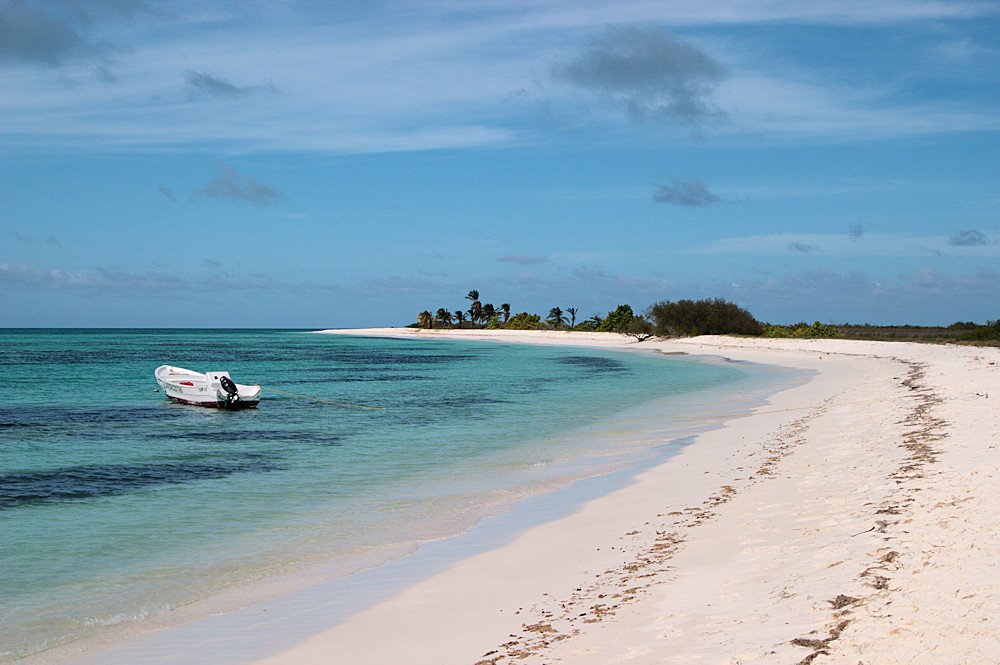
In 1678, thirteen French warships sailed toward these reefs and never sailed away. The Las Aves Archipelago - "The Birds" in Spanish - sits in the southern Caribbean between Bonaire and the Los Roques Archipelago, a scatter of 21 low-lying islands and cays that barely rise above the waterline. From the air, you see what Admiral Jean d'Estrees could not: two ring-shaped reef complexes, turquoise shallows fading to deep blue, and not a single settlement. Venezuela claims these islands as part of its Federal Dependencies, but the birds and the fish have always been the real tenants.
The Admiral's Blunder
Admiral Jean d'Estrees was en route to seize the Dutch island of Curacao when three Dutch ships lured his fleet onto the reefs of Aves de Sotavento. His flagship struck first. He fired his cannons as a warning, but the ships behind him interpreted the shots as a signal that he was under attack. They rushed to his aid and struck the same reefs, one after another, like dominos toppling in shallow water.
All thirteen French ships were lost. The survivors who dragged themselves onto the barren cays found no fresh water - only sand, coral rubble, and relentless sun. They subsisted on barrels of wine and salted meat that washed ashore until those supplies ran out. Most perished. D'Estrees was among the few rescued. On Curacao, the Dutch observed a Day of Thanksgiving for their narrow escape, a tradition that continued well into the 18th century. Three ships had defeated thirteen without firing a shot.
Two Rings of Coral
The archipelago divides into two atoll-like complexes. Aves de Barlovento, the eastern group, forms a fringing reef roughly eight kilometers across, sheltering three cays in its southwestern lee - Isla Tesoro, Cayo Bubi, and Cayo de Las Bobas among them. To the west, Aves de Sotavento spreads wider, anchored by Isla Maceta, a cay thick with mangroves where frigatebirds roost in dark tangles of aerial roots.
Between the two groups, the water shifts from pale green to cobalt in the span of a few hundred meters. The reefs that wrecked d'Estrees' fleet remain just beneath the surface, invisible at high tide, barely breaking at low. Fishermen from the Venezuelan coast know these waters intimately - fishing remains the islands' primary economic activity - but there are no permanent inhabitants, no docks, no airstrips. The archipelago should not be confused with Aves Island, Venezuela's most remote territorial claim, which lies far to the north.
Contested Sovereignty
For centuries, the Dutch considered Las Aves part of their West Indian possessions. In 1836, Marten Douwes Teenstra wrote in The Dutch West Indies that "The Government of Curacao also includes the uninhabited islets and rocks Little Curacao, Aves, Roques and Orchilla." The islands sat in a jurisdictional gray zone - too remote and barren for anyone to press the point.
That changed in 1978, when Venezuela and the Kingdom of the Netherlands formally established marine boundaries between the Federal Dependencies and the Dutch Antilles. The agreement drew a line through Caribbean waters that had been ambiguous for three hundred years, finally settling which uninhabited reefs belonged to whom. Today Las Aves falls under Venezuelan administration, though 'administration' is a generous word for islands where the only regular visitors arrive by fishing boat and leave with their catch.
A Birdwatcher's Silence
The name promises birds, and the archipelago delivers. Frigatebirds, boobies, and terns nest across the cays in numbers that justify the Spanish name. Without human settlement to disturb them, the colonies have maintained themselves in a kind of Caribbean isolation - no introduced rats, no feral cats, no resort development creeping across the sand. The mangroves of Isla Maceta provide nesting habitat that has vanished from more developed islands nearby.
What strikes visitors most, though, is the quiet. No generators, no music, no engine noise beyond their own boat. The wind across the reef flats, the slap of waves against coral rubble, the occasional shriek of a tern defending its patch of sand. Las Aves exists in a version of the Caribbean that predates tourism, predates colonialism, predates everything except the slow work of coral polyps building reef on reef.
From the Air
Located at 12.0N, 67.67W in the southern Caribbean Sea. The archipelago appears as two distinct ring-shaped reef formations - Aves de Barlovento (east) and Aves de Sotavento (west) - visible as turquoise halos against the deep blue Caribbean. Best viewed from 3,000-5,000 feet to appreciate the atoll-like reef structures. No airstrips on the islands. Nearest airports: Curacao (TNCC) approximately 100nm to the west; Bonaire (TNCB) roughly 80nm west-southwest; Caracas/Simon Bolivar (SVMI) approximately 130nm to the south. Los Roques Archipelago is visible to the east. Expect tropical weather with good visibility outside of squall lines.