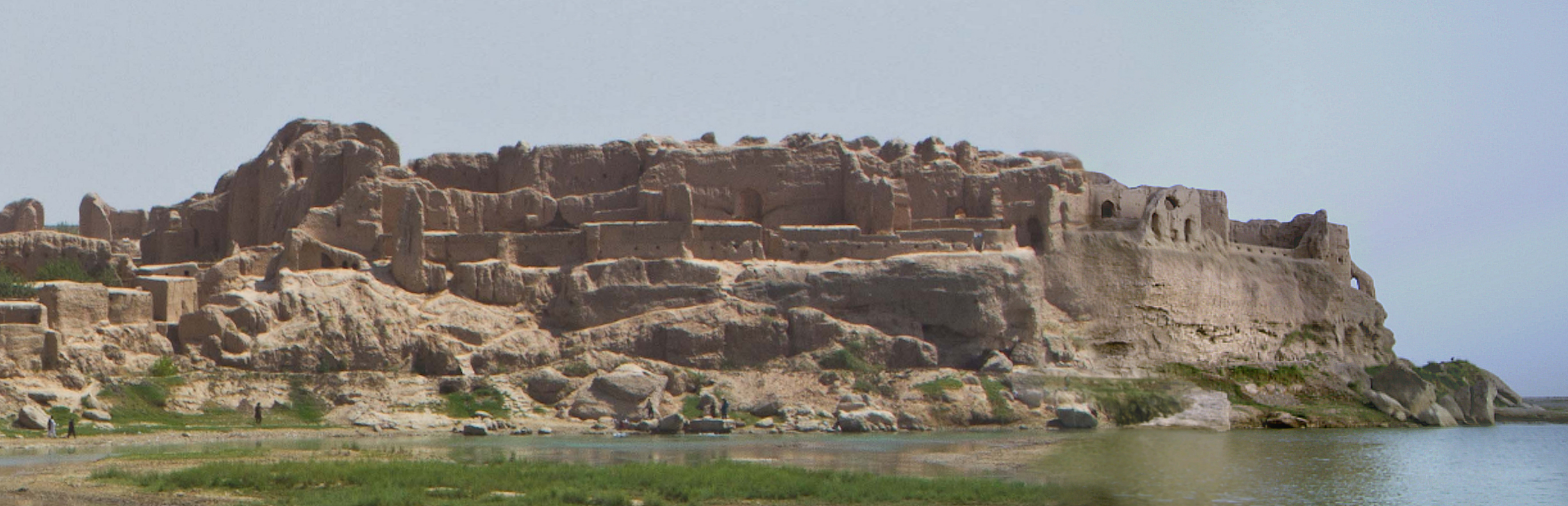
Lashkari Bazar
The name translates as 'military market,' but what the Ghaznavid emperors built on the west bank of the Helmand River was anything but utilitarian. Lashkari Bazar was a royal compound of three palaces, surrounded by gardens and fortified walls studded with semi-circular towers -- a statement of imperial power planted in the desert of what is now Helmand Province, Afghanistan. The oldest of its structures may date to the Samanid period, which ended in 999 CE. The paintings that once covered its walls are among the most significant early Islamic artworks ever discovered, their colors drawn from lapis lazuli and their compositions borrowing from Persian, Sasanian, and Byzantine traditions simultaneously. Today the palaces are ruins of mud brick and memory, but what survives tells a story about the medieval Islamic world that few other sites can match.
Three Palaces on the River
Lashkari Bazar consisted of three distinct palace complexes arranged along the Helmand River near modern Lashkargah. The Northern Palace was the most elaborate in plan: three separate courtyard buildings separated by gardens, the whole compound enclosed by a wall reinforced with 15 semi-circular towers, four of which anchored the corners. The Central Palace, measuring 32 by 52 meters, is the oldest structure on the site and is thought to date from the Samanid period -- the dynasty that ruled much of Central Asia and Iran from 819 to 999 CE. Its walls were built with unbaked mud bricks set on a foundation of fired bricks for stability. The South Palace was the most richly decorated of the three, its rooms finished with stucco carvings, painted frescoes, and carved marble panels that signaled the wealth and artistic ambitions of the Ghaznavid dynasty that expanded and embellished the complex.
Paintings Between Empires
The wall paintings at Lashkari Bazar are what make the site irreplaceable. Discovered by French archaeologists who first published their findings in 1952, these works are among the most detailed early Islamic paintings found anywhere in Afghanistan. The scenes depict Ghaznavid court life: figures in elaborately ornamented garments and jewelry, posed in ways that communicated status and authority to anyone who entered the royal chambers. What makes the paintings remarkable beyond their age is their synthesis of traditions. A portrait from the Southern Palace courtroom shows a figure painted frontally -- a compositional choice rooted in Sasanian elite imagery, which depicted rulers facing the viewer to project power. Yet the figure wears textiles whose patterns derive from late Sasanian and Byzantine artistic conventions, traditions that the Ghaznavids absorbed as they governed a crossroads empire stretching from eastern Iran to northwestern India.
The Colors of Lapis and Intention
Beyond the figurative paintings, geometric and floral designs covered entire walls of the palace complex. The dominant palette was red, gold, and black -- with blue also present, achieved in part through pigments derived from materials like lapis lazuli, the deep-blue stone mined in northeastern Afghanistan's Badakhshan province and traded across the ancient world. The choice was not merely aesthetic. Lapis was expensive and difficult to process into pigment, and using it to paint decorative wall panels in a desert palace was a deliberate display of resources. Floral motifs intertwined with geometric patterns in compositions that reflected the Islamic artistic principle of infinite repetition -- designs that suggest continuation beyond their physical boundaries, a visual metaphor for the divine. These wall decorations transformed the mud-brick palaces into spaces of extraordinary visual richness, rooms where every surface communicated something about the people who built them.
What the Desert Keeps
Lashkari Bazar's original name was probably al-'Askar, and its local name -- Qala-e-Kohna, meaning 'Old Castle' -- speaks to how long these ruins have been part of the landscape's identity. The site was documented by the French Archaeological Delegation in Afghanistan, whose mid-20th century surveys produced the foundational scholarship on the complex. A 2013 stability and security survey assessed the condition of the ruins in the context of decades of conflict that have made systematic archaeology nearly impossible in Helmand Province. Mud brick does not forgive neglect. Without active conservation, the desert wind and occasional flooding erode what remains, grain by grain. What the Ghaznavid emperors built as a statement of permanence -- stone foundations, fired-brick reinforcements, walls thick enough to support towers -- now depends on the fragile hope that the circumstances of modern Afghanistan will eventually allow scholars to return, to document what is left before the desert reclaims it entirely.
From the Air
Located at 31.57N, 64.35E on the west bank of the Helmand River, immediately northwest of modern Lashkargah. The palace ruins extend along the riverbank and are identifiable from the air as a series of rectangular foundations and eroded walls amid otherwise flat desert terrain. The Helmand River provides the key visual reference -- the palaces were built to overlook it. Nearest significant airfield is Camp Shorabak/Bastion (OAZI), approximately 18 km southwest. Best viewed from 2,000-4,000 feet AGL where the relationship between the palace complex, the river, and the nearby Fort of Bost (Qala-e-Bost) is visible. The green irrigated zone along the river contrasts sharply with the surrounding desert.