Last Exit on Brooklyn
"So what if games-people turn away business," Irv Cisski told Chess Life magazine in 1985. "They add flavor. Chess and Go are assets to a coffeehouse." This was the philosophy that kept the Last Exit on Brooklyn running for more than a quarter century in Seattle's University District: that a coffeehouse existed not to maximize revenue per table but to give people a place to sit, think, argue, and play. Cisski opened the Last Exit on June 30, 1967, in a small light-industrial building at 3930 Brooklyn Avenue NE, leased from the University of Washington. The name was suggested by Paul Dorpat, editor of the underground newspaper The Helix, as a wordplay on Hubert Selby Jr.'s raw counterculture novel Last Exit to Brooklyn. The coffeehouse would become a landmark of Seattle's pre-Starbucks coffee culture, a chess haven of national reputation, and one of the longest-running bohemian gathering places on the West Coast.
Espresso, Orange Peel, and Chocolate
The Last Exit arrived at a moment when Seattle's coffee scene barely existed. The cafe added an espresso machine shortly after Cafe Allegro, a few blocks away, installed what is credited as the University District's first in 1975. The Last Exit became known for its original espresso creation, the Caffe Medici: a doppio poured over chocolate syrup and orange peel, topped with whipped cream. In an era when most American coffeehouses served drip from a Bunn-O-Matic, the Medici was an act of caffeinated ambition. Described in 1985 as "America's second oldest, continuously running coffeehouse," the Last Exit also offered inexpensive food, folk music, and what might best be described as a tolerance for people who wanted to occupy a table for six hours without spending more than a dollar. That tolerance was the point. Cisski understood that a coffeehouse's atmosphere was its product, and the atmosphere at the Last Exit came from the people who refused to leave.
A Chess Haven on Brooklyn Avenue
The chess players made the Last Exit legendary. Peter Biyiasas, a Canadian grandmaster, called it "a chess haven where an unlikely bunch of unusual people congregates to do battle." Yasser Seirawan, who would become one of America's top grandmasters, practically grew up there. Interviewed by Sports Illustrated in 1981, Seirawan described the scene: "Scrabble players, backgammon players, chess and game hustling... This became my home. This was to become my family." Go players claimed their own tables. The games ran from opening to closing and sometimes beyond. Cisski could have filled those tables with paying customers, but he chose not to. The chess and Go players drew other curious visitors, who ordered coffee and stayed to watch, and the whole ecosystem sustained itself through a combination of modest spending and genuine community. Few coffeehouses have produced a grandmaster. The Last Exit helped produce several.
Bohemia Near the University
Beyond the game boards, the Last Exit functioned as an informal community center for Seattle's counterculture. Folk musicians performed. Bohemian conversation filled the long tables. The building itself was unassuming, a converted light-industrial space with none of the polish that later Seattle coffeehouses would adopt. Knute Berger, the Seattle writer and journalist, memorialized the Last Exit as an essential piece of the city's cultural fabric, a place where the University District's mix of students, artists, activists, and eccentrics could share a room without anyone asking them to buy something or move along. The atmosphere was thick enough to inspire novelists: Kristin Hannah described it in her 2008 novel Firefly Lane, David Guterson wove it into The Other that same year, and Marjorie Kowalski Cole captured it in her 2012 story collection The City Beneath the Snow.
Last Call
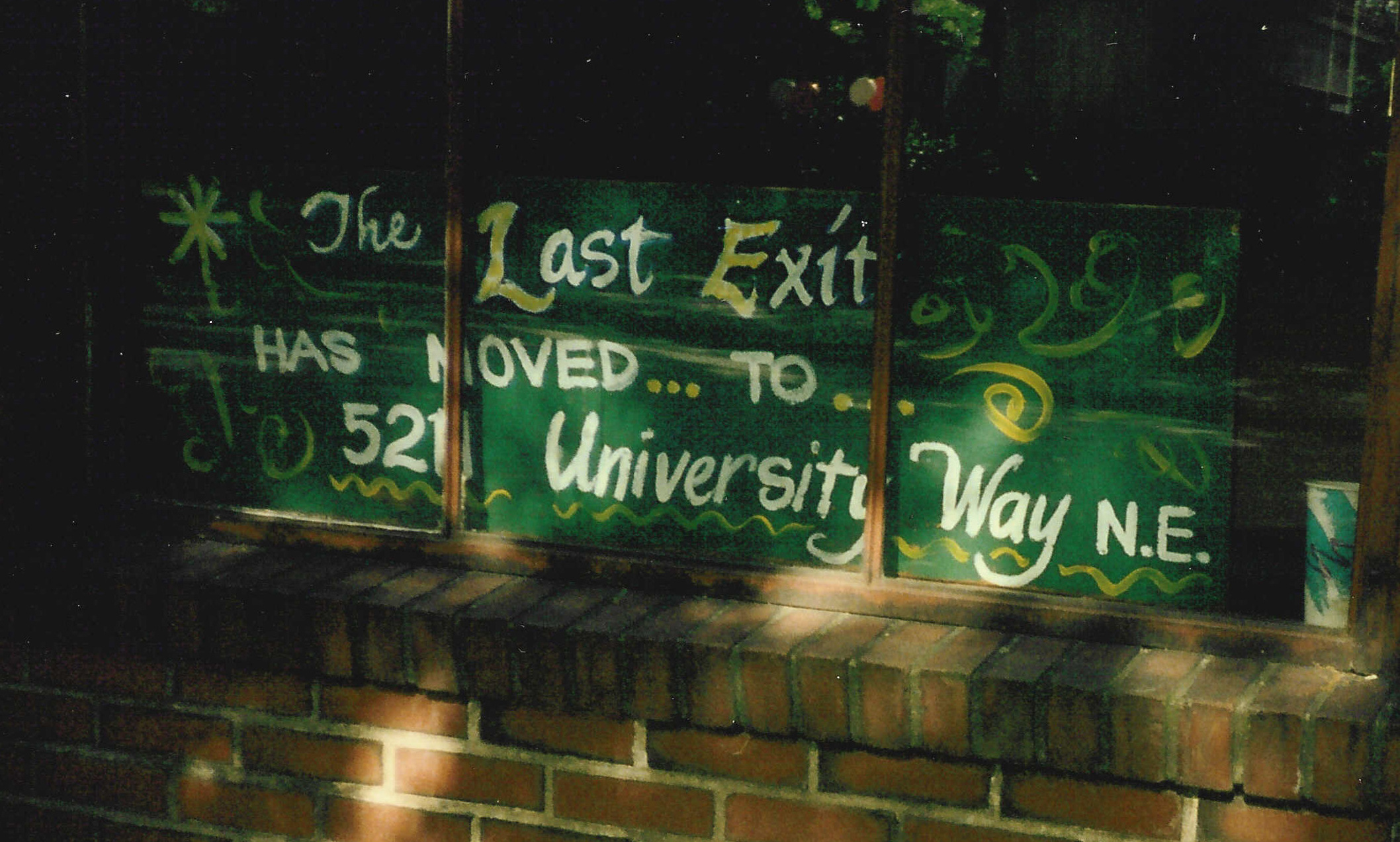
Irv Cisski died on August 25, 1992, and with him went the sensibility that had sustained the cafe for twenty-five years. In 1993, the University of Washington ended the building's lease, and the Last Exit's new owners relocated to upper University Way. The move stripped the cafe of its original character, and it eventually closed. What the Last Exit represented, a coffeehouse as public square rather than retail transaction, did not survive Seattle's coffee boom of the 1990s. Starbucks, Tully's, and their successors optimized for throughput, not for chess players who occupied tables all afternoon. The Last Exit belonged to an older model, one where the value of a coffeehouse was measured not in drinks sold but in the quality of the hours people spent inside it. Seattle became the coffee capital of America, but it lost something in the process: the idea that a cafe could be a home.
From the Air
Located at 47.655N, 122.314W in Seattle's University District, near the University of Washington campus. The U District is visible from altitude as the dense urban area immediately north of the UW campus and Portage Bay. Brooklyn Avenue NE runs north-south through the neighborhood. Nearest airports: Boeing Field (KBFI) 7nm south, Kenmore Air Harbor (S60) 5nm north, Renton Municipal (KRNT) 11nm southeast. Best viewed at 2,000-3,000 feet approaching from the west over Portage Bay, where the University District's commercial core and the UW campus are clearly distinguishable.