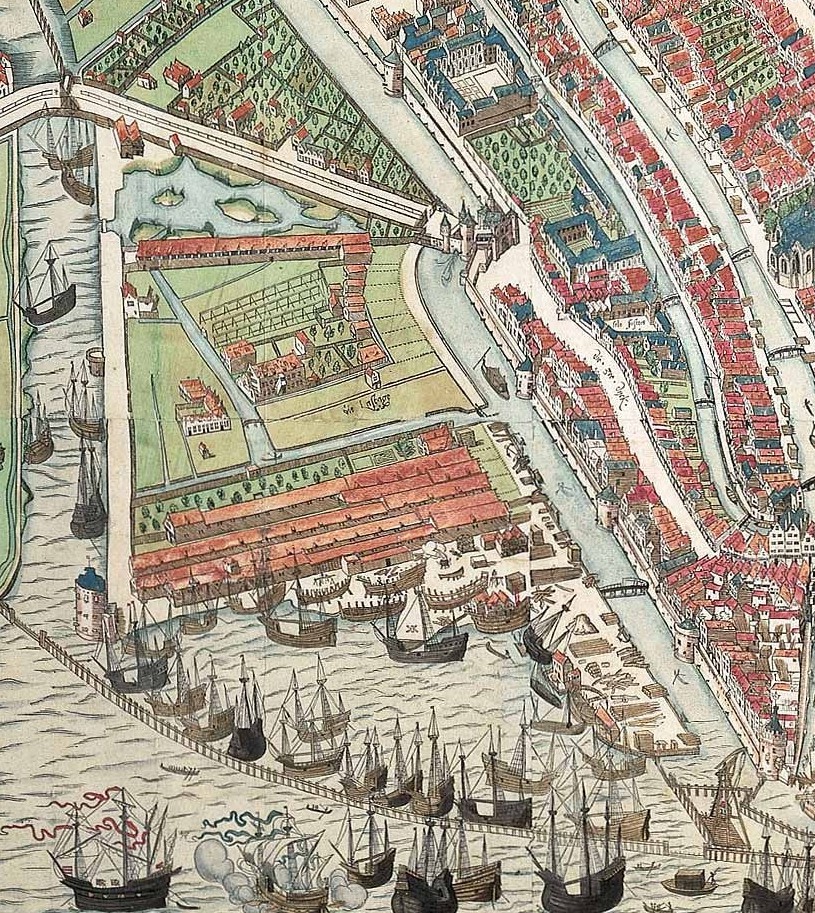
Lastage
The name is older than most of the streets it now describes. Lastage comes from the Dutch verbs ballasten, ontlasten, belasten - to load, to unload, to charge. It was a word for the heavy work of the dockside, and the ground it referred to was always meant to be working ground: marshland east of the medieval city wall, just outside the regulations, just outside the taxes, just inside the reach of the new harbor on the IJ. The first recorded permission to build there dates from 1404, when the city allowed a man named Ysebrant Pietersz to settle on the swampy edge of town and put up a house with a ropewalk - a long, narrow lane where rope was twisted from hemp fibers, sometimes hundreds of meters long. Where there was one ropewalk, more would follow.
The Trades That Built a Fleet
By the middle of the 1500s, Lastage had become Amsterdam's first true industrial quarter - five ropewalks, mast factories, shipyards for caulking and refitting, blacksmiths and tar boilers and warehouses, all crowded onto the spit of land between the Geldersekade and what is now the Oudeschans. The location was deliberate: outside the city wall meant lower taxes, fewer building codes, and a free hand with the smoke and stink of industries that no city would have tolerated indoors. The bend of the IJ called the Waal was too shallow for laden merchantmen but ideal for laying up ships in winter. The shipwrights of Lastage and the neighboring Uilenburg island would, over the next century, build the fleets that carried the Dutch East India and West India Companies to Asia and the Americas. Almost every ocean-going Dutch vessel of the seventeenth century had its rigging spun, its masts shaped, or its hull caulked on this ground.
The Wars of Guelders
Living outside the wall meant living unprotected. In the spring of 1508, during the Guelderian Wars, the troops of Charles of Guelders occupied the nearby towns of Weesp and Muiden, and the city of Amsterdam burned Lastage to the ground as a precautionary measure - rather than let a hostile army use the workshops and warehouses for cover. In December 1512, the Guelders troops returned the favor and burned it again. The workers rebuilt both times. Twice in 1543 and 1548 the residents petitioned to be brought inside the city walls. Twice the city refused, citing the fire hazard of all those tar pots and pitch barrels and forges. By 1550, however, there were already 550 houses standing outside the walls, and Lastage was no longer a neighborhood the city could afford to leave undefended.
The Amelioration
The Dutch Revolt of 1566 and the threat of the Duke of Parma's armies marching north finally forced the issue. After 1578, when Amsterdam joined the revolt and the new Protestant council came to power, the city resolved to bring Lastage inside a new defensive rampart - the one we now call the Oudeschans. The legal mechanism for doing so was a process called amelioration: the city would lay out new streets, raise the marshy land with sand, and install paving, and the landowners would pay for it. The landowners, predictably, did not want to pay. The case went all the way to the Court of Holland. Two ropemakers - Claes Burchmansz Dob and Robrecht Cools - refused outright. They were eventually overruled, and the new rampart went up in haste. The full amelioration took fifteen years, from 1589 to 1604, far longer than the seventeenth-century chronicler Tobias van Domselaer believed. After seven years of court fights, the city finally reduced the amelioration tax by thirty percent. The 10,000 guilders left over were given to the poor.
Nieuwmarkt and the Saved House
When the wall was rebuilt further east, the old Sint Antoniespoort - St. Anthony's Gate - lost its purpose as a defensive structure. Rather than tear it down, the city repurposed it as a weighhouse, a guildhall, and briefly a stock exchange. The canal in front of the gate was partially filled in to make a market square: Nieuwmarkt, the New Market, which has been a market square ever since. The most striking survival in Lastage is the Huis De Pinto on Sint Antoniesbreestraat, a mansion built around 1605 and remodelled around 1680 for the Sephardic banking family de Pinto - sometimes called the Rothschilds of the Dutch Golden Age. In the 1960s the city planned a four-lane highway and a metro line straight through the quarter, and the De Pinto House sat directly on the route. The activist Geurt Brinkgreve, the De Pinto Foundation, and squatters from the kraakbeweging movement campaigned to save it. On 5 January 1972 the city council abandoned the road project. The metro went through anyway, demolishing entire blocks to dig its tunnels, and in March and April of 1975 riots erupted in the streets over the demolitions.
What Lastage Looks Like Now
Today Lastage is a quiet, narrow-streeted neighborhood pressed between Chinatown, De Wallen, and Waterlooplein. The Montelbaanstoren rises from the Oudeschans, built as a defensive tower in 1516 and given its current decorative spire in 1606 - Rembrandt sketched it more than once. The Zuiderkerk, completed in 1614, is the great Protestant church Hendrick de Keyser designed at the heart of the quarter; Claude Monet painted it in 1874. The Scheepvaarthuis on Prins Hendrikkade, completed in two phases in 1916 and 1928, was the first major building of the Amsterdam School movement and is now a hotel. The neighborhood that began as the place where ropes were twisted and masts were stepped is now valued, the city's heritage register dryly notes, for its tranquility.
From the Air
Lastage occupies the wedge between the Geldersekade and the Oudeschans canals, just east of Amsterdam Centraal station, around 52.373 N, 4.903 E. Key visual landmarks from the air: the Montelbaanstoren tower on the Oudeschans, the green-domed Scheepvaarthuis on Prins Hendrikkade, and the spire of the Zuiderkerk to the south. The IJ waterfront and Amsterdam Centraal lie immediately to the north. Nearest airport: Schiphol (EHAM), 9 nm southwest. The quarter sits beneath Schiphol approach paths to runways 06 and 36C.