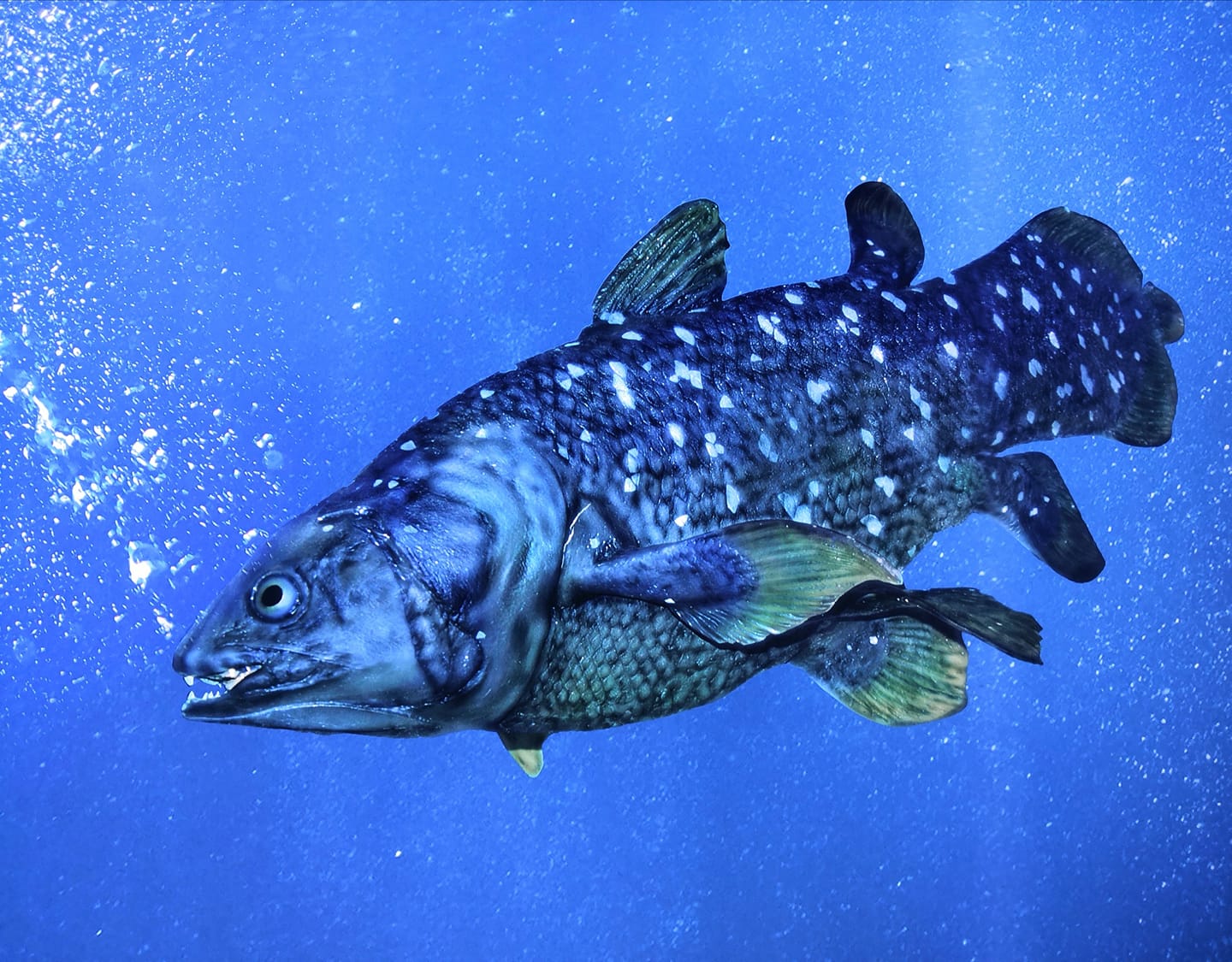
Latimeria
On December 22, 1938, museum curator Marjorie Courtenay-Latimer was sorting through the catch of a trawler docked at East London, South Africa, when she noticed a steel-blue fish unlike anything in her reference books. It was 1.5 meters long, with fleshy, limb-like fins and an iridescent sheen that seemed almost prehistoric. She was right to be stunned. The fish belonged to a lineage scientists believed had vanished with the dinosaurs, 66 million years earlier. The coelacanth was alive.
Older Than Bones
Coelacanths first appear in the fossil record roughly 400 million years ago, predating the first dinosaurs by more than 150 million years. They once inhabited oceans, rivers, and swamps worldwide, leaving behind fossils on every continent. Then, in rocks younger than the late Cretaceous, the trail goes cold. Scientists assumed the entire order had perished alongside the ammonites and tyrannosaurs. Courtenay-Latimer's discovery shattered that assumption. She sent a sketch to ichthyologist J.L.B. Smith at Rhodes University, who responded with a now-famous telegram: "Most Important Preserve Skeleton and Gills." Smith named the genus Latimeria in her honor and spent the next fourteen years searching for a second specimen to confirm the find was not a fluke.
The Fishermen Always Knew
That second specimen arrived on December 21, 1952, pulled from the deep waters off the Comoran island of Anjouan. The fisherman, Ahamadi Abdallah, was puzzled by the fuss. Comorans had been catching these fish for generations, calling them gombessa or mame -- a creature considered nearly inedible, its flesh producing an oily, unpleasant taste. What the scientific world hailed as the zoological find of the century was, to the people of these islands, an occasional nuisance hauled up from the deep. The South African Prime Minister, Daniel Francois Malan, dispatched a military Dakota aircraft to retrieve the specimen. When shown the ancient-looking fish, Malan -- a staunch creationist -- reportedly quipped, "My, it is ugly. Do you mean to say we once looked like that?"
A Body Built for Deep Time
Latimeria chalumnae can grow to over two meters and weigh around 90 kilograms. Its brain occupies just 1.5 percent of a braincase otherwise filled with fat. It possesses a vestigial lung packed with lipids, a heart shaped like a straight tube rather than the looped organ of most modern fish, and lobed fins that move in an alternating pattern eerily reminiscent of a walking tetrapod. These animals are nocturnal drift-hunters, riding deep-ocean currents to ambush cuttlefish, squid, and small sharks, orienting themselves in any direction -- including upside down and in headstands -- using a rostral organ that likely provides electroreception. Females carry their young for what researchers now estimate may be up to five years, the longest gestation of any vertebrate. Individuals can live to 80 or even 100 years, reaching sexual maturity only around age 55.
Volcanic Caves of the Comoros
The islands of Grande Comore and Anjouan provide perhaps the most important habitat for the West Indian Ocean coelacanth. The underwater volcanic slopes, steeply eroded and covered in sand, are riddled with caves and crevices where coelacanths shelter during daylight hours at depths between 150 and 700 meters. In 1988, marine biologist Hans Fricke became the first person to photograph a coelacanth in its natural habitat, filming the deep blue fish gliding through the darkness 180 meters below Grande Comore's west coast. A second species, Latimeria menadoensis, was identified in 1997 when marine biologists Mark and Arnaz Erdmann spotted a brownish-gray specimen at a fish market on Sulawesi, Indonesia -- 10,000 kilometers from the Comoros. DNA analysis confirmed it had diverged from its African cousin 30 to 40 million years ago.
Still Evolving, Still Endangered
Despite popular descriptions as a "living fossil," the coelacanth is still evolving. Genome sequencing published in Nature in 2013 confirmed that while its protein-coding regions change more slowly than those of any other known vertebrate -- consistent with its remarkably stable body plan -- its non-coding DNA shows significant divergence driven by transposable elements. The label fits the body, not the genes. Both species are now critically threatened. Fewer than a thousand West Indian Ocean coelacanths are thought to survive. Comoran communities, once puzzled by Western interest in their gombessa, have established programs to return accidentally caught specimens to deep water alive. The fish that rewrote paleontology's assumptions about extinction now depends on the conservation efforts of the very islanders who always knew it was there.
From the Air
Located at 11.81S, 43.27E, off the northwestern coast of Grande Comore island in the Comoros archipelago. The coelacanth's deep-water habitat lies along the volcanic slopes visible from the air as dark underwater contours. Nearest airport is Prince Said Ibrahim International Airport (FMCH) in Moroni. Best viewed from 5,000-10,000 feet altitude where the dramatic drop-off from the island's volcanic coastline into deep ocean is visible. The Mozambique Channel stretches to the west; Madagascar lies to the east.