Lauda Air Flight 004
Twelve minutes after takeoff, the warning light appeared. Captain Thomas Welch and First Officer Josef Thurner, climbing through 24,700 feet over central Thailand on the night of 26 May 1991, saw an indication on their EICAS display that the thrust reverser on the left engine might deploy in flight. They consulted their Quick Reference Handbook. The light was 'coming on and off,' they noted. 'Just an advisory thing.' Moments later, the thrust reverser activated at 400 knots, and the Boeing 767-300ER named Mozart rolled into an unrecoverable dive. All 223 people aboard were killed.
A Test That Answered the Wrong Question
In 1982, Boeing had tested what would happen if a thrust reverser deployed in flight. They flew a 767 at 10,000 feet, slowed to 250 knots, and activated the reverser. The pilots maintained control. The FAA accepted the results. But the test bore almost no resemblance to the conditions that killed Flight 004. The Lauda aircraft was climbing at 400 knots true airspeed through 24,700 feet when the left reverser deployed, a scenario of far greater speed and altitude than anything Boeing had simulated. At those parameters, the asymmetric thrust was catastrophic. James Chiles, author of Inviting Disaster, framed the systemic failure precisely: a thorough test would not have saved Welch and Thurner, since a mid-flight reverser deployment at those conditions might not have been survivable regardless. But a thorough test would have told the FAA and Boeing that the scenario was so dangerous that a positive mechanical lock, not just an electronic safeguard, was essential to prevent it.
The Night Over Suphan Buri
Flight 004 had originated in Hong Kong and stopped in Bangkok before departing Don Mueang International Airport at 23:02 local time, bound for Vienna. The passenger manifest read like a cross-section of the world: 83 Austrians, 52 Hong Kong residents, 39 Thai nationals, and citizens of more than a dozen other countries. Among them were Pairat Decharin, the governor of Chiang Mai province, and his wife. A group of students from the University of Innsbruck were returning from a tour of the Far East, led by Captain Welch himself, an American who had made his home in Vienna. When the aircraft broke apart, wreckage scattered across roughly one square kilometer of remote forest at an elevation of 600 meters, in what is now Phu Toei National Park in Suphan Buri province. The flight data recorder was destroyed. Only the cockpit voice recorder survived, its final seconds capturing a catastrophe that unfolded too fast for any human response.
A Racing Champion's Worst Race
Niki Lauda had survived things most people could not imagine. The Formula One world champion had crawled from a burning car at the 1976 German Grand Prix with burns so severe that a priest administered last rites in the hospital. He returned to racing six weeks later. But when he heard that Flight 004 had crashed, the airline founder flew immediately to Thailand. He examined wreckage where the largest fragment measured roughly 5 meters by 2 meters, about half the size of the biggest piece from the Lockerbie bombing. He attended a funeral for 23 passengers who were never identified. Then he flew to Seattle to confront Boeing. Lauda later said the crash and its aftermath constituted the worst period of his life, worse even than the burns that nearly killed him. The investigation that followed, led by Thailand's Aircraft Accident Investigation Committee over eight months, concluded that an uncommanded thrust reverser deployment caused the loss of flight path control. The specific reason the reverser activated was never definitively identified.
What the Logbook Could Not Say
Questions about Lauda Air's maintenance practices surfaced in the years that followed. Austrian aviation safety expert Patrick Huber and Austrian Wings magazine reported that more than 20 pages had been removed from the aircraft's technical logbook after the crash, suggesting deliberate evidence manipulation. An Austrian expert report, described as considerably more thorough than the Thai investigation commission's findings, reportedly pointed to Lauda Air's responsibility for the accident. The left engine's thrust reverser had been generating automatic warnings before the flight, yet the aircraft was cleared for departure. According to critics, the airline had only two long-haul aircraft available for the holiday travel season and chose schedule pressure over safety. The No. 1 engine, with the faulty reverser, had been on the aircraft since October 1990 and had accumulated 2,904 hours and 456 cycles. The No. 2 engine had been on the airframe since its assembly, logging 7,444 hours and 1,133 cycles without incident.
The Forest Remembers
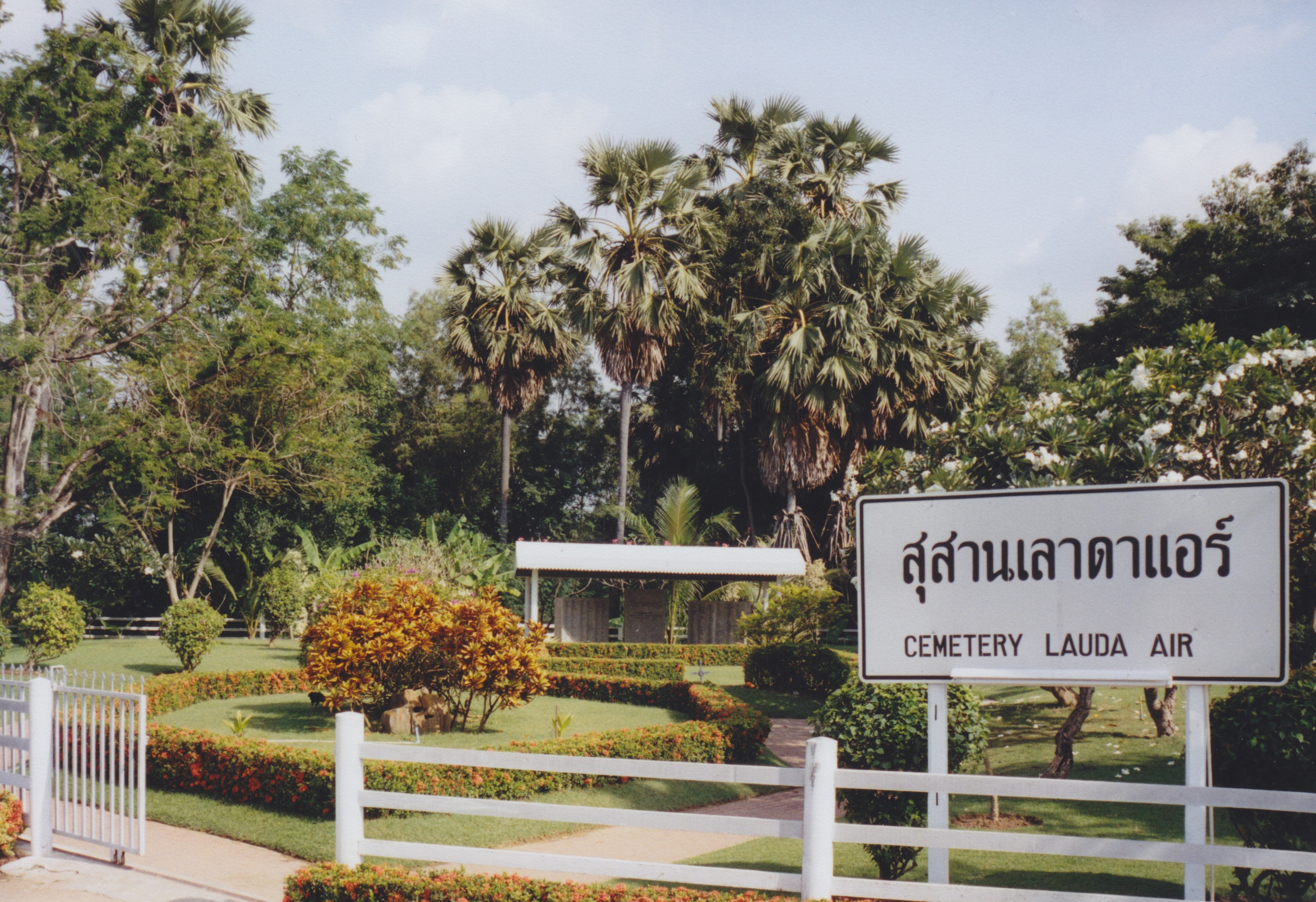
Today, a shrine stands at the crash site in Phu Toei National Park, accessible to visitors who make the trek into the forested hills of Suphan Buri. Another memorial and cemetery sits at Wat Sa Kaeo Srisanpetch, about 90 kilometers away in Mueang Suphan Buri district. Of the 223 people aboard, 27 were never identified. The immediate aftermath had been grim even by the standards of aviation disasters: volunteer rescue teams and local villagers looted the wreckage, taking electronics and jewelry, leaving relatives unable to recover personal possessions. Bodies transported to a Bangkok hospital decomposed in unrefrigerated storage. The crash of Flight 004 changed aircraft design. The uncommanded reverser deployment that killed 223 people led to requirements for mechanical locks on thrust reversers, ensuring that what happened over Suphan Buri on that May night could not happen again. The forest has grown back over the scar. The regulation that followed has held.
From the Air
The Lauda Air Flight 004 crash site is located at approximately 14.947N, 99.453E in Phu Toei National Park, Suphan Buri province, Thailand. The wreckage is scattered across forested hills at roughly 600 meters elevation. The area is approximately 150 km northwest of Bangkok. Don Mueang International Airport (VTBD), the departure point for the flight, is in Bangkok. The terrain is hilly and forested, part of the western Thai highlands. From cruising altitude, Phu Toei National Park appears as dense forest cover in the central Thai uplands.