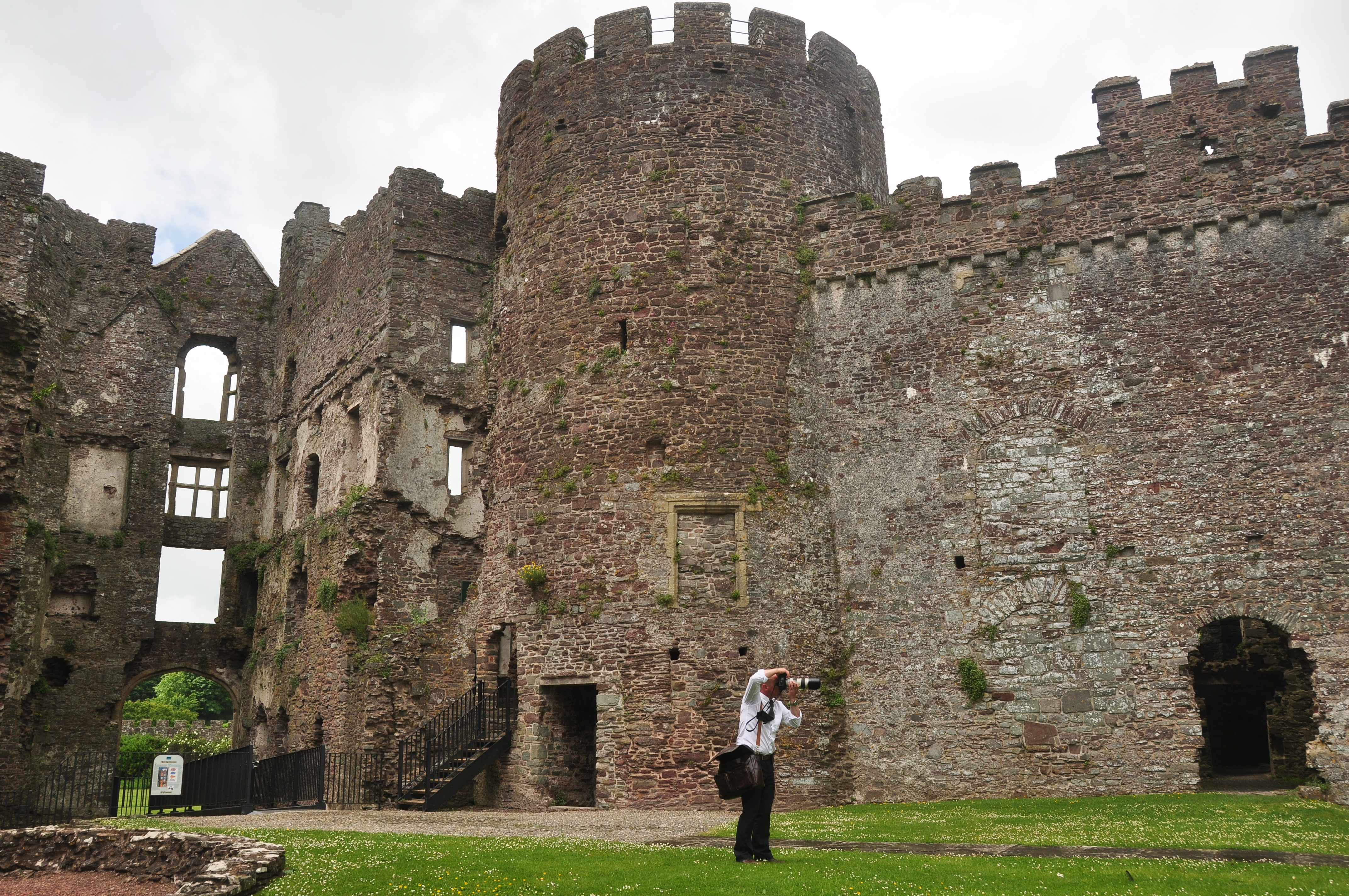
Laugharne Castle
Dylan Thomas never lived in Laugharne Castle, but he lived in its shadow. From the Boathouse down on the estuary, he could see the ruins above the town -- two robust round towers and the remnants of curtain walls, all softened by centuries of weather and the careful neglect that turns fortifications into gardens. Thomas called Laugharne 'this timeless, mild, beguiling island of a town,' and the castle is part of what makes it so. Before any poet noticed it, though, Laugharne was a place where kings made treaties, rebels were ambushed, and the line between Welsh and English power was drawn and redrawn across eight centuries.
Treaties and Treachery
The original castle was established by 1116, built by Robert Courtemain, who entrusted its care to the Welshman Bleddyn ap Cedifor. From the start, Laugharne existed on a border -- Norman authority meeting Welsh governance in a landscape that neither side fully controlled. In 1171-1172, the castle served as the meeting place where Henry II and Rhys ap Gruffudd agreed a treaty of peace, a rare moment of diplomatic resolution in a region more accustomed to fire and siege. When Henry II died in 1189, Rhys seized Laugharne along with the nearby castles of St Clears and Llansteffan. The castle may have been burned in the process. By 1247 it had passed to the De Brian family, only to be destroyed again in 1257 when Llywelyn ap Gruffudd captured Guy de Brian within its walls.
The Soothsayer's Warning
In 1403, Owain Glyndwr brought his rebellion to Laugharne -- and here, for the first time, his extraordinary momentum faltered. Perhaps lulled into complacency by his earlier successes, Glyndwr was caught in an ambush and lost 700 men. When a local soothsayer warned him to leave the area or face capture, he retreated. The episode marked a turning point: after Laugharne, the rebellion gradually lost force under the weight of greater English numbers. By 1415, Glyndwr had vanished entirely, fading into the Welsh landscape and into myth. Laugharne Castle, meanwhile, endured. In 1584, Elizabeth I granted it to Sir John Perrot, rumoured to be an illegitimate son of Henry VIII. Perrot converted the fortification into a Tudor mansion, trading battlements for comfort, before he too fell from royal favour and died in the Tower of London.
Red Sandstone and Green Stone
The castle's architecture is a palimpsest of its long history. The two round towers date from the late thirteenth century, built of the local red sandstone that gives the ruins their warm colour. In the mid-fourteenth century, sections of the curtain wall and towers were raised in height using a noticeably different greenish stone -- a change so visually striking that you can still read the building's phases from across the estuary. The Tudor conversion in the sixteenth century added comfortable accommodation and mock battlements, a characteristic gesture of the era: the appearance of defence without its substance. After the Civil War slighting, the castle was left as a romantic ruin while the new Castle House was built nearby around 1730. The outer ward was eventually laid out as formal gardens, and the park earned a Grade II listing on the Cadw Register of Parks and Gardens of Special Historic Interest.
The Writer's Castle
In the 1930s and 1940s, the novelist Richard Hughes leased Castle House and wrote his novel In Hazard while working in the garden gazebo overlooking the River Taf. It was Hughes who introduced Dylan Thomas to Laugharne, and Thomas spent the last years of his life in the town, writing Under Milk Wood in his shed above the estuary. Thomas's Laugharne is not quite the real Laugharne -- Llareggub is a composite, a dream -- but the town's atmosphere seeps into every line. The castle today is managed by Cadw and open to the public from spring to autumn. Visitors arrive through the same gateway that Norman lords, Tudor magnates, and twentieth-century writers passed through, each drawn by something different but all choosing to stay in a place where the estuary light has a quality that resists description and rewards patience.
From the Air
Located at 51.770N, 4.462W on the estuary of the River Taf in Carmarthenshire, Wales. The castle ruins and adjacent Castle House are visible from low altitude above the town of Laugharne. Pembrey Airport (EGFP) is approximately 8 nm west-southwest. The estuary setting and Dylan Thomas's Boathouse nearby are best appreciated from the south at 1,500 ft.