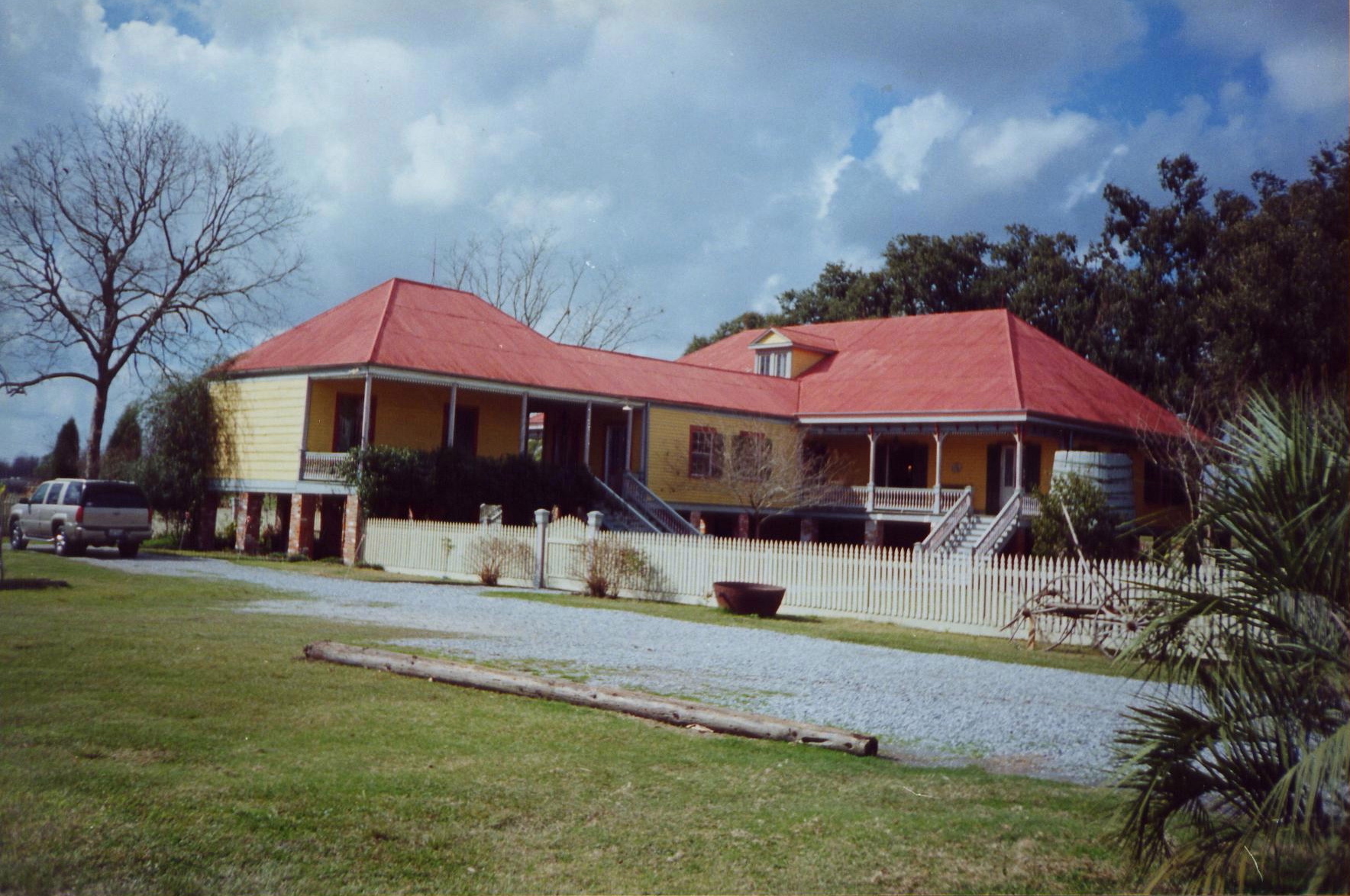
Laura Plantation
The clever rabbit outsmarted everyone. Long before Walt Disney turned him into a cartoon, long before Joel Chandler Harris wrote him into Uncle Remus, the trickster rabbit lived in the stories that enslaved Senegalese people carried across the Atlantic in the 1720s. They called him Compair Lapin, and they told his tales in the Louisiana Creole language that had taken root along the Mississippi. In the 1870s, a folklorist named Alcee Fortier visited the freedmen living at a plantation in Vacherie, Louisiana, to listen. The stories he collected and published in 1894 would ripple through American culture for more than a century. That plantation was Laura, and its story runs far deeper than a rabbit's cunning.
Where the River Bends and Empires Collide
Before there was a plantation, the Acolapissa people maintained a village on this high ground above the Mississippi River. They called it Tabiscanja, meaning "long river view." In 1785, Acadian refugees settled on the site, but it was a Frenchman named Guillaume Duparc who shaped its future. A naval veteran of the American Revolutionary War, Duparc petitioned President Thomas Jefferson for land in 1804, shortly after the Louisiana Purchase added this territory to the young republic. Jefferson obliged, and Duparc's enslaved workers built the plantation house over the next two years. The French considered the Colapissa to be allies rather than obstacles, and remarkably, the indigenous community continued living on the rear portion of the plantation until 1915 -- a quiet coexistence spanning more than a century.
Sugar, Sweat, and the Architecture of Bondage
The plantation grew into a sprawling sugar operation. Behind the main house, a dirt road stretched back toward the sugar mill, lined with slave cabins that told their own story of human endurance. Before the Civil War, the quarters held 69 cabins, each shared by two families with separate doors and a central double fireplace. There was a slave infirmary, communal kitchens, and water wells. Near each cabin, families kept vegetable gardens, chicken coops, and pigpens -- small acts of self-sufficiency within a system designed to deny it. The big house itself is one of only 30 substantial Creole raised houses surviving in Louisiana, with a brick-between-posts upper floor, Federal-style woodwork, and a Norman roof truss. Shaded beneath sprawling oaks, it is almost hidden from the road, a building that whispers rather than shouts.
Four Women and a Sugarcane Empire
Laura Plantation passed through the hands of remarkable women. After Elisabeth Duparc married George Raymond Locoul of Bordeaux in 1821, the property entered the Locoul family line. It was Laura Locoul Gore who gave the plantation its enduring name. As its fourth mistress, she ran it as a sugarcane business until selling to Aubert Florian Waguespack in 1891. The Waguespack family operated, lived on, and maintained the property for nearly another century, until 1984. Farm workers continued to occupy the original slave cabins until 1977, making these structures among the longest-continuously-inhabited plantation quarters in the South. Today, six of those original cabins still stand alongside the big house and a maison de reprise -- a remarkable survival that earned the complex a place on the National Register of Historic Places.
Compair Lapin Lives On
The plantation's most unexpected legacy lives not in its buildings but in its stories. The Brer Rabbit and Brer Fox tales woven into Southern folklore originated in Senegal and traveled to Louisiana with enslaved people around the 1720s. The stories featured Compair Lapin, the clever rabbit, and Compair Bouki, the stupid fool -- a trickster tradition where wit triumphed over brute power. When Alcee Fortier, a neighboring planter and student of folklore, published these tales in 1894 as Louisiana Folk Tales: In French Dialect and English Translation, he preserved a cultural thread connecting West Africa to the American South. It was this literary connection that drew preservationist Norman Marmillion to Laura in the late twentieth century. He assembled a for-profit company, recruited investors -- some descended from former owners -- and launched a ten-year restoration that brought the plantation back from near-oblivion.
Layers Beneath the Live Oaks
Laura Plantation today is a place where history refuses to flatten into a single narrative. The Acolapissa village, the Acadian settlers, the French planter, the enslaved Senegalese storytellers, the Creole women who ran the business, and the farm workers who lived in those cabins into the 1970s -- each layer adds complexity. Unlike the grand Greek Revival mansions that dominate the plantation tourism circuit along the Mississippi, Laura's Creole architecture speaks to a different tradition, one rooted in French colonial practice rather than Anglo-American ambition. The plantation does not romanticize the past. It interprets the full sweep of a place where indigenous, African, Acadian, and French histories converged on a bend in the river, and where an enslaved people's folklore outlasted the empire that tried to own them.
From the Air
Located at 30.009N, 90.725W on the west bank of the Mississippi River in Vacherie, Louisiana. The plantation sits along the River Road (LA-18) in St. James Parish. From the air, look for the distinctive bend in the Mississippi with the oak-shaded complex on the western bank. Nearby airports include Louis Armstrong New Orleans International (KMSY, 35 nm southeast) and Baton Rouge Metropolitan (KBTR, 40 nm northwest). Best viewed at 1,500-2,000 feet AGL for detail of the plantation layout and surrounding sugarcane fields.