Laurel, Mississippi
The town's original name was a misspelling. In 1882, when the Post Office Department asked sawmill operators John Kamper and A.M. Lewin to name the lumber camp growing around their mill on the New Orleans and Northeastern Railroad, they submitted "Lawrell" -- an homage to the mountain laurel thickets covering the surrounding hills. Federal officials corrected the spelling without asking, and Laurel, Mississippi got its name from a bureaucrat's red pen. It was an inauspicious beginning for a town that would, within four decades, ship more yellow pine lumber than any other place on Earth. Today Laurel is better known for the architectural legacy those timber fortunes built -- a historic district so grand that HGTV chose it as the setting for Home Town, the renovation series that turned a fading lumber town into a destination.
The Iowa Barons of the Piney Woods
Laurel's first decade was rough. Kamper's primitive sawmill struggled, and by 1891 his company teetered on bankruptcy. He sold the mill and more than 15,000 acres to Lauren Chase Eastman and brothers George and Silas Gardiner -- lumber barons from Clinton, Iowa, who saw opportunity in Mississippi's seemingly inexhaustible longleaf pine forests. The Eastman-Gardiner Company built a state-of-the-art mill that began operations in 1893, and the transformation was immediate. Other lumber operations followed: Gilchrist-Fordney from Alpena, Michigan in 1906, Wausau-Southern from Wisconsin in 1911, Marathon from Memphis in 1914. By March 1907, the railroad made four stops daily in Laurel, hauling freight from nine sawmills that together produced around 583,000 board feet per day. By the end of World War I, Laurel's mills led the world in yellow pine production. The Eastmans and Gardiners did something unusual for lumber barons of the era: they paid workers in cash, not company scrip, and operated no company store. A middle class flourished.
Broad Avenues and Timber Mansions
The wealth generated during Laurel's timber era, roughly 1893 to 1937, produced one of Mississippi's most remarkable architectural districts. The Eastman and Gardiner families laid out the city with broad avenues and named streets echoing their Iowa hometown. They built homes whose addresses matched their Clinton, Iowa residences -- a homesick touch that planted Midwestern civic planning in Deep South soil. The Laurel Central Historic District, listed on the National Register of Historic Places since 1987, is considered Mississippi's largest, finest, and most intact collection of early twentieth-century architecture. Craftsman bungalows sit alongside Colonial Revival mansions, Queen Anne cottages, and Tudor homes, all shaded by mature trees along those deliberate avenues. The timber families also funded public parks and strong public schools. Laurel is also home to the Lauren Rogers Museum of Art, Mississippi's oldest art museum, established by the family of Lauren Eastman Rogers -- connecting the town's cultural present directly to its lumber-dynasty past.
Darkness in the Piney Woods
Laurel's history is not all architectural charm. The city was the site of some of Mississippi's most painful racial episodes. In 1942, Howard Wash, a forty-five-year-old African-American man convicted of murder, was dragged from the county jail and lynched by a mob. In 1951, Willie McGee was electrocuted at midnight in Laurel after being convicted of raping a white woman in a case that drew international attention and condemnation. Hundreds of white citizens gathered at the courthouse for the execution, which was broadcast on the radio. In March 1968, Martin Luther King Jr. spoke at St. Paul United Methodist Church in Laurel -- one year after the Ku Klux Klan had firebombed the building. These events are part of Laurel's fabric, inseparable from the grandeur of its historic homes and the genteel shade of its avenues.
From Blanche DuBois to Home Town
Laurel has lived in the American imagination longer than most small towns. Tennessee Williams set his fictional character Blanche DuBois as a native of Laurel in A Streetcar Named Desire -- a woman haunted by the ghosts of a faded Southern past, fleeing to New Orleans with delusions of grandeur. Mississippi singer-songwriter Steve Forbert opened his 1978 debut album with "Goin' Down to Laurel." But the town's most transformative cultural moment came in 2016, when Laurel residents Ben and Erin Napier began hosting HGTV's Home Town. The show features renovations of homes in and around Laurel's historic district, and its success brought a wave of tourism, new businesses, and national attention to a city whose population of 17,161 had been declining since its 1960 peak. Amtrak's Crescent train still connects Laurel to New York, Philadelphia, Washington, Atlanta, and New Orleans -- a reminder that even as the lumber trains stopped running, the rails never did.
From the Air
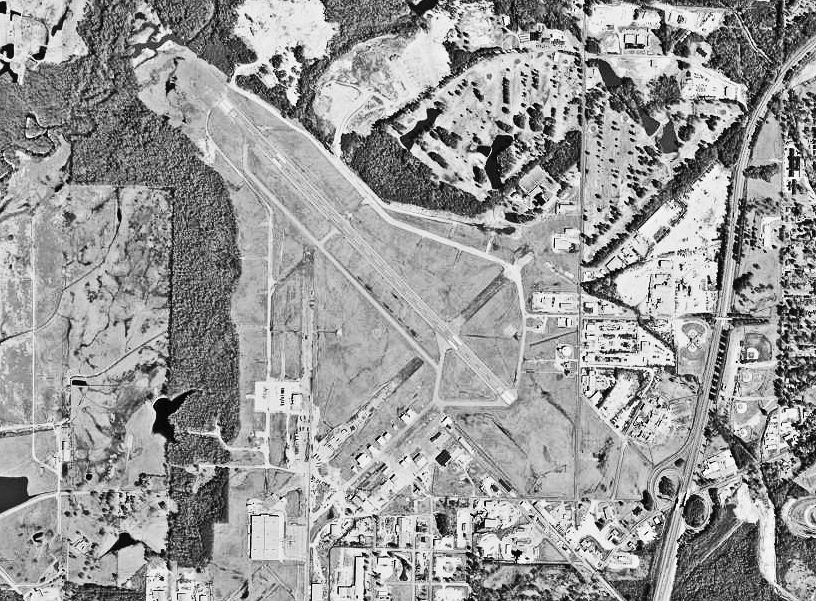
Located at 31.70N, 89.14W in north-central Jones County, Mississippi. The city sits on a low ridge between Tallahala Creek to the east and Tallahoma Creek to the west. Interstate 59 and US Route 11 are visible as they pass through town running southwest to northeast. Look for the distinctive grid of broad avenues in the historic district. Nearest airport: Hattiesburg-Laurel Regional Airport (KPIB), approximately 15nm southwest near Moselle. The terrain is gently rolling piney woods at roughly 250 feet MSL. Laurel is about 30nm northeast of Hattiesburg and 60nm southeast of Jackson. Best viewed at 3,000-4,000 feet AGL to appreciate the city layout and surrounding forest.