Laurier Palace Theatre Fire
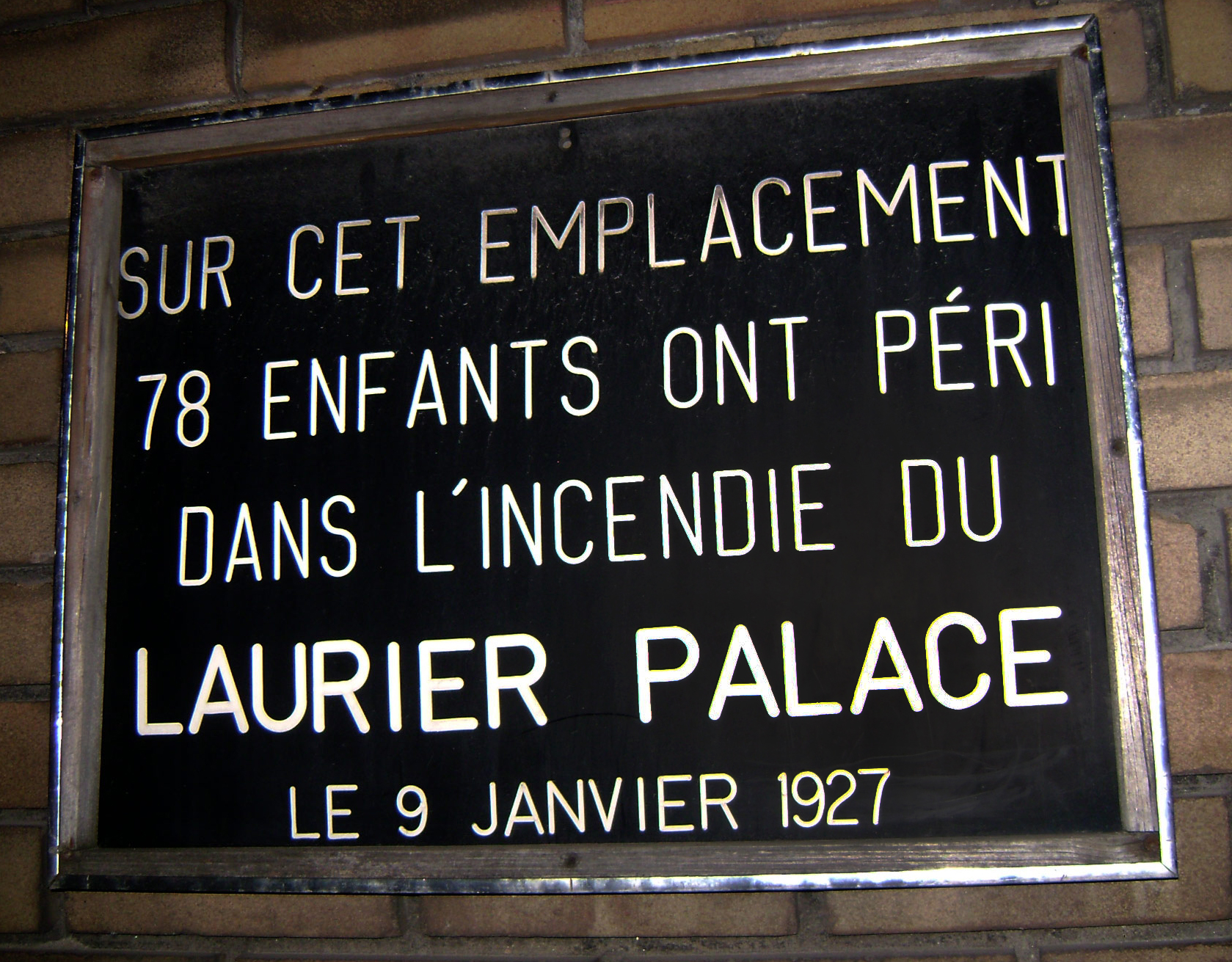
The comedy playing that afternoon was called Get 'Em Young. It was January 9, 1927, a Sunday, and the Laurier Palace Theatre at 3215 Saint Catherine Street East in Montreal was full of children -- roughly 250 of them, the majority unaccompanied by any adult. What happened next earned the fire a name that persists in Quebec's collective memory: the Saddest Fire. When smoke began filling the balcony, ushers made a fatal miscalculation. Not grasping the danger, they blocked the east balcony exit and urged the children back to their seats. The children who ignored them and rushed for the doors found those doors opened inward. The crush of small bodies pressing forward made it impossible to pull the doors open. Seventy-eight children died that afternoon -- twelve crushed in the stampede, sixty-four asphyxiated by smoke, and two killed by the fire itself.
Heroes in the Projection Booth
Not everyone froze. Emile Massicotte, the projectionist, acted with extraordinary clarity. From his booth above the balcony, he pulled thirty children away from the locked exit and guided them into the small projection room. One by one, he passed them through a window onto the marquee above the sidewalk, where they climbed down firemen's ladders to safety. At the other stairway that was not blocked, usher Paul Champagne directed the evacuation, steering children toward the one viable escape route. Between them, Massicotte and Champagne were credited with preventing what could have been well over a hundred additional deaths. A fire station stood directly across the street from the theatre, and firemen arrived within minutes. But for the children trapped behind inward-opening doors on the east stairway, minutes were an eternity.
The Cruelest Details
Among the seventy-eight dead were the son of a firefighter and three children of a policeman who had been called to the scene to assist. The officer arrived to find his own children among the victims. The official cause of the fire was never conclusively determined. Theatre management and employees claimed that children in the audience had been lighting matches to see under their seats. Others pointed to faulty electrical wiring. What was not in dispute was the catastrophic failure of the building itself -- doors designed to open inward in a venue packed with unaccompanied children, exits that became death traps under the pressure of a panicked crowd. The Montreal Gazette's next-day headline captured the scale of the horror in blunt terms: "Seventy-Six Children Killed in Panic on Stairway at Fire in East St. Catherine Street Movie Theatre Sunday Afternoon." The final toll would rise to seventy-eight.
A Province Reshapes Its Laws
The inquiry that followed produced sweeping changes to Quebec law. Children under sixteen were banned from attending cinemas entirely -- a prohibition that remained in effect for thirty-three years, until 1961. Building codes were rewritten to require that doors in all public buildings open outward, a reform that spread far beyond Quebec and became a standard of modern fire safety. In 1967, the cinema law was further modified, establishing a motion picture rating system that divided audiences into age groups: eighteen and over, fourteen and over, and general admission for all. The Laurier Palace fire did not just change how Quebec built its theatres. It changed how the province thought about the relationship between children, public spaces, and the duty of care owed by the adults who managed them.
Grief Woven Into Song
The fire became embedded in Quebec's cultural fabric in ways that went beyond legislation. A large number of songs were written about the disaster, the most notable performed by the singer Hercule Lavoie. The lyrics gave voice to a community's grief in the direct, plainspoken French of working-class east-end Montreal -- the Hochelaga-Maisonneuve neighborhood where many of the victims' families lived. The theatre itself stood on Saint Catherine Street East, the commercial spine of the francophone east side, in an era when cinema was still a novelty and a Sunday matinee was a rare affordable treat for working families. The children who crowded into the Laurier Palace that afternoon were there because their parents could spare the admission price for a few hours of entertainment. That ordinary act of generosity became the source of grief that defined a generation in east-end Montreal.
What Remains on Saint Catherine Street
The Laurier Palace Theatre is gone. The building at 3215 Saint Catherine Street East has been replaced, and the commercial strip has evolved through decades of change. A memorial plaque dedicated to the victims marks the site. The fire station that stood across the street -- whose crews were among the first through the doors -- anchors the memory geographically. Today, the legacy of January 9, 1927, is most visible not at the site itself but in every public building in Quebec where the doors swing outward, in every age restriction printed on a movie ticket, and in the building codes that treat crowd egress as a matter of life and death. Seventy-eight children, most of them under twelve, went to the movies on a Sunday afternoon and never came home. Quebec made certain the country would not forget why.
From the Air
The former theatre site is at 45.5394°N, 73.5408°W on Saint Catherine Street East in the Hochelaga-Maisonneuve neighborhood of Montreal's east end. From the air, Saint Catherine Street runs east-west and is one of Montreal's most prominent commercial corridors. The site is approximately 3 nautical miles east of downtown Montreal's skyscrapers. The nearest major airport is Montreal-Trudeau International (CYUL) approximately 14 nautical miles to the west. Best viewed at 2,000-3,000 feet AGL, where the grid pattern of the east-end residential streets is clearly visible.