Le Génie du Mal
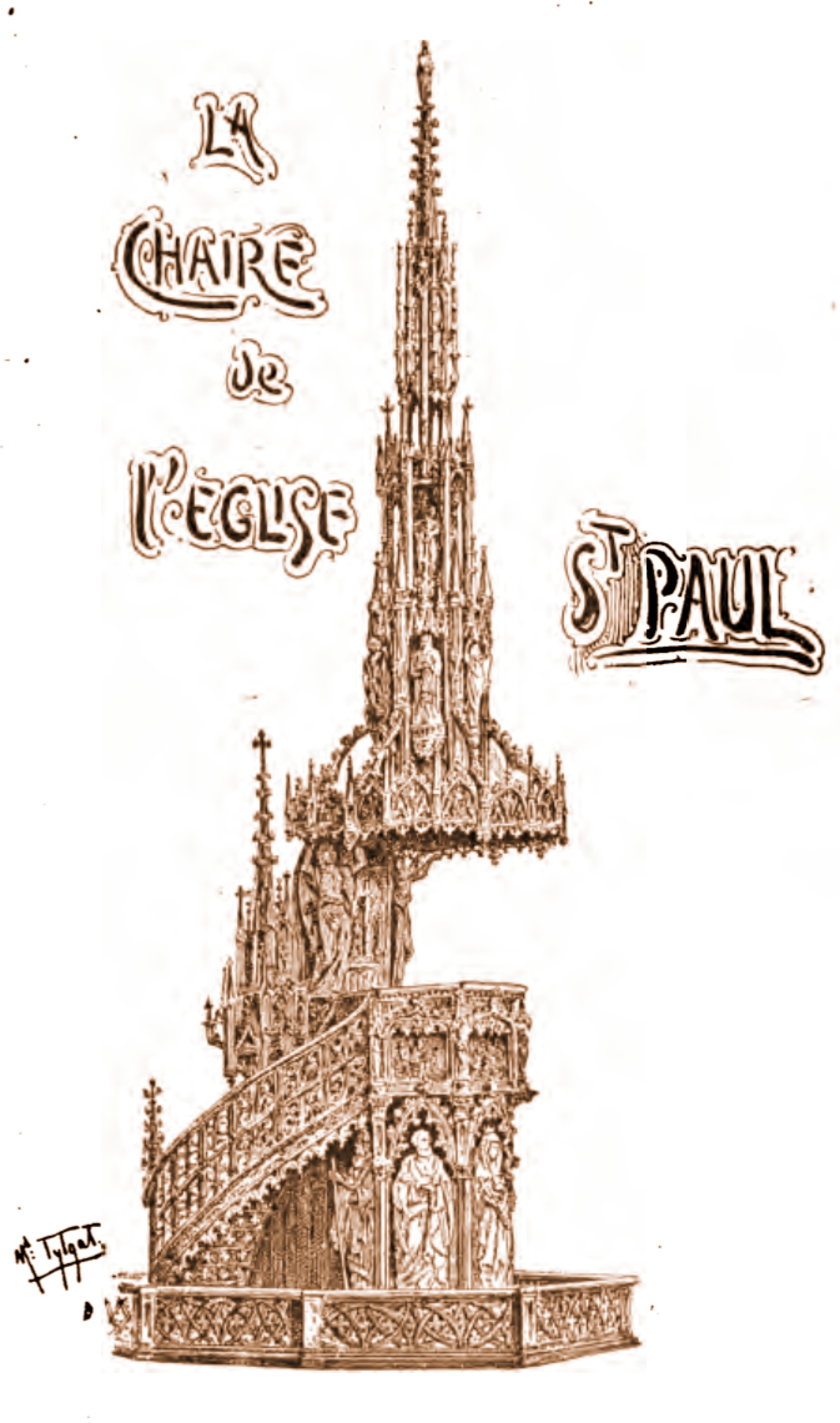
The cathedral administration had a problem they had not expected to have. The devil they had commissioned for the new pulpit of St. Paul's was, in their own words, too sublime. The local press complained that the pretty penitent girls of Liège were paying more attention to the marble fallen angel than to the sermons being preached above him. Joseph Geefs had carved a Lucifer so beautiful that he was distracting the faithful from their own salvation. The bishop ordered the statue removed. Then he handed the commission to Joseph's older brother Guillaume, with a quiet instruction to do better.
Brothers in marble
The Geefs family produced six sculptor-brothers in nineteenth-century Belgium, and Guillaume was the eldest and most established of them. In 1837 he was put in charge of designing the elaborate pulpit at St. Paul's, around the theme of "the Triumph of Religion over the Genius of Evil." He delegated the figure of evil itself to his younger brother Joseph, who finished L'ange du mal in 1842 and installed it the following year. Controversy arrived almost immediately. Joseph had given Lucifer the body of a winged Adonis, nearly nude, with hips bared and thighs parted, his expression somber and faintly sensual. A serpent uncoiled at his feet. One critic later called the work "one of the most disturbing works of its time." Bishop van Bommel agreed, in his own way, and ordered it taken out.
Too sublime
Joseph's Lucifer did not languish. King William II of the Netherlands bought the deracinated original for three thousand florins. The Grand Duke of Saxe-Weimar ordered a marble replica. The Royal Museums of Fine Arts of Belgium eventually received the original into their collection, where it remains. The work elevated Joseph Geefs to the top tier of sculptors of his day, even as the cathedral that rejected him turned to his older brother. Guillaume installed his own version, Le Génie du Mal, permanently in 1848. The two sculptures are strikingly similar at first glance, apparently inspired by the same human model, occupying almost the same dimensions in space. The differences are in the details, and the differences turned out to be everything.
Chains and a Promethean tear
Guillaume covered more of the body. The drapery undulates thickly over the thighs and conceals the hips, where Joseph's barely skimmed the groin. He shifted the direction of the gaze so it leads away from the body rather than along it, and drew Lucifer's knees together protectively. He added horns to dehumanize the figure, talons for nails, an apple with bite marks at the feet, the broken finial of the morning star's sceptre. Most importantly, he added chains. The right ankle and left wrist are fettered to the rock. In nineteenth-century Belgium, fresh from its own revolutionary independence in 1830, the figure of a magnificent rebel chained in defeat carried complicated weight. Lucifer became a Promethean figure, a tortured genius struggling against his bonds. A single tear slips from his left eye. The hauteur of Joseph's version is gone. What remains is closer to remorse, or grief.
What seduction survives
Whether Guillaume actually succeeded in removing the seductive elements remains a matter of individual perception. The exposed flesh is resolutely modeled, the pectorals and calves more defined, the upper arms tensed against the chains. A nineteenth-century reviewer found Joseph's version "gentle and languid," a devil sick, the sting of Satan taken out. Visitors today, climbing the elaborate pulpit at the base of its semi-spiral stairs, look down into the niche and see a beautiful chained man with bat wings, weeping. The cathedral got the more pious of the two Lucifers. It also got a Lucifer who looks, more than anything, sorry. Both brothers were buried in Brussels. The disputed sculptures, separated for nearly two centuries, still face each other across the chasm of what their century could and could not allow.
An afterlife in installation
In 1986, the Belgian artist Jacques Charlier made Le Génie du Mal the focal point of an installation called Himmelsweg, the German word meaning "Road to Heaven." A framed photograph of the sculpture hangs above a black-draped table, on which sit three books: a Carmelite study on Satan, a scientific treatise on air, and a memorial of the Belgian Jews murdered at Auschwitz. On the lower shelf, shackles. The title is borrowed from the Nazi euphemism for the ramp that led to the gas chambers. The road to paradise leads to hell, Charlier was saying, and the Fall is so close to redemption. Guillaume Geefs carved a chained angel in 1848 to teach a lesson about evil and its punishment. A century and a half later, an artist used the same figure to ask whether anyone had ever really learned it.
From the Air
Liège Cathedral sits at 50.6403 N, 5.5717 E, in the heart of the city of Liège on the Meuse River in eastern Belgium. Best viewed from 2,000 to 4,000 feet for cathedral identification. Nearest airport is Liège Airport (EBLG), about 8 km west. Brussels Airport (EBBR) lies 80 km west, Maastricht Aachen Airport (EHBK) 30 km north. The cathedral's 90-meter spire is a landmark visible across the Meuse valley.