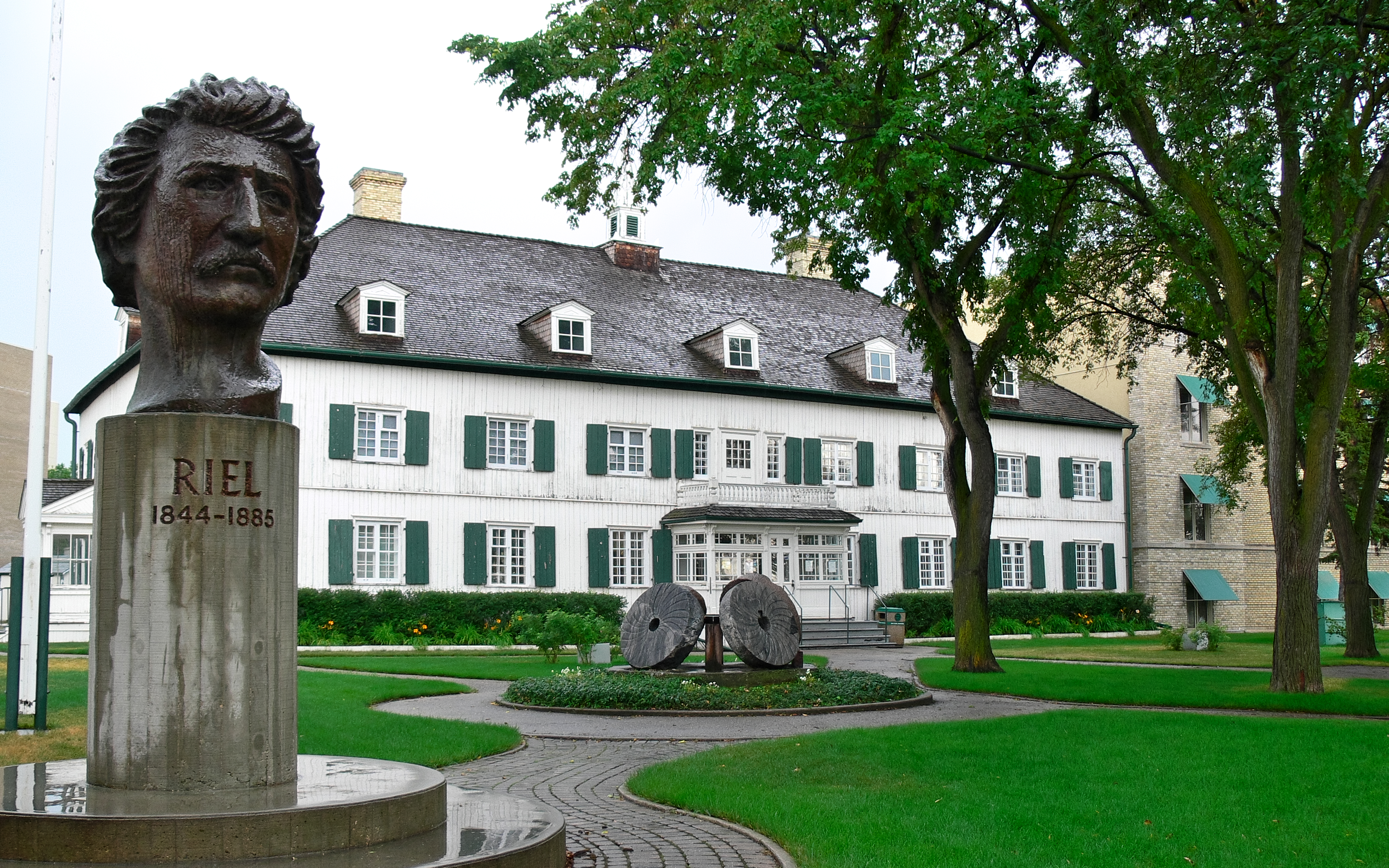
Le Musee de Saint-Boniface: Bison Pelts on the Ceiling, a Rebel's Rope Under Glass
Four Grey Nuns moved into an unfinished building in December 1846, with only the exterior walls of the first floor and a partial second-story kitchen floor completed. The Manitoba winter was already brutal. To survive it, the nuns hung bison pelts from the ceiling as insulation, turning their half-built convent into something between a construction site and a buffalo-hide tent. That improvised shelter still stands -- the second oldest building in Winnipeg, now Le Musee de Saint-Boniface Museum, a repository of Franco-Manitoban and Metis history that holds artifacts as intimate as locks of hair and as haunting as a hangman's rope.
Built Without Nails
The convent was constructed using the Red River building method, a technique of interlocking timber also described as mortise and tenon or tongue and groove joinery. Not a single nail holds the structure together. Construction began in 1846 and finished in 1851, producing a building with a basement, two full floors, and an attic. The Grey Nuns who commissioned it had arrived in 1844, living initially with Bishop Norbert Provencher until their own quarters could be started. The completed convent would serve the community in a remarkable succession of roles -- orphanage, school, seniors' home, and the first incarnation of St. Boniface Hospital. Each transformation reflected the growing needs of the Red River settlement, and each left its mark on the building's interior.
The Grey Nuns on the Frontier
The Grey Nuns who settled here were not cloistered contemplatives but frontier workers. They arrived in the Red River Colony at a time when the nearest city of any size was hundreds of miles away, winter temperatures plunged far below zero, and the local economy revolved around pemmican and fur pelts. Their convent became a social services hub long before that term existed, absorbing orphaned children, educating local families, and providing medical care that would eventually grow into a full hospital. The building they occupied was itself an act of resilience -- begun before it could be properly finished, insulated with animal hides, and standing through nearly two centuries of Manitoba weather without the benefit of a single iron fastener.
Riel's Personal Effects
The museum's most powerful exhibit centers on Louis Riel, the Metis leader who led two resistance movements against the Canadian government and was executed by hanging on November 16, 1885. Under glass in Saint-Boniface, visitors encounter Riel's personal belongings with startling intimacy: locks of his hair, his revolver, his shaving kit, his moccasins. Then the display turns darker -- pieces of the rope used to hang him, the white hood placed over his head before the execution, and the coffin on which his body was laid afterward. Riel was born in Saint-Boniface and his grave lies nearby at the Saint-Boniface Cathedral. The museum's collection transforms a political figure into a physical presence, making abstract history uncomfortably tangible.
From Convent to National Historic Site
The convent building was designated a National Historic Site of Canada in 1958. A year later, in November 1959, the municipality formally established the museum and appointed a board of directors. Since the late 1960s the building has been administered by municipal government -- first the city of Saint-Boniface, then the City of Winnipeg following the amalgamation of 1971. Today Le Musee de Saint-Boniface Museum is dedicated to preserving Franco-Manitoban and Metis culture, telling the story of the French-speaking communities that helped shape Manitoba from the fur trade era through Confederation and beyond. The building itself remains the most compelling artifact in the collection -- a nail-free timber structure that has outlasted every other building of its era in Winnipeg except the 1831 store at the Seven Oaks House Museum.
From the Air
Located at 49.89°N, 97.12°W in the Saint-Boniface neighborhood of Winnipeg, Manitoba, on the east bank of the Red River directly across from The Forks. From altitude, the Saint-Boniface Cathedral with its distinctive facade ruin is a useful landmark -- the museum sits nearby. Winnipeg James Armstrong Richardson International Airport (CYWG) is approximately 8 km to the west-southwest. The flat terrain and grid street pattern of Winnipeg make the Red River and its east-bank neighborhoods clearly visible on approach.