Le Pays de la Sagouine
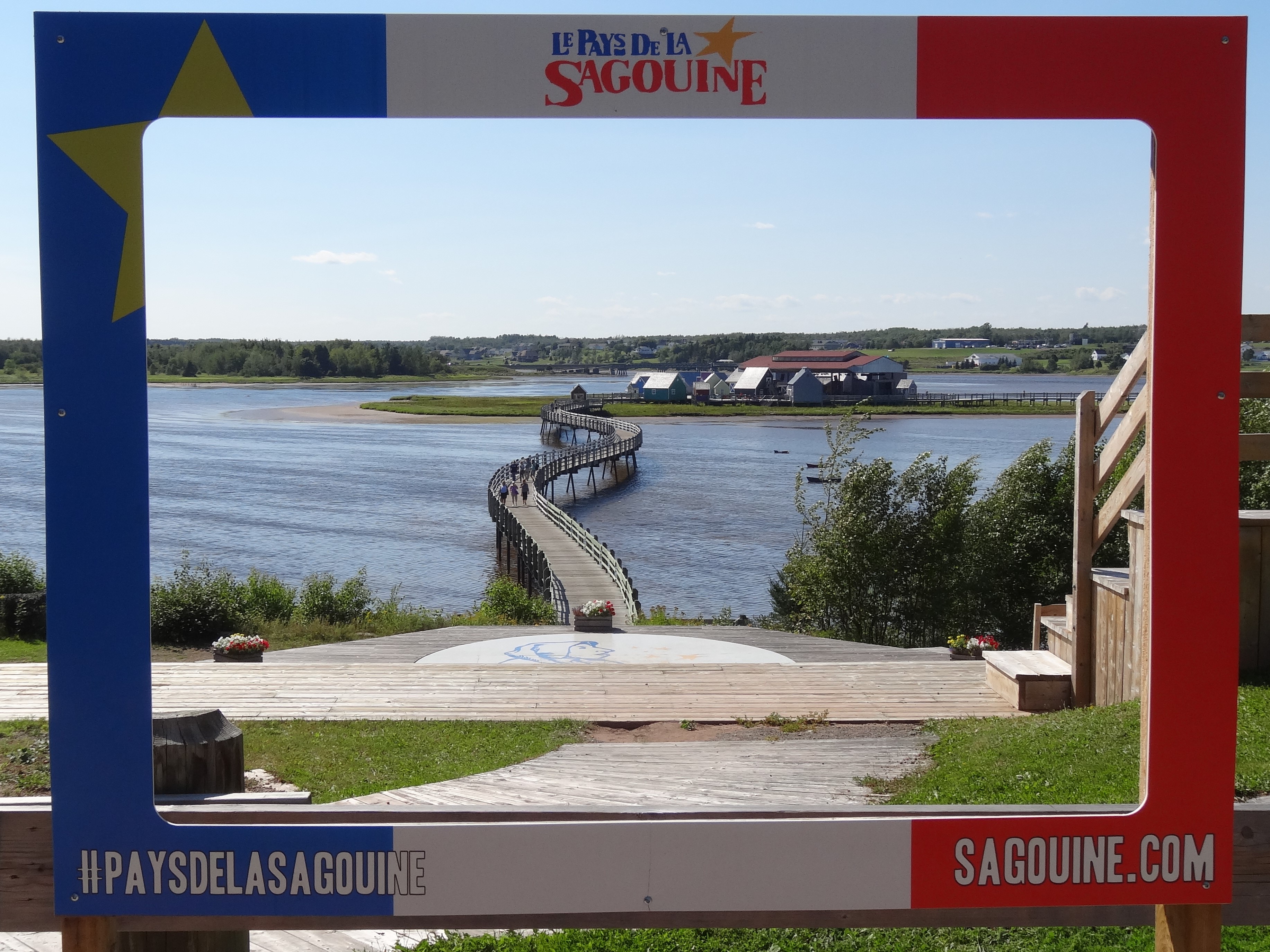
She scrubs floors for a living, speaks in the rich, rolling dialect of coastal Acadian French, and has opinions about everything. La Sagouine -- the title character of Antonine Maillet's 1971 play -- is a cleaning woman whose monologues reveal an entire culture: its humor, its poverty, its stubborn refusal to disappear. The play was so beloved, and the world it described so vivid, that in 1992 someone built that world for real. Le Pays de la Sagouine sits on Ile-aux-Puces, a small island in the harbor of Bouctouche, New Brunswick, connected to the mainland by a wooden boardwalk. It is a place where a fictional character became so real that she needed an address.
The Woman Who Gave Voice to Acadia
Antonine Maillet spent her career writing the Acadian experience into existence. Over the course of more than 30 plays and novels, she documented a culture that had survived deportation, poverty, and marginalization with a resilience that bordered on defiance. Her character La Sagouine -- the name loosely translates to 'the untidy woman' or 'the slovenly one' -- was inspired by a real person, Sarah Cormier, whose life Maillet learned about through her grandson's memoirs. Through La Sagouine's monologues, delivered in the Acadian dialect of southeastern New Brunswick, Maillet gave voice to working-class Acadian life in a way that literary French never could. The play premiered in 1971 and became one of the most significant works of Acadian literature, earning Maillet recognition that culminated in her winning the Prix Goncourt in 1979 for her novel Pelagie-la-Charrette -- the first non-European to receive France's most prestigious literary award. Maillet passed away in February 2025, but the world she built in words continues to live in wood and paint on an island in Bouctouche.
A Village Made from Fiction
Le Pays de la Sagouine opened in 1992 as an immersive recreation of the Acadian coastal village that Maillet's characters inhabit. The site occupies Ile-aux-Puces -- Flea Island -- a small piece of land in Bouctouche harbour that visitors reach by crossing a long wooden boardwalk over the water. The village consists of rustic buildings designed to evoke the Acadian communities of the early and mid-20th century, a world of fishing shacks, community halls, and kitchens where food was prepared in quantities meant for sharing. Actors in period costumes populate the village during its summer operating season, performing scenes from Maillet's works, engaging visitors in conversation, cooking traditional dishes, and playing the music that has defined Acadian gatherings for generations. The effect is less theme park than living theater -- the village is a stage, and the visitors are part of the audience.
Sixty Thousand in a Town of Twenty-Four Hundred
Bouctouche is a small community of roughly 2,400 people on the Northumberland Strait coast of New Brunswick. During the summer season, Le Pays de la Sagouine draws approximately 60,000 visitors -- more than twenty-five times the town's population. The park employs more than 150 people during its ten-week season, making it one of the largest employers of Acadian performers in the world. The economic impact on the surrounding community is substantial, but the cultural impact may be greater. For Acadian visitors, the site offers something that museums and monuments cannot: the experience of walking through a living version of their own cultural past, hearing their own dialect spoken as everyday language, eating the foods their grandparents ate. For non-Acadian visitors, it provides an entry point into a culture that most Canadians know only vaguely -- a people who were expelled from their homeland in the 18th century and who rebuilt their identity, community by community, across the Maritimes.
More Than Nostalgia
Le Pays de la Sagouine could easily have become a quaint exercise in historical reenactment, a frozen snapshot of a vanished way of life. Instead, the site has evolved into a platform for contemporary Acadian culture. Evening dinner theater performances draw crowds for comedy, music, and storytelling that blend traditional forms with modern sensibilities. Interactive night-walk experiences use light and sound to create immersive journeys through Acadian history and mythology. The park has become a gathering place where Acadian identity is not just preserved but actively performed and debated. La Sagouine herself, the fictional cleaning woman who started it all, remains the presiding spirit -- a character who refuses to be polite, refuses to be quiet, and refuses to pretend that the Acadian experience is anything other than what it is: complicated, painful, funny, and profoundly alive.
From the Air
Located at 46.46N, 64.71W in Bouctouche, New Brunswick, on the Northumberland Strait coast. The site is on Ile-aux-Puces, a small island in Bouctouche harbour connected by a boardwalk. From the air, the wooden boardwalk and cluster of rustic village buildings on the island are visible at lower altitudes. The Bouctouche Bay and Dune de Bouctouche (a 12 km sand dune) provide dramatic coastal scenery nearby. Best viewed at 1,500-2,500 feet. Nearest airport: CYQM (Greater Moncton International Airport), approximately 50 km southwest.