Le Puy Cathedral
To enter Le Puy Cathedral, you climb. Sixty steps rise from the street to the west porch. Sixty more ascend from there into the nave. The stairway passes through the very foundations of the building, emerging near the altar so that medieval pilgrims arrived at the heart of the church from below, as if born up from the earth itself. This is a cathedral designed around the act of ascending, built against the steep flank of the Rocher Corneille in Le Puy-en-Velay, and it has been drawing pilgrims upward since before the time of Charlemagne.
The Black Madonna and the Road to Compostela
The pilgrimage predates the current building by centuries. An early Christian church on this site housed a celebrated image of the Virgin Mary carved in ebony — one of France's many Black Madonnas, whose dark figures inspired intense devotion across the medieval world. The original statue was destroyed during the French Revolution in 1794, but a 19th-century replacement now occupies the main altar, dressed in seasonal costumes as the original once was. Beginning in the 10th century, Le Puy became a major stop on the pilgrimage route to Santiago de Compostela, and the cathedral chapter grew to forty priests. A Hôtel-Dieu sheltered impoverished pilgrims, while chapels, convents, and schools multiplied around the cathedral in response to the flood of travelers.
A Church of Every Century
Le Puy Cathedral is not one building but many, layered across a millennium. Fragments of Roman temple sculpture are embedded in its walls. The earliest Christian foundations date to the 5th century. The bulk of what stands today was built in the first half of the 12th century in the Romanesque style, but a 1427 earthquake, a 16th-century lightning strike, and centuries of modification have left architecture from every period between the 5th and 19th centuries coexisting within the same structure. The west front, a triumphal arch of white sandstone and dark volcanic stone, was entirely rebuilt in the 1840s by the architect Mallay under the supervision of Viollet-le-Duc, who aimed to return the cathedral to its medieval appearance. Since 1998 the cathedral has been part of a UNESCO World Heritage Site along France's Santiago pilgrimage routes.
Painted Walls and Watchful Towers
The west porch preserves some of the cathedral's oldest treasures. Byzantine-style frescoes from around 1200 depict the Transfiguration on the south wall — Christ with Moses and Elijah, the apostles at their feet. Opposite, the Virgin Mary sits enthroned before a curtain held by angels and prophets. Cedar doors installed at the end of the 12th century carry a Latin inscription warning the impure not to enter. Above the nave, six octagonal cupolas rest on massive pillars, covering the central vessel while collateral aisles run alongside. The bell tower stands seven stories and 56 meters high, originally serving a military as well as a religious function. Watchmen stationed at its peak scanned the countryside for approaching enemies, and the tower's practical usefulness as a lookout saved it from destruction during the Revolution.
The Cloister and the Chapel of the Dead
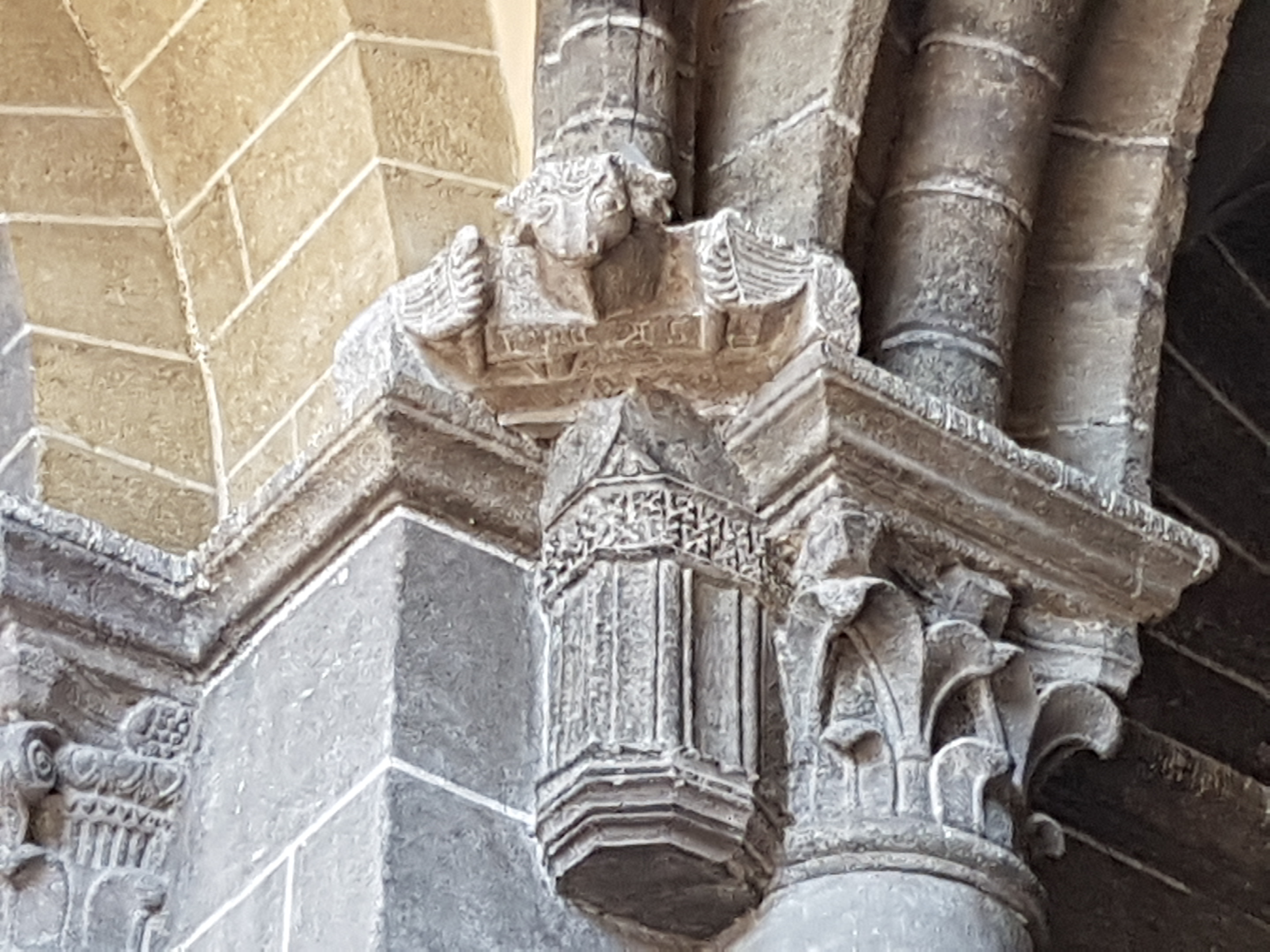
The multicolored cloister on the north side of the cathedral dates from the Carolingian period through the 12th century, its polychrome columns and carved capitals displaying a riot of Romanesque artistry. Nearby, the Chapter Hall — called the Chapel of the Dead for the funeral monuments lining its walls — holds a Crucifixion mural painted around 1200. An inscription in Latin boasts that it was completed in less than one hundred days. The painting marks the transition from Byzantine to Gothic style, a shift visible in a single room. The 11th-century baptistry of Saint John, built on Roman foundations, connects to the cathedral by the Porch of Saint John, which was once reserved for the entry of kings, princes, and provincial governors.
From the Air
Located at 45.04°N, 3.88°E in Le Puy-en-Velay, Haute-Loire department. The cathedral sits at the city's highest point, against the massive Rocher Corneille volcanic butte, which is topped by a large statue of the Virgin Mary. Le Puy-en-Velay Loudes Airport (LFHP) is nearby. Clermont-Ferrand Auvergne Airport (LFLC) is the larger regional hub. The cathedral and Rocher Corneille are prominent visual landmarks from altitude. Recommend viewing at 3,000-5,000 ft AGL.