Leaning Tower of Zaragoza
Five master builders raised the Torre Nueva in 1504: Christians Gabriel Gombao and Anton Sarinena, Muslims Ismael Allabar and Monferriz, and a Jew named Juce Gali. In the Spain of the Catholic Monarchs, where religious persecution was intensifying and the Inquisition cast a long shadow, these men from three faiths collaborated to create the tallest Mudejar tower ever built. It stood eighty meters high, its base a sixteen-pointed star, its bricks laid in patterns that blended Gothic arches with Moorish geometry. Almost immediately, it began to lean.
Built in Haste, Tilted by Design
The lean appeared soon after construction, likely because the southern portion of the foundation was laid faster than the northern side. The difference in tension between the two halves pulled the tower off vertical, and although workers reinforced the foundation, the tilt persisted. By the time measurements were taken in its final years, the deviation from vertical was nearly three meters -- more than eight feet of overhang. A description in The Brickbuilder journal in 1896 noted the paradox: the lean appeared almost deliberate, increasing noticeably above the base, as if the tower were straining toward something only it could see. The 11.5-meter-wide structure rose through four distinct stories, each treated differently. The first body formed that sixteen-pointed star in cross section; the upper stories shifted to octagonal forms with angular buttresses. A triple spire topped the whole thing, added in 1749 and removed in 1878.
Sentinel and Symbol
From the sixteenth century onward, the Torre Nueva became inseparable from Zaragoza's identity. During the French sieges of 1808 and 1809, defenders used the tower as a lookout to track Napoleonic troop movements and sound warnings across the city. In peacetime, it served as a clock tower, marking the hours for a city that had grown up around its tilted silhouette. Painters and photographers made it famous across Europe: Charles Clifford captured it in October 1860, J. Laurent photographed it repeatedly between 1863 and 1877, and Gustave Dore drew it for an 1874 French travelogue. Even William's cigarettes, a now-defunct British brand, featured the tower on a collectible card in a series about remarkable buildings around the world.
The Greatest Artistic Crime in Spain
In 1878, the city council removed the triple spire, citing structural concerns. Fourteen years later, in 1892, they voted to tear down the entire tower, claiming the lean and alleged deterioration made it a danger to the public. The decision provoked outrage. Intellectuals denounced what they called a "patricide" -- the destruction of what defenders described as "the most beautiful Mudejar tower" and "the greatest artistic crime committed in Spain." Protests and petitions failed. The demolition took a full year, beginning with scaffolding erected in the summer of 1892. When it was over, citizens bought the bricks as souvenirs. Some of those bricks ended up in the foundations of new houses across Zaragoza -- the old tower literally absorbed into the city that had killed it.
A Boy Still Looking Up
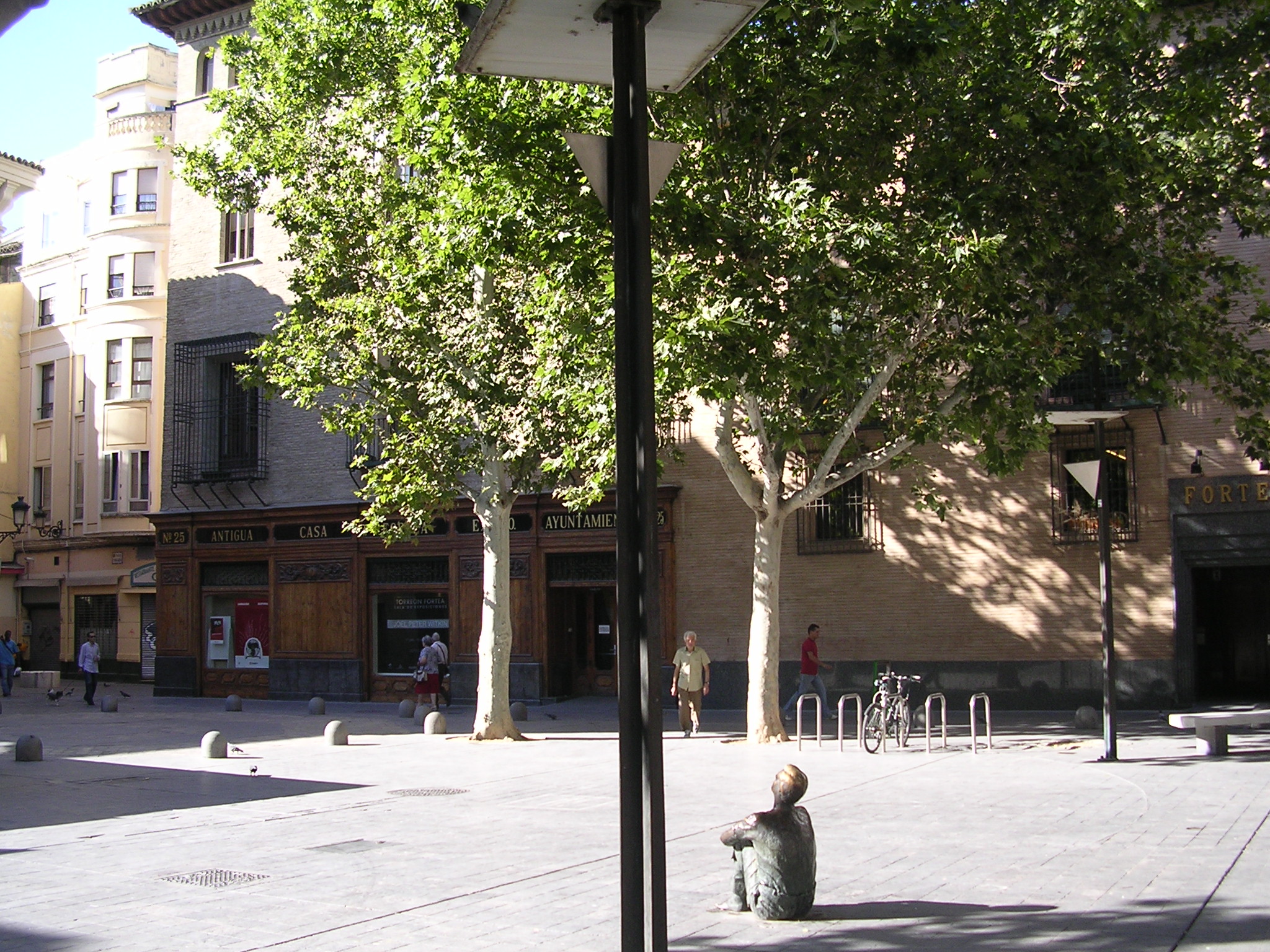
In the 1990s, the city placed a memorial in the Plaza de San Felipe where the tower once stood. The perimeter of the base is outlined on the pavement, marking the ghost of that sixteen-pointed star. Beside it sits a bronze sculpture of a boy, gazing upward at the empty sky where eighty meters of brick and geometry once tilted against the Aragonese light. In a shop on the square, a small museum displays photographs, fragments, and memories of the tower. It is a quiet act of civic remorse -- or at least acknowledgment -- for a decision that erased one of Europe's most distinctive buildings. The Leaning Tower of Pisa survived because Italians chose to save it. Zaragoza's tower fell because its own people chose otherwise.
From the Air
Located at 41.65N, 0.88W in central Zaragoza at the Plaza de San Felipe. The tower no longer exists -- only a ground-level memorial marks its former position. Nearest airport is Zaragoza (LEZG). The plaza is in the old city center near the Basilica del Pilar. Best appreciated by understanding what once rose from this spot.