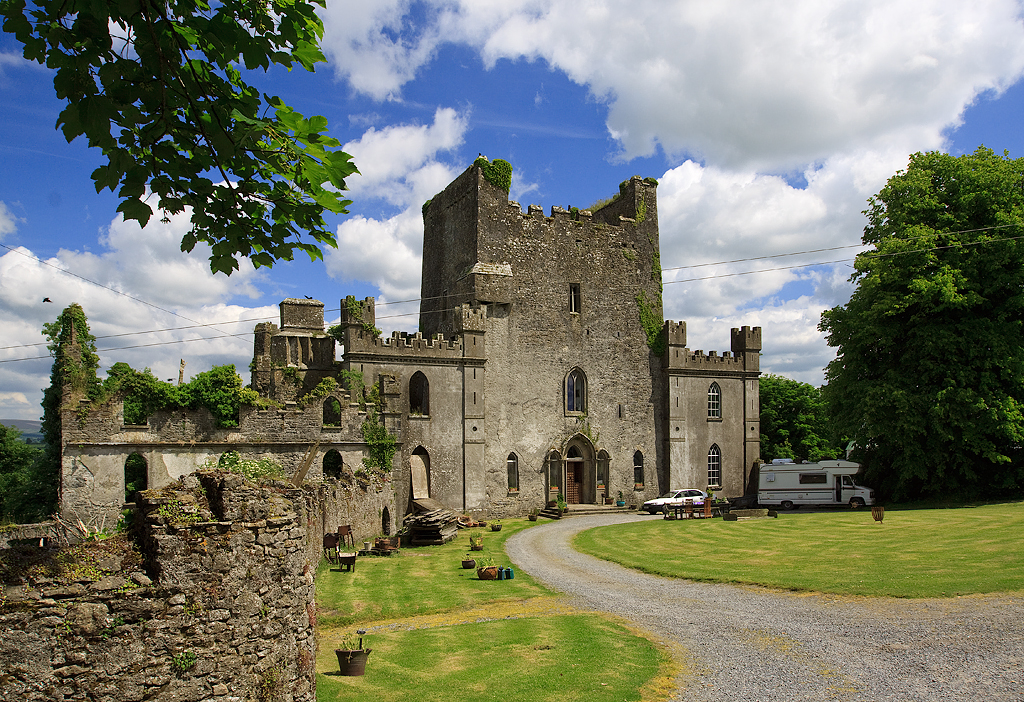
Leap Castle
The room is still called the Bloody Chapel. Sometime after 1532, during a savage struggle for control of the O'Carroll clan, one brother burst through the door while another -- a priest -- was saying mass before their family. He drove his sword into the priest. The wounded man fell across the altar and died in front of his kin. Whatever happened in that room seeped into the stone. Leap Castle, perched on a ridge in County Offaly between Roscrea and Kinnitty, calls itself "the world's most haunted castle," and for once the marketing may be underselling the history.
The Leap of the O'Bannons
The castle's Irish name is Leeim Ui Bhananin -- the Leap of the O'Bannons, the clan that built the original tower keep, most likely around 1250 AD. The O'Bannons were secondary chieftains, subject to the ruling O'Carroll clan, and there is evidence the castle was raised on the site of a still-older stone structure, perhaps ceremonial, with occupation stretching back to the Iron Age and possibly to Neolithic times. The Annals of the Four Masters record that the Earl of Kildare, Gerald FitzGerald, attacked the castle in 1513 and again in 1516, partially demolishing it. By 1557, the O'Carrolls had rebuilt and reclaimed it. But the family's internal violence would prove harder to survive than any siege.
The Oubliette and the Seances
Below the castle lies an oubliette -- a hidden dungeon whose name comes from the French oublier, to forget. Prisoners were dropped through a trapdoor and left to die, their remains accumulating in the darkness below. When the pit was eventually opened, bones were found. The castle passed by marriage to the Darby family in 1642, and it was a Darby who would give Leap its modern reputation. In the late 19th century, Mildred Darby, wife of Jonathan Charles Darby and a writer of Gothic novels, held seances within the castle walls. What she reportedly encountered -- an apparition she described as an "elemental" presence, something not quite ghost and not quite demon -- generated publicity that has never faded. Claims of paranormal activity include a Red Lady ghost, the spirits of two young girls, and Mildred's elemental, which seems to have taken up permanent residence in the popular imagination.
Burned, Bought, and Rebuilt
The Darbys expanded the castle significantly, but the costs of the extensions led them to raise rents and sell much of the surrounding land -- a decision that bred resentment. In 1922, during the Irish Civil War, the castle was burned. A reinstatement estimate from Dublin surveyors Beckett and Medcalf put the damage at over 22,000 pounds, roughly equivalent to one million euros in 2018, though the claim was settled for less. The ruin sat empty for decades. In 1974, it was purchased by Australian historian Peter Bartlett, whose mother had been a Banon -- a descendant of the castle's original builders. Bartlett, with builder Joe Sullivan, carried out extensive restoration until his death in 1989. Since 1991, the castle has belonged to musician Sean Ryan and his wife Anne, who continue the work.
The Castle That Television Cannot Leave Alone
Ghost hunting television has made Leap Castle a recurring destination. ABC Family's Scariest Places on Earth, Living TV's Most Haunted, Syfy's Ghost Hunters, and Travel Channel's Ghost Adventures have all filmed here. The YouTube channel Sam and Colby brought a newer generation of viewers. Author Aaron Mahnke dedicated a chapter of The World of Lore: Dreadful Places to the castle, titling it "The Tainted Well" after the oubliette. In 1996, Robert Hardy examined the castle's history in Castle Ghosts of Ireland. Whether the hauntings are real is a question the castle itself seems uninterested in answering. What is undeniable is the history: the fratricide in the chapel, the bones in the pit, the seances, the burning. Leap Castle has earned every reputation it carries, paranormal or otherwise.
From the Air
Located at 53.03N, 7.81W in County Offaly, on a ridge between Roscrea and Kinnitty along the R421. The castle tower is visible against the Slieve Bloom Mountains to the east. Nearest airports: Shannon (EINN) approximately 100 km west, Dublin (EIDW) approximately 130 km northeast. Best viewed below 3,000 ft AGL. The surrounding landscape is rolling farmland with the Slieve Bloom range providing a backdrop.