Leavenworth (Washington)
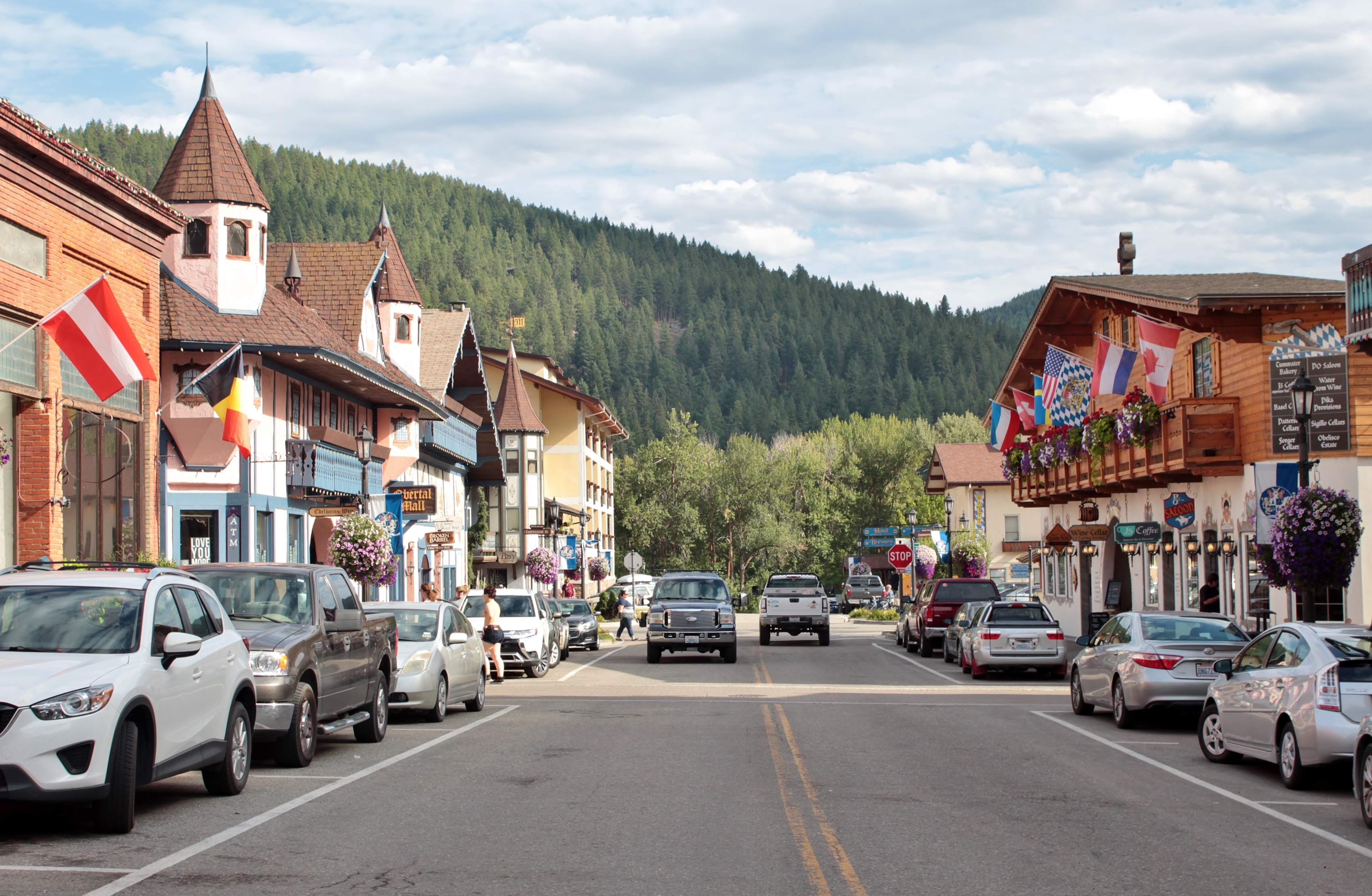
The first glimpse is disorienting. You've driven for hours through Douglas fir forest and sagebrush steppe, crossed Stevens Pass in the Cascades, and suddenly there it is: a Bavarian village tucked into a mountain valley, complete with half-timbered buildings, flower boxes overflowing with geraniums, and shopkeepers who greet you with 'Willkommen.' This is Leavenworth, Washington - a former railroad and logging town that reinvented itself in the 1960s when the timber industry collapsed. The transformation was deliberate, inspired by the Danish-themed town of Solvang, California, and executed with enough commitment that today the entire downtown looks like it was transplanted from the Alps. It's a tourist attraction, certainly - but the real mountains rising behind the fake Bavarian facades are no illusion.
The Reinvention
Leavenworth's Bavarian theme wasn't organic - it was planned. By the early 1960s, the town was dying. The Great Northern Railway had moved its operations to Wenatchee. The sawmill had closed. The population was shrinking. Two local business owners, Owen and Pauline Watson, proposed a radical solution: transform the town into a themed tourist destination, modeled on the successful experiment in Solvang.
The community bought in. Buildings were renovated with Bavarian facades. Shop owners adopted German themes. Festivals were created - Maifest, Oktoberfest, Christmas Lighting - to draw visitors year-round. The transformation took years, but it worked. Today, Leavenworth welcomes over a million visitors annually, its downtown packed on weekends with tourists browsing nutcracker shops and beer halls. Critics might call it kitsch; residents call it survival. The alternative was ghost town status, and Leavenworth chose to live.
The Enchantments
Above town, the mountains don't care about themes. The Enchantments - a series of alpine lakes, granite spires, and pristine wilderness - rank among the most spectacular backcountry destinations in the American West. Prusik Peak, Dragontail Peak, and the otherworldly Enchantment Lakes draw climbers and backpackers from around the world. The scenery is almost too beautiful to believe: turquoise lakes nestled beneath jagged peaks, larch trees turning gold in autumn, mountain goats traversing seemingly impossible terrain.
Access is limited and highly competitive. Overnight permits are distributed by lottery, with demand far exceeding supply. Day hikers can attempt the core enchantment zone via a brutal 18-mile round trip with nearly 5,000 feet of gain. Those who make it report experiences that reshape their understanding of what wilderness can be. The Enchantments represent everything Leavenworth's Bavarian theme suggests but amplifies it with raw, unmediated natural splendor.
The Christmas Lights
From Thanksgiving through February, Leavenworth transforms into something approaching magic. Over half a million lights illuminate the downtown, draped across every building, wound through every tree, reflected in the Wenatchee River that flows past the village. The effect, against a backdrop of snow-covered peaks, is genuinely spectacular. This isn't a tasteful display - it's an all-out assault of illumination, a commitment to holiday spirit that borders on the overwhelming.
The Christmas Lighting Festival, held on the first three weekends of December, draws crowds so large that traffic backs up for miles on Highway 2. Carolers in period costume roam the streets. Roasted chestnuts and hot cider warm cold hands. The gazebo in the town center hosts entertainment. For families, it's become a Pacific Northwest tradition - a reminder that even in the age of irony, sincere celebration has its place. The lights stay up past Christmas, extending the season for those who need more time to absorb the glow.
The River and the Valley
The Wenatchee River flows through Leavenworth, providing a natural counterpoint to the constructed theme. In summer, the river offers some of the best whitewater in Washington - Class III rapids that draw rafters and kayakers, gentler sections for tubing on hot afternoons. The river trail offers walking and cycling along the water's edge, connecting the town to the broader valley.
Icicle Creek descends from the Enchantments through a canyon lined with campgrounds and climbing areas. The creek road leads to trailheads accessing the Alpine Lakes Wilderness, a vast protected area that extends from Leavenworth toward Snoqualmie Pass. The surrounding Wenatchee National Forest offers endless exploration - hiking, mountain biking, fishing, cross-country skiing in winter. The Bavarian theme gets you to Leavenworth; the landscape keeps you there.
East of the Cascades
Leavenworth sits precisely where the wet west side of the Cascades transitions to the dry east. The town receives moderate precipitation, but drive thirty minutes east and you're in orchard country - the apple and pear operations of the Wenatchee Valley, irrigated from rivers that carry Cascade snowmelt. This transition zone creates its own microclimate, with weather patterns that often differ dramatically from Seattle's perpetual gray.
The eastern setting means more sun, more snow, more extremes. Winter dumps feet of powder on nearby Stevens Pass; summer brings genuine heat. The seasons are pronounced in ways that western Washington rarely experiences. And the mountains loom closer here, the peaks visible from downtown streets, unobscured by the marine layer that so often blankets the coast. Whatever you think of the Bavarian theme, the mountain setting is authentic - Alps that require no imagination to appreciate.
From the Air
Located at 47.60°N, 120.67°W at the eastern base of the Cascade Range. The town appears as a small developed area in the narrow Wenatchee River valley. The Bavarian-themed downtown is visible as a compact village. The Wenatchee River runs through town. Look for the dramatic transition from forested Cascades to drier eastern Washington terrain. The Stuart Range and Enchantments are visible to the southwest (jagged granite peaks with alpine lakes). Stevens Pass ski area is 35nm west. Nearest airports: Pangborn Memorial (KEAT) in Wenatchee 30nm east, Seattle-Tacoma (KSEA) 100nm west. Mountain wave turbulence can be significant in the valley. Winter conditions can close Stevens Pass.