Ledenhof
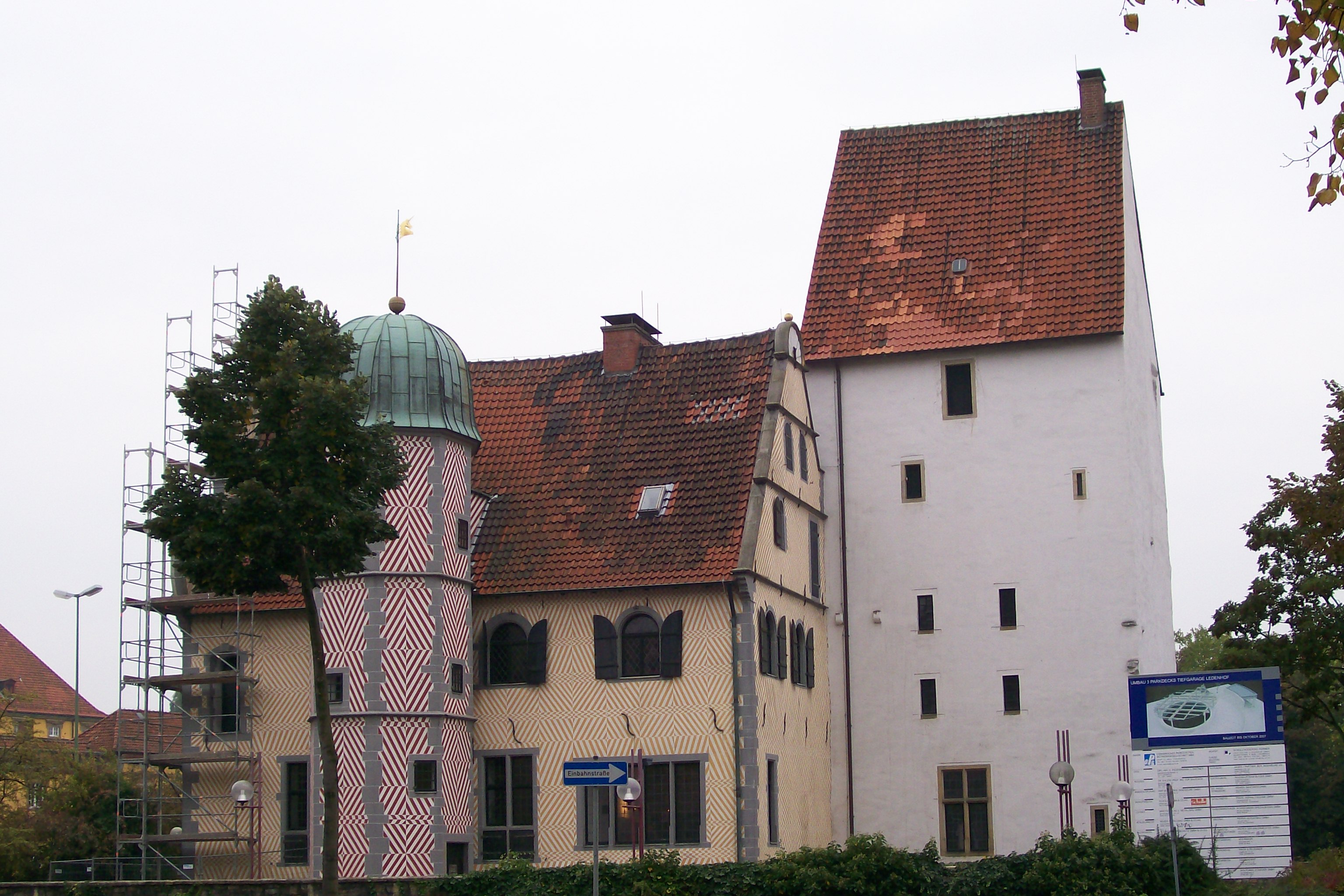
The Steinwerk of the Ledenhof looks exactly like the kind of medieval keep built for a noble family to retreat into when the city outside was on fire. Square-shouldered quarried stone, seven floors tall, hatchways on the south wall for dropping things on attackers, a saddle roof. It was built in the fourteenth century by a wine merchant named Johann Leden. He did not build it to defend himself. He built it to store wine. The give-away is the cellar door at ground level - vaulted, conveniently accessed, exactly what you do not want in a real keep, where the only way in is supposed to be a ladder twenty feet off the ground. The Ledenhof was masquerading as a fortress because in medieval Osnabrück, fortress was the architectural style that announced you had arrived. Six hundred years later the German foundation for peace research moved in.
A Merchant on the Edge of the Old Town
In the mid-fourteenth century, Johann Leden built a half-timbered residence and a wine store on the fringe of Osnabrück's Altstadt, near the spot where the late Gothic Katharinenkirche - St Catherine's church - rose at the same time. He prospered. His descendants kept the land and the trade. The third in his family to bear the name Heinrich von Leden inherited the property and in 1499 was granted extensive privileges by Maximilian I, then German King and soon to be Holy Roman Emperor. With imperial favour and merchant money behind him, this Heinrich tore down what remained of the original house and built the surviving great hall on its foundations. The Ledenhof's earliest mention in surviving records is from that same year, 1499. By 1787, when Du Plat drew his map of Osnabrück, the complex had grown into a rectangular courtyard with a gatehouse, enclosed against the surrounding city like a small private estate.
The Steinwerk That Wasn't a Keep
The Steinwerk is the older of the two surviving buildings, dating from the fourteenth century and measuring almost exactly square - 9.15 by 9.13 metres on each side. From the street it reads as a keep. The proportions are martial. The walls are massive. The hatchways on the south face look like murder-holes. But the cellar entrance is at ground level and the cellar itself is vaulted in a way no defensive structure would be, both features that exist for moving barrels in and out, not for repelling attackers. In its first life the Steinwerk was a high-status warehouse, a flex by a merchant who wanted his goods stored as conspicuously as a nobleman's family. In the fifteenth century the third Heinrich converted it into a proper seven-storey keep with hatchways, and added a lavatory and a connecting door between the Steinwerk and the new great hall. The building had finally caught up to its architecture.
The Great Hall
Heinrich von Leden built the great hall in the fifteenth century with two pediments, the Late Gothic style of the wealthy north-German merchant class. The ground floor is a four-metre-high hallway measuring 9.64 by 8.18 metres - kitchen and living room combined, with a back parlour 3.84 metres deep entered through two doors on either side of the fireplace. The parlour was almost certainly the bedroom of Heinrich and his wife Margarete von Bar. A staircase led to the upper floor and its ballroom, with valuable ornamentation on the beamed ceiling and once a gallery room attached to its eastern side. In the late sixteenth century the original stairs were replaced by a polygonal spiral staircase tower built in oak, which still stands. The ballroom's walls were painted with diamond-shaped bands in white and gold on plaster, a decorative scheme that survived in fragments and was restored in the twentieth century. From this floor there was also a connecting entrance back into the Steinwerk - Heinrich's two architectural ambitions stitched together at the top.
From Old Mint to Ledenhof
Through the nineteenth and early twentieth centuries the complex was known as the Alte Münze - the Old Mint - because it had probably once housed an Osnabrück mint. The name Ledenhof had fallen out of use. Ownership fragmented: in the late eighteenth century parts of the property belonged to manufacturer Heinrich Wilhelm Storck while others remained with the counts of Münster until 1781. By the late nineteenth century Friedrich August Koch and Ernst Conrad Kromschröder were running businesses out of the buildings. In 1930, Rudolf vom Bruch published Die Rittersitze im Fürstentum Osnabrück - The Manor Houses of the Principality of Osnabrück - and the older name Ledenhof came back into circulation, where it has stayed. The same year, Osnabrück City Council acquired the property.
Renovation, Award, Peace Research
Through the Second World War and the lean years afterwards, the remaining Ledenhof buildings stood close to collapse. Between 1964 and 1976 the city ran an extensive restoration of both the Steinwerk and the great hall, returning the painted decorations of the ballroom and reinforcing the medieval stonework. In 1980 Osnabrück City Council was awarded the Europa Nostra prize for the project, recognising it as an exemplary preservation of a European cultural monument. The buildings briefly housed the municipal music library. Then in 2002 they became the head office of the Deutsche Stiftung Friedensforschung - the German Foundation for Peace Research, an independent foundation set up by the federal government in 2000 to fund academic work on conflict prevention and peacebuilding. The choice was deliberate. The Ledenhof is a five-minute walk from the town hall where the Peace of Westphalia was signed in 1648. A wine merchant's mock fortress is now headquarters to a foundation studying how to stop the next war.
From the Air
The Ledenhof sits at 52.27°N, 8.05°E on Großes Markt, between the Baroque Osnabrück Castle and the late Gothic Katharinenkirche. EDDG (Münster/Osnabrück International) is 30 km north. From low altitude on a circuit of the old town, look for the distinctive square Steinwerk tower beside the spiral-staircase tower of the great hall, both standing free of taller modern surrounding buildings.