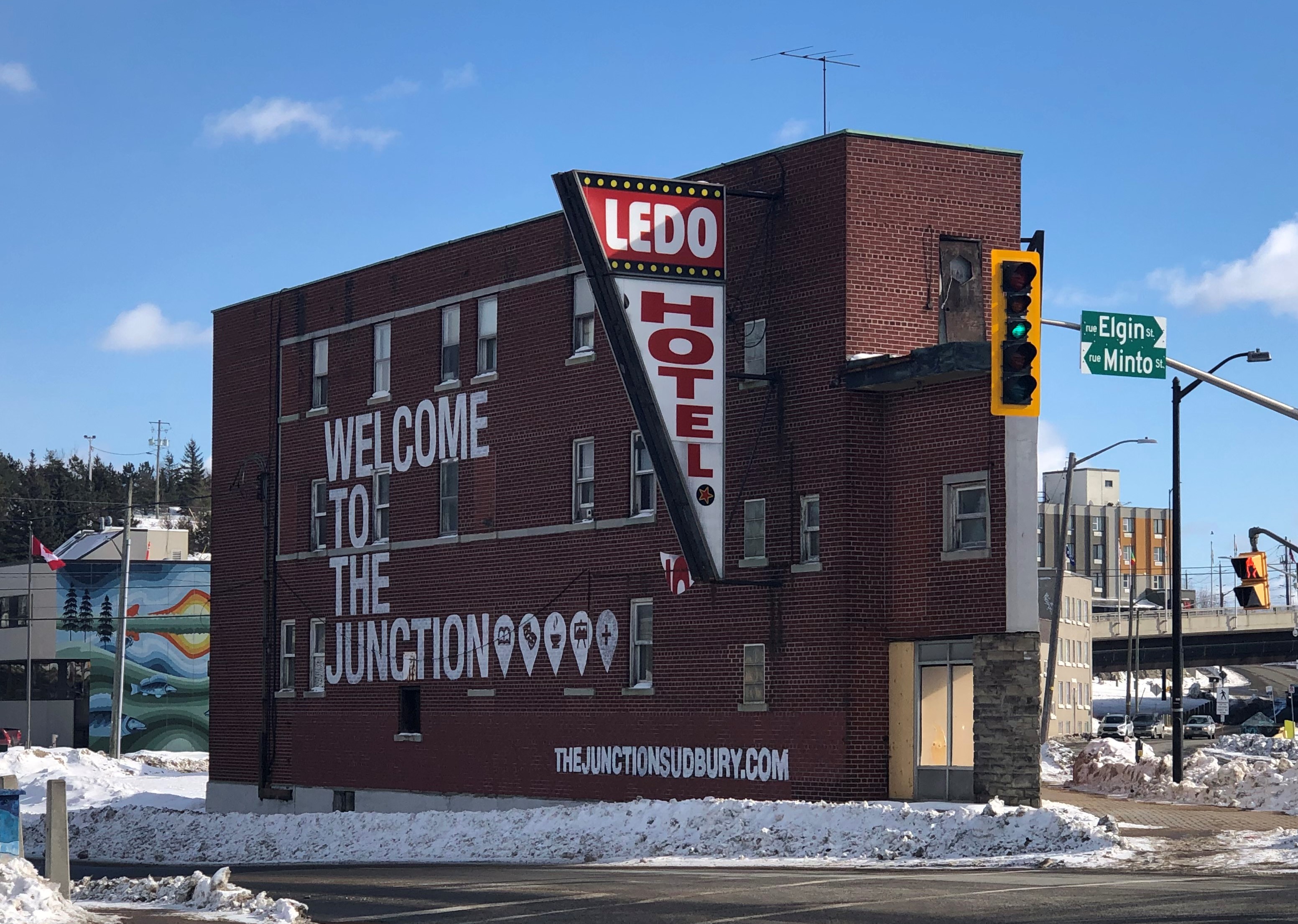
Ledo Hotel
The demolition crew arrived on January 8, 2024. Within weeks, the three-storey brick building at the triangulated intersection of Van Horne, Elgin, and Shaughnessy Streets -- where Sudbury's downtown meets the rail lines -- was gone. In its place: a parking lot. The Ledo Hotel had stood at that corner for more than a century, built when miners flooded into Northern Ontario and the Canadian Pacific Railway brought them through town by the thousands. Its story mirrors Sudbury's own arc -- boom, bust, reinvention, and the unanswerable question of what a city owes its oldest buildings when they become too expensive to save.
The Greek and the Flat-Iron
In 1910, P. Manolakos, a Greek immigrant in the Sudbury community, constructed a two-storey flat-iron building directly across from the old CPR train station, now the Sudbury station. The unusual triangular footprint followed the lot's shape at the junction of three streets, giving it the wedge profile that flat-iron buildings are named for. On the ground floor, Manolakos operated an ice cream and confectionery store alongside a restaurant, serving both locals and the steady stream of travelers arriving by rail. Large-scale mining was transforming Sudbury in the early 1900s, and the railways brought waves of workers through town. Demand for lodging grew, and a third storey was added to the building, which was renamed the Sudbury Hotel. For decades it anchored the corner, a landmark for anyone arriving by train. The original building was destroyed by fire in 1952, but a new structure rose on the same footprint, taking the name that would stick: the Ledo Hotel.
A Century at the Crossroads
The Ledo occupied a high-traffic site at the heart of downtown Sudbury, surrounded by restaurants, entertainment venues, local craft stores, tattoo parlors, and the Place des Arts. Across the street, trains still rolled through the station. The hotel changed hands and purposes over the decades, serving variously as a proper hotel, a rooming house, and apartment suites. Moses, one of its later operators, sold the building upon retirement in 1949. By 2007, the property and the adjacent Ledo Block had been purchased by George Soule, a Sudbury landlord who ran the Ledo as a rooming house rented on a monthly basis. But decades of deferred maintenance were catching up. Water leaked through the roof. Windows broke and were not replaced. Ground-floor doors were pried open and left that way. The building was deteriorating from the inside out, each year of neglect making the next year's repairs more expensive and less likely.
Condemned
In October 2020, the Sudbury Fire Marshal deemed the Ledo Hotel too dangerous for human occupation. The building was evacuated and the doors locked, but the damage continued. Wind and water worked on the exposed brick. The three-storey structure that had once welcomed miners, travelers, and railway workers stood vacant at one of the most visible intersections in downtown Sudbury, an unavoidable reminder of what happens when maintenance stops and ownership changes too many times. Proposals emerged to save the building. Developers eyed the Ledo Block's location along the proposed Elgin Street Greenway, a planned multi-use pathway that would buffer the rail lines from the downtown core. A thesis project proposed converting the Ledo into affordable housing with rehabilitation services for the homeless. Le Lido Inc. developed plans for the site. Community members formed a Best Option committee that argued the Ledo Block would be a better location for the McEwen School of Architecture than the chosen site at 85 Elm Street, citing advantages like distance from the rail lines and proximity to the arts district.
The Vote
None of the proposals prevailed. On June 13, 2023, the Greater Sudbury City Council voted to purchase the land and building for $900,000 and demolish the structure to create public parking. The decision crystallized the tension at the heart of downtown revitalization everywhere: the gap between a building's historical significance and the cost of bringing it back to code, between a community's desire for character and its need for functional infrastructure. Sudbury's downtown had been undergoing a rejuvenation in recent years -- the McEwen School of Architecture, the Place des Arts, the Elgin Street Greenway -- all part of a master plan to revitalize the once-bustling city center. The Ledo Hotel, despite its century of service and its prominent location, did not fit into that vision in its current state. The council determined that a parking lot serving the revitalized downtown was a better use of $900,000 than a building rehabilitation that would cost many times more.
What a Parking Lot Remembers
Demolition began on January 8, 2024. The flat-iron footprint that P. Manolakos had chosen in 1910 -- wedged between three streets across from the train station -- returned to open air for the first time in over a century. The Ledo was not a grand or architecturally distinguished building. It was an ordinary commercial block that did ordinary work: feeding travelers, housing workers, anchoring a corner. Its story matters because it is common. Across Northern Ontario, across small cities everywhere, buildings like the Ledo reach a tipping point where the cost of preservation exceeds the will to pay it. The Sudbury community debated the Ledo's fate for years, proposed creative reuses, and ultimately chose the practical path. What remains is a flat piece of asphalt at the junction of Van Horne, Elgin, and Shaughnessy Streets, in a downtown that is otherwise working hard to build itself back up.
From the Air
Located at 46.49°N, 80.99°W in downtown Greater Sudbury, Ontario. The site is at the triangulated intersection of Van Horne, Elgin, and Shaughnessy Streets, directly across from the Sudbury railway station. From the air, the distinctive triangular lot shape is visible adjacent to the CPR rail corridor that runs through downtown. Greater Sudbury Airport (CYSB) is approximately 15 km to the northeast. The Superstack (380 m tall) at the Vale smelter complex is the most prominent visual landmark in the area. Best viewed at 2,000-3,000 feet AGL to appreciate the downtown grid, the railway corridor, and the surrounding mining landscape of the Sudbury Basin.