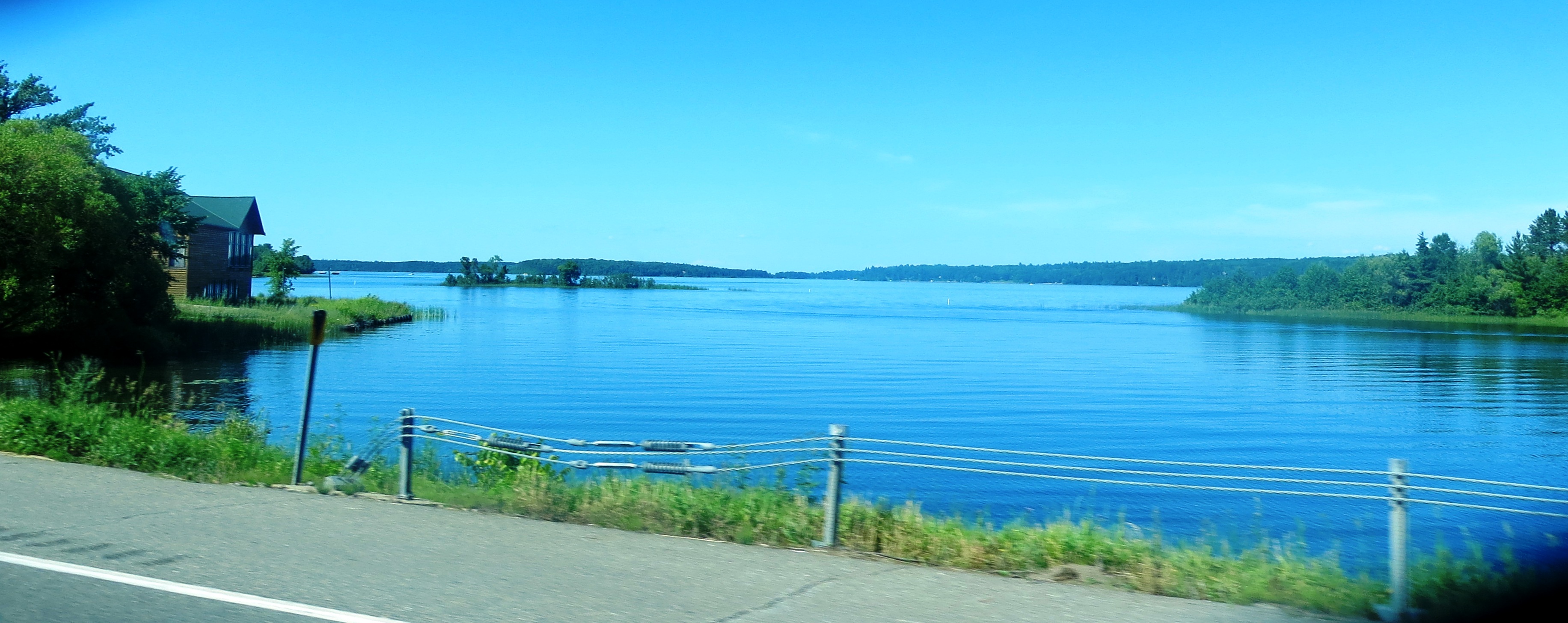
Leech Lake
The Ojibwe called it Gaa-zagaskwaajimekaag -- lake abundant with bloodsuckers. The leeches that inspired the name still inhabit the shallows, but the lake itself has proven far more generous than that translation suggests. Covering roughly 102,000 acres in north-central Minnesota with 195 miles of shoreline, Leech Lake is the state's third-largest body of water, a sprawling system of bays, narrows, and eleven islands spread across 1,617 acres of land. It sits entirely within the Chippewa National Forest and mostly within the Leech Lake Indian Reservation, fed by seven major rivers and creeks and drained by a single outlet -- the Leech Lake River, which flows into the Mississippi. The lake functions as a reservoir, its water levels regulated by a dam at the outlet. Wild rice emerges through more than 4,000 acres of its shallow waters, a crop the Ojibwe have harvested here for centuries.
The Battle Nobody Expected
On October 5, 1898, a detachment of the 3rd U.S. Infantry Regiment arrived at Sugar Point on the north shore of Leech Lake to arrest an Ojibwe man named Bug-O-Nay-Ge-Shig for bootlegging violations. The Leech Lake Band of Ojibwe had grievances far deeper than one man's arrest warrant -- years of broken treaties, timber theft, and forced relocations had pushed tensions to a breaking point. When a soldier accidentally discharged his rifle, a firefight erupted. By the time it ended, six soldiers lay dead and ten were wounded. The Ojibwe suffered one casualty. The Battle of Sugar Point is often called the last armed conflict between Native Americans and the U.S. military east of the Mississippi River. Private Oscar Burkard received the Medal of Honor on August 21, 1899, for his actions during the engagement -- though the battle's real legacy was forcing Washington to pay closer attention to conditions on the reservation.
When the Muskies Went Wild
In the summer of 1955, something extraordinary happened in Leech Lake's waters. Muskellunge -- the elusive, sharp-toothed predators that most anglers consider the ultimate freshwater trophy -- suddenly began biting with reckless abandon. Over a two-week period in July, hundreds of muskies were caught, many by fishermen who had never landed one before. The event became known as the Leech Lake Musky Rampage, and it thrust the lake into the national sporting spotlight. Biologists never fully explained the phenomenon, though theories ranged from unusual water temperatures to a population boom in forage fish. The rampage cemented Leech Lake's reputation as one of the premier musky waters in the upper Midwest. Today the lake still harbors muskellunge alongside walleye, northern pike, largemouth and smallmouth bass, black crappie, and yellow perch -- a diversity that keeps fishing resorts along the shoreline booked through the summer season.
Ice, Eelpout, and Black Ties
While summer draws the crowds, winter once revealed Leech Lake's most eccentric tradition. For forty years beginning in 1980, the International Eelpout Festival transformed the frozen lake into a carnival dedicated to one of freshwater fishing's least glamorous species. The eelpout -- also known as the burbot -- is a bottom-dwelling, eel-like fish that is rarely seen in warmer months but becomes plentiful when ice covers the lake and the fish move into shallow water to spawn. The festival featured a contest to catch the largest eelpout, alongside ice bowling and, improbably, a black-tie dinner held on the frozen surface. The event captured something essential about life in northern Minnesota: the refusal to surrender the outdoors to winter, and the ability to find celebration in the most unlikely places. Towns ringing the lake -- Walker, Federal Dam, Onigum, Whipholt, and others -- came alive during the festival, their populations swelling with visitors who braved subzero temperatures for the spectacle. The festival held its final edition in 2019, ending a forty-year run after rising costs and safety concerns proved insurmountable.
A Living Ecosystem Under Pressure
Beneath the surface, Leech Lake sustains an ecosystem shaped by both abundance and invasion. Wild rice, sacred to the Ojibwe and central to their diet and ceremony, grows across thousands of acres of shallow water. But the lake faces threats from invasive species. The narrow-leaf cattail, Typha angustifolia, has colonized shoreline areas, outcompeting the native broad-leaf cattail and disrupting habitat along the water's edge. Each plant can produce around two million seeds annually, spreading rapidly through the aquatic system. The lake's hydrology is complex: seven major inlets -- including the Boy River, Steamboat River, Shingobee River, and Benedict River -- feed its waters, while nine minor creeks contribute additional flow. The sole outlet through the Leech Lake River connects the system to the Mississippi watershed. Managing this balance between incoming water, regulated outflow, and ecological health remains an ongoing challenge for both tribal and state resource managers.
From the Air
Located at 47.156°N, 94.390°W at approximately 1,295 feet MSL in the Chippewa National Forest of north-central Minnesota. Leech Lake is the state's third-largest lake, covering roughly 102,000 acres with a distinctive irregular shape featuring Walker Bay, Agency Bay, and numerous peninsulas. The Narrows divides the lake into eastern and western sections. Eleven islands are visible from altitude, the largest being Bear Island. The town of Walker (KY49 - Walker Municipal Airport) sits on the western shore. Cass Lake is visible to the northwest, and Lake Winnibigoshish to the north-northeast. From 5,000-8,000 feet, the full extent of the lake and its relationship to the surrounding national forest is spectacular -- dark green pine canopy broken by the gleaming irregular shapes of hundreds of smaller lakes surrounding the main body of water.