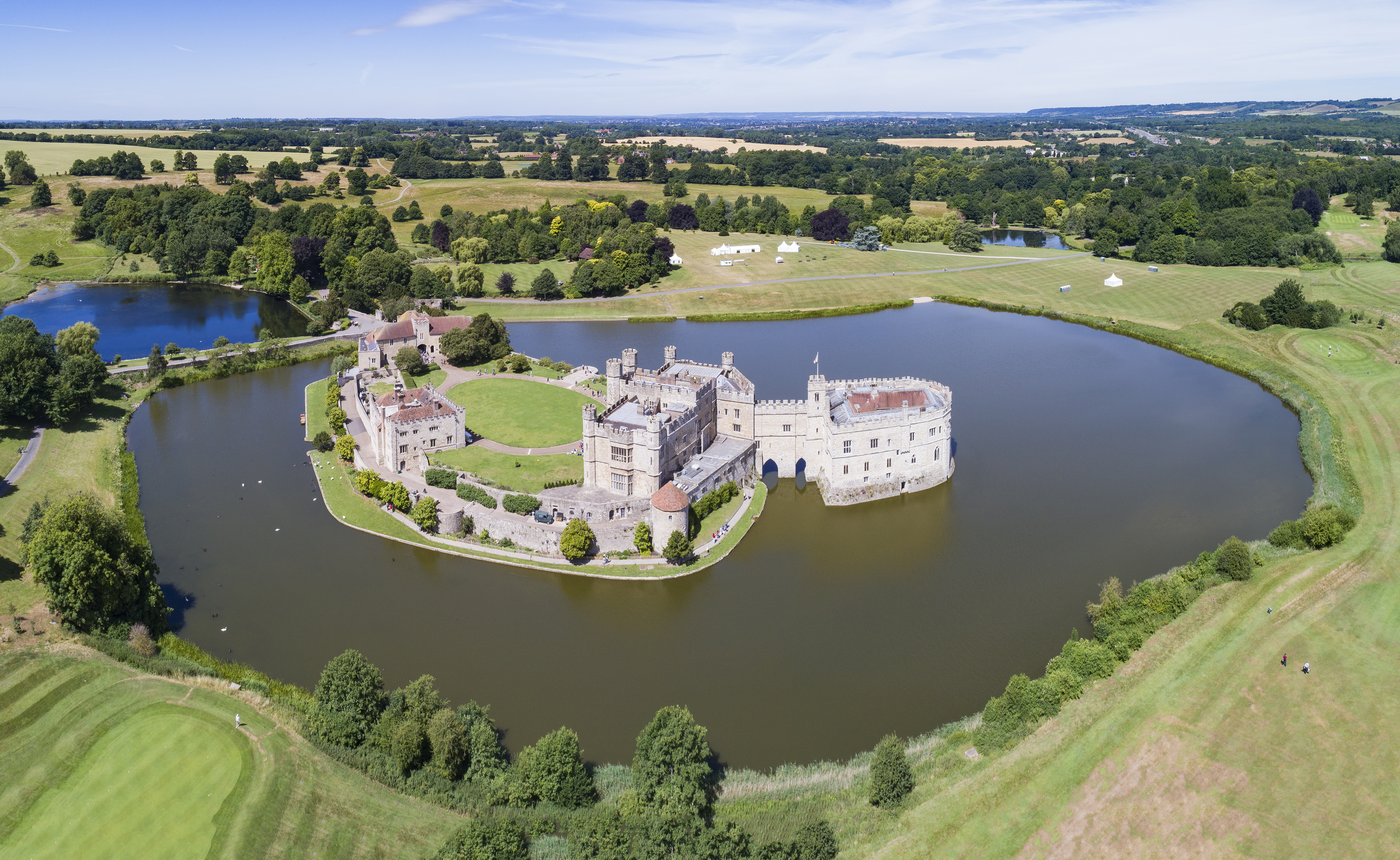
Leeds Castle
A castle has stood on this island in the River Len since 857, which makes Leeds Castle older than the Norman Conquest, older than the Domesday Book, older than England itself as a unified kingdom. What sets it apart from every other ancient fortress in Britain is not its age or its architecture but its improbable versatility. Over twelve centuries, Leeds Castle has been a royal residence for six medieval queens, a prison, a Civil War arsenal, a hospital for burned airmen, a venue for Middle East peace negotiations, and the home of what may be the world's only museum dedicated to dog collars.
The Queens' Castle
Leeds Castle became royal property in 1278 when Eleanor of Castile, queen of Edward I, acquired it through the purchase of a debt bond from Jewish moneylenders -- who were forced to sell at a steep discount thanks to her husband's own punishing tax policies. Edward transformed the site, probably creating the lake that now surrounds the castle and building a barbican that spans three islands. A gloriette with royal apartments was added, making Leeds one of the most lavish residences in medieval England. The castle became particularly associated with queens. After Edward II died in 1327, his widow Isabella of France took it as her primary residence. Anne of Bohemia, Richard II's first wife, spent the winter of 1381 here on her way to be married. Henry VIII remodeled it in 1519 for Catherine of Aragon. The pattern was not always gentle: in 1321, when Margaret de Clare refused to admit Queen Isabella, Lady Badlesmere ordered her archers to fire on the royal party. Six people were killed. Edward II besieged and captured the castle, and Lady Badlesmere was imprisoned in the Tower of London for a year.
War, Ruin, and Survival
Leeds Castle survived the English Civil War because its owner, Sir Cheney Culpeper, chose the winning side, supporting Parliament against the king. The castle served as both an arsenal and a prison during the conflict. Other branches of the Culpeper family were less pragmatic -- John Colepeper, 1st Baron Colepeper, backed the Royalists and was rewarded with vast land grants in Virginia. This transatlantic connection proved enduring. Thomas Fairfax, 6th Lord Fairfax of Cameron, was born at the castle in 1693 and later settled in colonial Virginia to manage the Culpeper estates. A sundial at Leeds Castle still tells the time in Belvoir, Virginia, and a corresponding sundial stands in America. The relationship between castle and colony, forged in the fires of civil war, outlasted the conflict itself by centuries.
Burned Airmen and Peace Talks
During the Second World War, the castle was converted into a hospital. Lady Baillie, who had purchased Leeds in 1926, hosted burned Commonwealth airmen as part of their recovery. Survivors of wartime injuries remembered the experience with remarkable fondness -- the beauty of the lake and grounds provided a kind of therapy that no clinical setting could replicate. The castle's role as a place of healing and diplomacy continued into the postwar era. On 17 July 1978, Egyptian Foreign Minister Muhammad Ibrahim Kamel, Israeli Foreign Minister Moshe Dayan, and US Secretary of State Cyrus Vance met at Leeds Castle in preparation for the Camp David Accords. The medieval fortress on its Kent island became, briefly, one of the most consequential diplomatic venues in the world.
The Loveliest Castle
Lady Baillie died in 1974 and left Leeds Castle to a private charitable foundation with a single mandate: preserve the castle and grounds for the public. The transition from private residence to public attraction required ingenuity. Furniture was sold to raise funds, corporate conferences were hosted to generate revenue, and the gardens were opened to visitors in 1975, followed by the castle itself the following year. Today, the estate draws more than half a million visitors annually. The grounds include a golf course, a maze of 2,400 yew trees designed to resemble a topiary castle, falconry displays, and the celebrated dog collar museum, whose collection spans five centuries. The castle's 12th-century core, altered and expanded across the medieval, Tudor, and modern periods, rises from its lake with a symmetry that has earned it a persistent nickname: 'the loveliest castle in the world.' Whether that title is deserved matters less than what it represents -- a place that has reinvented itself so many times that reinvention has become its defining quality.
From the Air
Located at 51.25N, 0.63E on an island in a lake formed by the River Len, approximately 7 nm southeast of Maidstone, Kent. The castle is distinctively visible from the air as a medieval structure surrounded by water in a landscaped parkland setting. Nearest airports: Rochester (EGTO), approximately 12 nm to the northwest; Headcorn (EGKH), approximately 8 nm to the southeast. Best viewed at 2,000-3,000 ft AGL.