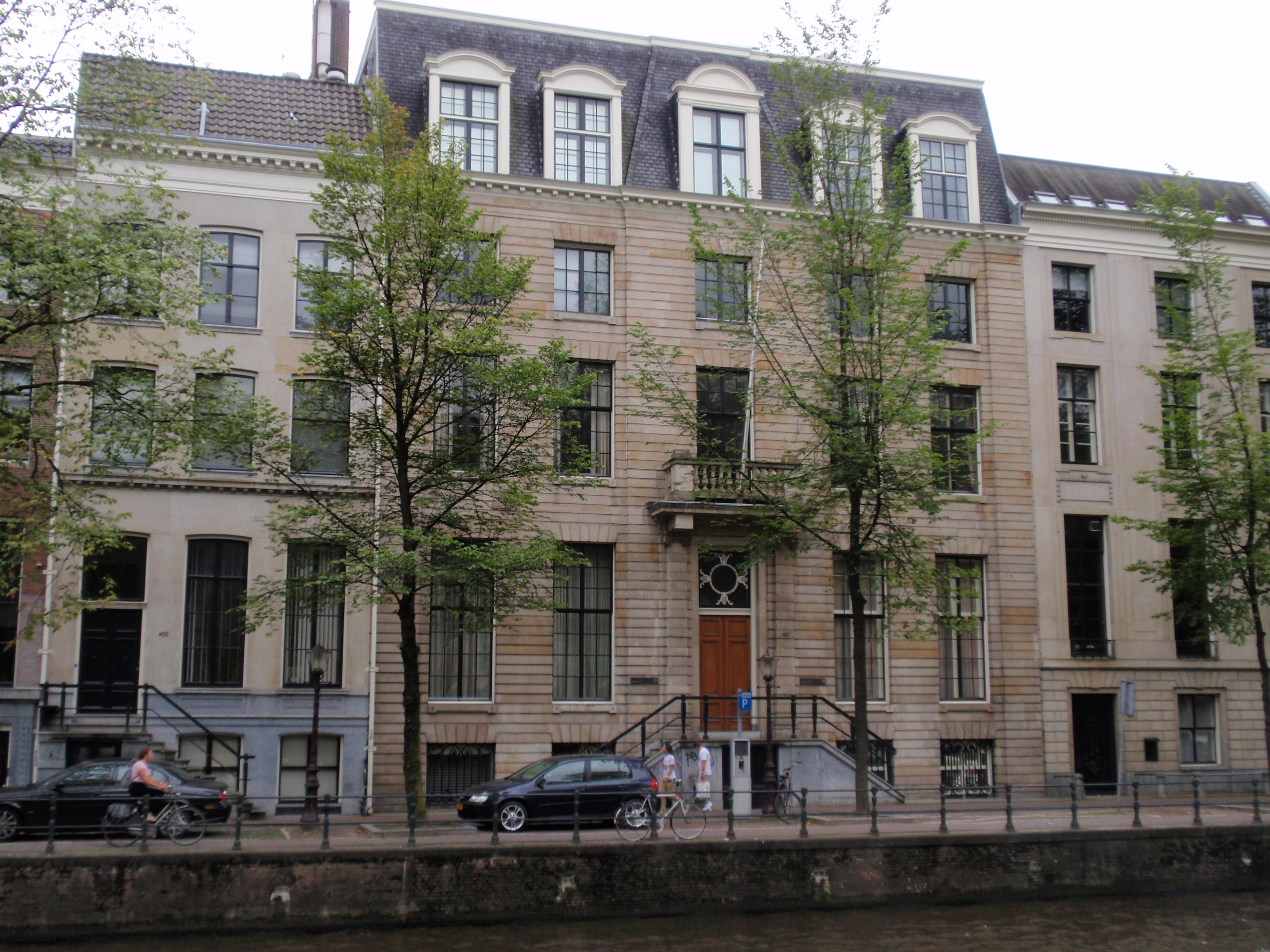
Leesmuseum voor Vrouwen
In 1877, an Amsterdam woman of the upper middle class who wanted to read in good company had nowhere to go. The Amsterdam Reading Museum, founded in 1800, took only men. The public libraries existed, but no respectable lady was supposed to use them. So eight women — among them the feminist Elise Haighton, the social worker Hendrina Commelin, and Wilhelmina Mercier-Meder, sister-in-law of the woman who founded social work in the Netherlands — pooled ten guilders apiece from eighty initial members, signed a charter, and opened the Leesmuseum voor Vrouwen. A reading museum, in nineteenth-century Dutch, did not mean a museum about reading. It meant a place where books and periodicals were kept and where members came to read them, talk about them, and lend them out. This one was for women only, because nowhere else was.
The Room They Built
The library started at Hartenstraat 20 in 1877 with eighty members. Word spread quickly. By 1897 there were 321 members. By 1913, more than a thousand women were registered. In 1899 the library could afford to hire a paid librarian — a small administrative milestone that the founders treated as a mark of arrival, because paid staff meant the institution was real. A second librarian followed. In 1900 the Leesmuseum moved into larger premises at Herengracht 450, on the grand inner canal, with space at last for a meeting room. Twenty-one years later it moved again, to P.C. Hooftstraat 148, across town near what is now the city's most expensive shopping street. The address changes track the rise of an institution that began as eight friends and ended up an Amsterdam fixture.
Who Got In
Membership was not for everyone. Candidates had to be at least sixteen (raised to eighteen after 1901), nominated by an existing member, and then approved by ballot. The membership skewed firmly upper-middle-class, which was both a financial necessity and a social filter. But the names that turn up on the rolls are striking: Helena Mercier, the social-work pioneer; Henriette van der Meij, editor of the feminist publication Belang en Recht; Jeltje de Bosch Kemper, one of the leading Dutch feminists of the late nineteenth century. The meeting room hosted Emilie Knappert speaking on religious education, the translator Margaretha Meijboom, the writer Augusta de Wit, and the actress Marie Kalff. A century before any Dutch university would feel modern about admitting women routinely, the Leesmuseum had built a parallel intellectual culture inside a single room.
The Aletta Jacobs Problem
Aletta Jacobs — the first woman to study medicine at a Dutch university, the country's most famous suffragist — declined to join. Her objection was practical: the Leesmuseum had no medical books, and she needed medical books. She kept pressing the original, male-only Amsterdam Reading Museum to admit her, and eventually they did. She became its only female member, and the small comedy that followed says everything about what the Leesmuseum was for. The men feared what their wives would think when they spent leisure hours in a reading room with another woman in it. Jacobs began receiving critical letters from those wives. The men were uncomfortable. The women were suspicious. One physician's quiet pursuit of medical journals had shown what happened when the door between worlds cracked open. Meanwhile, members of the Leesmuseum were taking their own kind of heat — accused of "neglecting their families" by reading at all.
Politics in the Reading Room
In 1898 the Dutch Women's Council was founded; the Leesmuseum joined as an institutional member shortly after. Reading was no longer just leisure. It was infrastructure. A women's library was, by definition, a place where ideas about the women's vote, women's education, women's work could circulate without male oversight. By the early twentieth century the Leesmuseum was part of a national network of women's organizations whose memberships overlapped and whose campaigns built on each other. The room at Herengracht 450 — and later at P.C. Hooftstraat — was both a polite ladies' library and a quiet political headquarters. Often the same thing.
The Long Closing
The Leesmuseum survived two world wars, the rise of universal women's suffrage in the Netherlands in 1919, the collapse of the world it had been built to work around. It also slowly lost its reason for existing. By the mid-twentieth century, Dutch women could borrow from any library, join any reading society, and read any book they wanted. The Leesmuseum closed in 1966, after eighty-nine years. There is no building plaque, no museum-of-the-museum at any of its three addresses today. What remains is in the city archives — minute books, membership rolls, library catalogs — and in the lives of the women who walked through its doors when no other door was open.
From the Air
Located at 52.3659 N, 4.8892 E in Amsterdam's central canal district. The Leesmuseum's three historical homes — Hartenstraat 20, Herengracht 450, and P.C. Hooftstraat 148 — all sit within a kilometer of one another. Nearest airport: Amsterdam Schiphol (EHAM/AMS), 14 km southwest. There is no surviving Leesmuseum institution at any of the addresses today.