Leiden Gunpowder Disaster
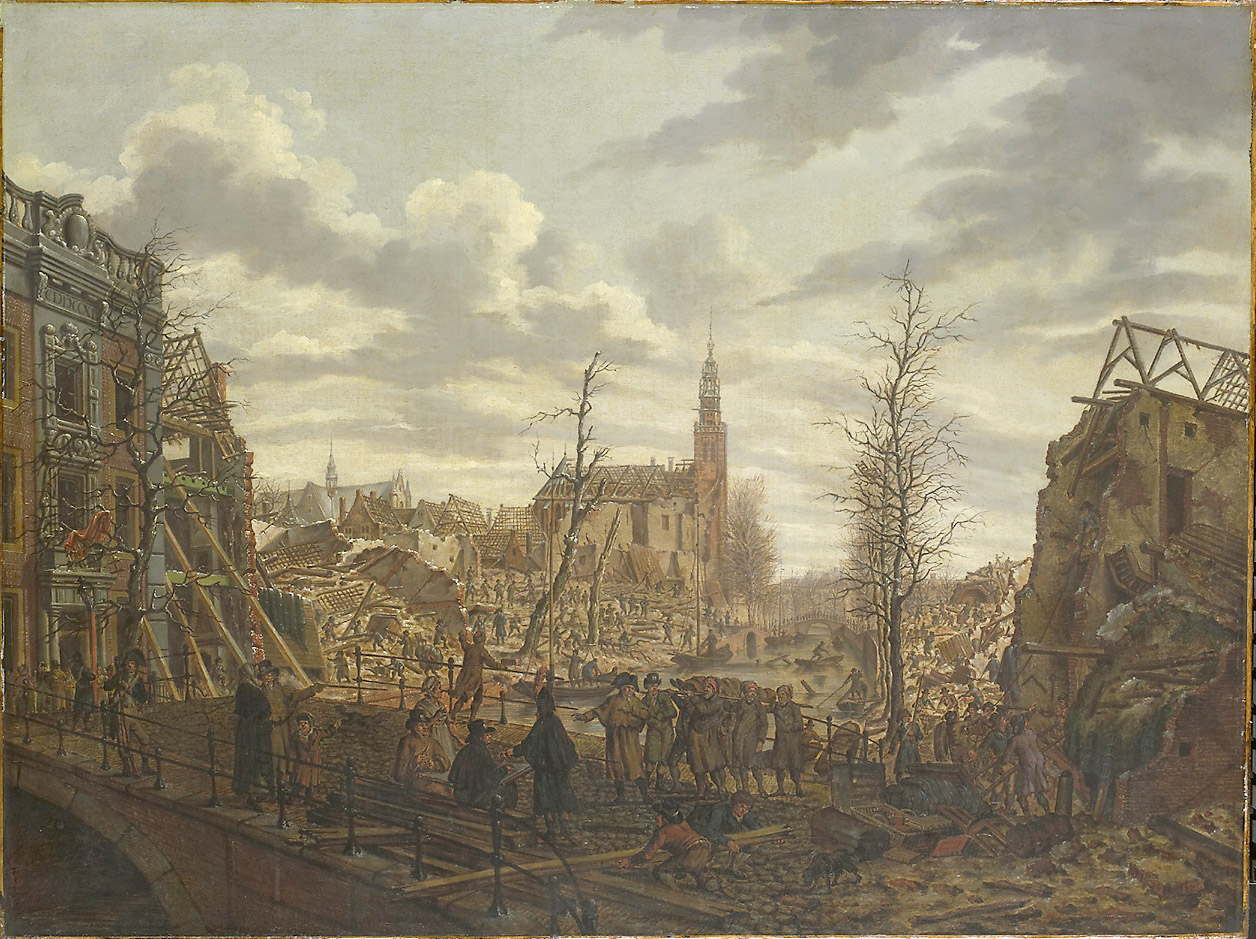
It was a quiet Monday afternoon in January, and the cook on the Delfs Welvaaren was peeling potatoes. Eyewitnesses saw the peelings go over the side at four in the afternoon. The crew was preparing fried fish and potatoes - a sailor's meal, modest and warm against the cold. Fifteen minutes later, the canal where the ship was moored, and the houses lining it on both sides for hundreds of meters, ceased to exist. One hundred and fifty-one people died, and a king who had ruled the Netherlands for less than a year stood weeping in the wreckage.
Why the Ship Was There
Holland in January 1807 was a satellite kingdom of Napoleon's France, ruled by his brother Louis Bonaparte. The British and the Fourth Coalition were preparing to invade. In December, the government had ordered the production of two hundred and fifty thousand pounds of black powder for the Dutch army's arsenal in Delft. The Delfs Welvaaren - 'Prosperity of Delft City' - was one of three civilian ships hired to carry the first load from Amsterdam south. Her captain, Adam van Schie, was an experienced powder carrier. He fell ill before the voyage and sent his two sons, Saloman and Adam, along with a servant named Jan van Engelen. The ship took on 369 hundred-pound barrels of black powder, each covered with horsehair sheets to smother any stray spark, and the hold was sealed by Amsterdam officials. By the time the other two ships finished loading, the Amsterdam canals had frozen. The Delfs Welvaaren sailed on alone.
Moored at the Steenschuur
She arrived in Leiden on 10 January. The two van Schie brothers had a sister in town and planned to spend the weekend with her - but Saloman had hurt his back or his leg and stayed aboard. On the morning of 12 January, word came that the rest of the convoy was iced in. The crew moved the Delfs Welvaaren from her original mooring to the Steenschuur, a canal that ran through some of the wealthiest streets in Leiden. They tied up next to the homes of professors, merchants, prominent families. Adam walked back from his sister's house in the afternoon. Around four o'clock, Saloman stood on deck talking down to the other two in the hold. The cook tipped peelings over the side. The smell of frying fish drifted up out of the hold and across the canal.
Four-Fifteen
A canal dredger working a hundred meters away later described what he saw: a small first explosion that lifted the mast and threw the hatches off the deck, and then a heartbeat of silence, and then a second blast that disintegrated the ship and everything around her. The anchor was found nine hundred meters away. The lead counterbalance landed three hundred meters distant. Two thousand buildings were damaged. Over two hundred were destroyed outright. Every tall structure in Leiden - including the Hooglandse Kerk and the Pieterskerk - took serious damage. Thousands of windows shattered across the city. For days, residents reported streets ankle-deep in glass and roof shingles. The 151 people killed were children walking home from school, women in upstairs rooms, families at the supper table, the men working the canal, the three crew on board. They were neighbors, not statistics.
The King Who Came to Help
Louis Bonaparte was twenty-eight, an unwilling king his brother had installed against his preferences, and not particularly loved by his French handlers because he kept trying to actually govern in his subjects' interest. When the news from Leiden reached him in The Hague, he came immediately - and stayed. He walked through the wreckage. He visited the wounded. He emptied his personal funds into the relief effort and pushed for state support beyond what Napoleon thought appropriate. The Dutch remembered. When Napoleon finally forced his brother to abdicate in 1810 and annexed the Netherlands outright, it was Louis's response to the Leiden disaster, more than any policy, that the country mourned. He had behaved, briefly and visibly, like a king who belonged to his people.
What the Investigation Found, Then and Now
Newspapers in the days after the blast blamed the absent captain Adam van Schie, falsely reporting he had walked below decks with a lit pipe. The story collapsed when he was found alive and well, eating in his own tavern in Delft. The official investigation concluded the cooking fire had ignited the powder. Two centuries later, in the early 2000s, Dutch historians took another look. The hold had been sealed and fireproofed. Eyewitnesses had reported two separate explosions, suggesting a single barrel went off first. The crewmen had been talking through the hatch shortly before the blast. The historians' conclusion: the crew had been trying to pry open a barrel to skim some gunpowder for themselves - a small theft, common enough on cargo runs - and the friction or a spark set it off.
The Park Where the City Was
Leiden's city records had not been kept current. The most recent surviving plans dated to the 1670s. When the time came to rebuild, many homeowners could only describe their lost houses from memory. The destroyed neighborhood sat empty for over a decade. In the 1820s, the city converted a portion of the cleared ground into a park, the Van der Werfpark, named for the mayor who had refused to surrender during the 1574 siege. Where families had eaten supper on a Monday afternoon, trees grew. The park is still there, a quiet rectangle in central Leiden whose grass and lindens mark the outline of an absence.
From the Air
The site of the 1807 disaster lies along the Steenschuur and Rapenburg canals in central Leiden at 52.156°N, 4.491°E. The Van der Werfpark, occupying part of the cleared blast zone, is visible from the air as a rare green rectangle in the otherwise tightly packed historic core. Recommended viewing altitude is 1,500-3,000 ft AGL. Nearest airports: Rotterdam The Hague (EHRD) about 15 nm south, Schiphol (EHAM) about 16 nm northeast. Check Schiphol TMA altitude restrictions before approach.