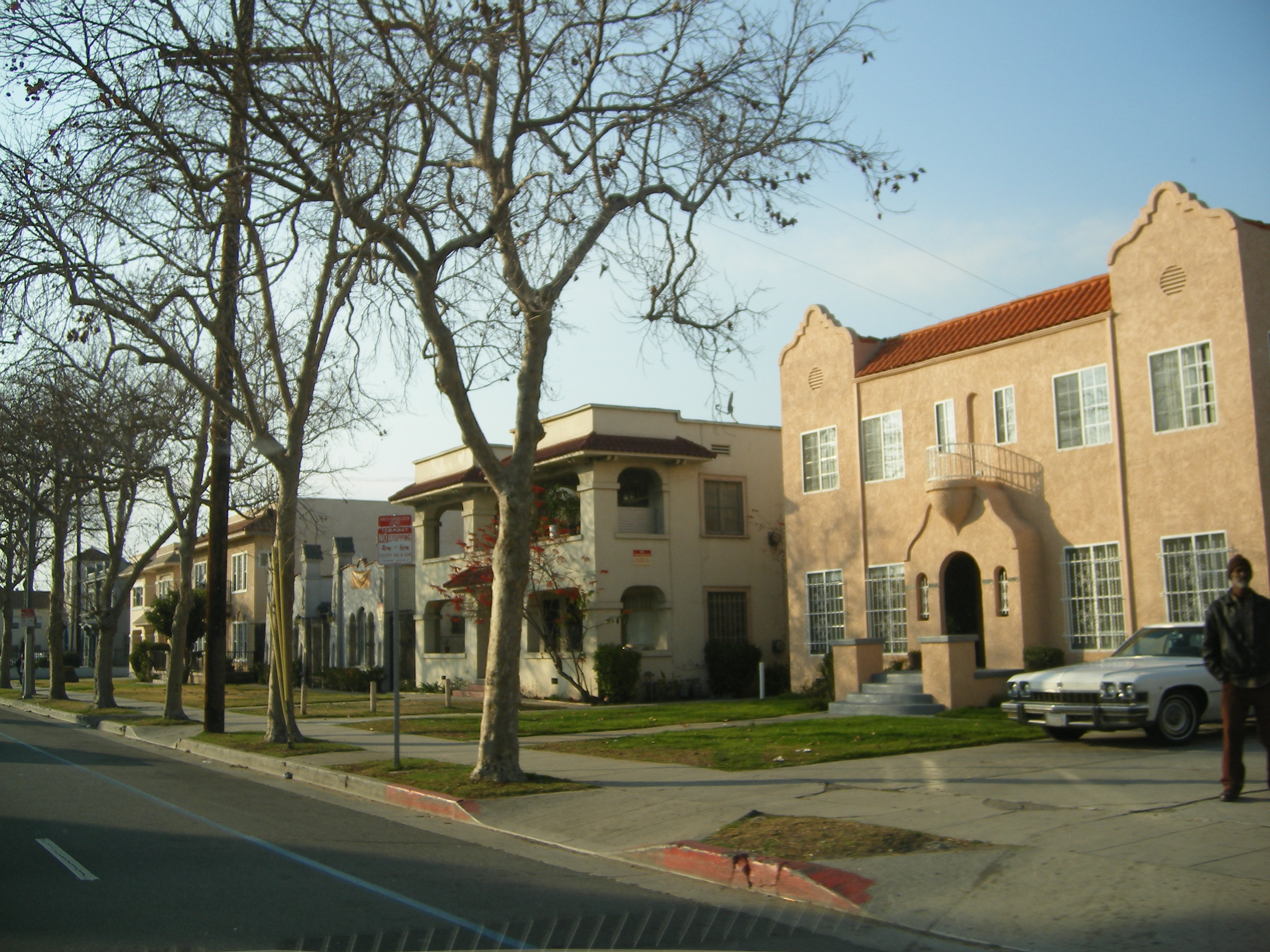
Leimert Park
There is a reason people call Leimert Park the cultural heartbeat of Black Los Angeles. The neighborhood was literally designed with that possibility in mind — not the Black part, which the original developers worked to prevent, but the cultural part. The bones were put there in 1928 by landscape architects who understood how to make a place worth gathering in. What the community built on top of those bones is the actual story.
Designed by the Olmsteds
Walter H. Leimert developed the neighborhood in 1928 and commissioned the Olmsted Brothers — sons of Frederick Law Olmsted, the designer of Central Park — to create the master plan. The plan centered on Leimert Park Plaza, a small circular park where the angled streets converge, and gave the neighborhood a spatial coherence unusual in the gridded sprawl of Los Angeles.
The development was built as a restricted white suburb. Like much of Southern California's mid-century development, it used racial covenants to exclude Black and Jewish buyers. The Supreme Court's 1948 Shelley v. Kraemer decision made such covenants unenforceable, and over the following decades Leimert Park transitioned into one of the primary residential destinations for the African American community that was building itself in Los Angeles.
Jazz, Blues, and the Village
By the 1980s and 1990s, the commercial district around Leimert Park Plaza had developed into what journalists and residents called the Leimert Park Village — a cluster of jazz clubs, art galleries, African import shops, and cultural organizations that had no real equivalent anywhere else in the city.
The Vision Theatre, a 1931 movie house that the city of Los Angeles eventually took over and renovated, anchored the cultural programming. The World Stage performance gallery, founded by drummer and poet Billy Higgins and poet Kamau Daaood, became a center for jazz performance and education. Babe's and Ricky's Inn, a blues club on Crenshaw, drew musicians and listeners for decades.
Ray Charles lived nearby. Ella Fitzgerald had roots in the area. Tom Bradley, the first Black mayor of Los Angeles, represented the district as a city councilman before his mayoral tenure.
Project Blowed and the Hip Hop Tradition
In 1994, an open mic night called Project Blowed began at the Good Life Café on Exposition Boulevard, just at the edge of the Leimert Park neighborhood. It became the world's longest-running hip hop open mic event, a weekly gathering that incubated a style of independent, lyrically dense underground rap that became its own genre — sometimes called the "Project Blowed sound" — and influenced artists nationally and internationally.
The Leimert Park hip hop tradition was built on what the jazz and blues generations had established: the idea that this particular corner of Los Angeles was a place where Black artists came to be heard, challenged, supported, and taken seriously. That continuity — from bebop to blues to hip hop — is one of the things that gives the neighborhood its particular weight.
The K Line and the Future
In October 2022, the Metro K Line opened with a station at Leimert Park, connecting the neighborhood to downtown Los Angeles and the broader transit network for the first time. The arrival of transit infrastructure that the neighborhood had lacked for a century was welcome and complicated in equal measure.
Welcome because transit access matters — it means Leimert Park is reachable from more of the city, that its businesses and cultural institutions are accessible to people who don't drive or can't park. Complicated because transit investment in Los Angeles has historically preceded gentrification, and Leimert Park's affordability and its predominantly Black character are already under pressure from surrounding markets.
The neighborhood has been named by the city as a cultural district, and preservation efforts are underway to protect the institutions and character of the Village. Whether those efforts succeed in the face of market pressure will determine whether Leimert Park remains what it has been for seventy years, or becomes one more Los Angeles neighborhood that people remember as something it used to be.
From the Air
Leimert Park is located in the Crenshaw District of South Los Angeles, roughly bounded by Crenshaw Boulevard to the west, Vernon Avenue to the south, and 43rd Place to the north. The distinctive wedge-shaped street pattern around Leimert Park Plaza is visible from the air. The Metro K Line runs north-south along Crenshaw Boulevard through the neighborhood.