The Governor Who Arrived by Rowboat
On January 10, 1862, Leland Stanford climbed into a rowboat to attend his own inauguration as governor of California. The Sacramento River had swallowed the capital. Streets ran like canals. And Stanford's handsome two-story home on N Street sat in the middle of it all, its first floor submerged, its elegant parlors ruined by muddy floodwater. Most men would have abandoned the house. Stanford, railroad baron and colossal ambition personified, decided to pick it up instead.
A House Built Twice
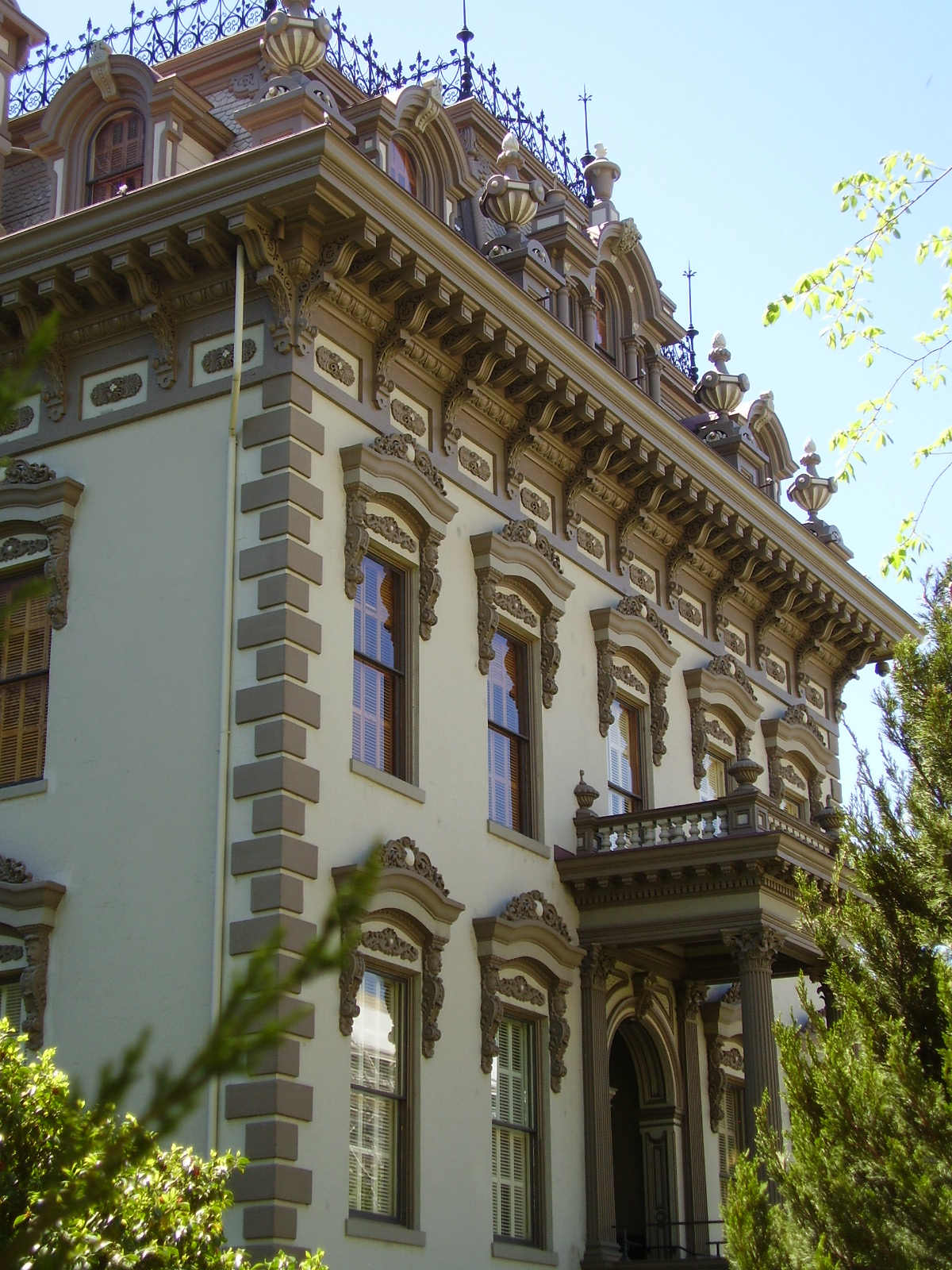
The home began modestly enough. Sacramento merchant Shelton C. Fogus built it in 1856 as a Renaissance Revival residence, designed by architect Seth Babson, who would go on to design the E.B. Crocker residence now part of the Crocker Art Museum. Stanford purchased it for $8,000 in June 1861, just months before winning the governorship. For two years it served as the state's executive office and living quarters, and his successors -- governors Frederick Low and Henry Huntly Haight -- would govern from the same rooms. But the floods of 1862 had exposed a fatal vulnerability. Between 1871 and 1872, Stanford ordered the entire house raised twelve feet above its original foundation. Workers jacked up the existing structure, built a new first floor beneath it, and added a fourth story on top. The home ballooned from 4,000 to 19,000 square feet and was reskinned in the French Second Empire style, complete with a fashionable Mansard roof. The original two-story house now sat sandwiched between the floors that ambition added above and necessity demanded below.
The Tycoon's Parlor
Understanding the mansion requires understanding the man. Stanford was not merely a governor. As president of the Central Pacific Railroad, he was one of the Big Four tycoons who hammered the transcontinental railroad across the Sierra Nevada and changed the geometry of a continent. The mansion on N Street was where politics and industry converged -- where a governor who also commanded one of the most powerful corporations in American history conducted both kinds of business under the same Mansard roof. When Stanford died in 1893, his widow Jane Lathrop Stanford continued to manage the estate. She had already co-founded Stanford University in memory of their son, Leland Jr., who died of typhoid fever at fifteen. The mansion in Sacramento, magnificent as it was, had become a monument to a family that was running out of members to fill its rooms.
Orphans in the Governor's Bedroom
In 1900, Jane Stanford donated the home to the Roman Catholic Diocese of Sacramento. The Sisters of Mercy transformed the railroad baron's palace into the Stanford and Lathrop Memorial Home for Friendless Children -- an orphanage whose name alone carries the weight of its era. Where governors had strategized and tycoons had dined, children now slept in rows. In 1932, the Sisters of Social Service took over, converting the orphanage into a residence for dependent high school girls. A fire in 1940 damaged the fourth floor, scarring the Mansard roof that Stanford had installed to announce his arrival among California's elite. The mansion was designated a California Historical Landmark in 1957, an acknowledgment that whatever its current use, the building mattered. But recognition did not equal rescue. The house continued to serve its quiet, institutional purpose, its grandeur fading behind institutional paint and practical renovations.
Fourteen Years Back to 1872
California acquired the property in 1978, and in 1987, the National Park Service declared it a National Historic Landmark. Then came the real work. Beginning in 1991, the mansion underwent a fourteen-year, $22 million restoration guided by an extraordinary archive: photographs taken by Alfred A. Hart in 1868 and by Eadweard Muybridge in 1872, plus detailed drawings from an 1986 Historic American Buildings Survey. Sacramento businessman Peter McCuen, a former Stanford University professor, helped drive the effort. Room by room, the mansion was returned to its 1872 appearance -- the high-water mark of the Stanford era, when the house was freshly raised, freshly expanded, and freshly styled in the imperial fashion of Napoleon III's Paris. When the doors finally opened to the public in September 2005, California had something it had lacked for nearly forty years: a ceremonial home worthy of hosting foreign leaders and official functions.
Still Governing
Today the Leland Stanford Mansion serves as the state's official reception center for visiting dignitaries and world leaders. The governor maintains an office inside. Daily tours guide visitors through rooms restored to a precision that borders on obsessive -- wallpaper patterns matched to Muybridge's photographs, moldings replicated from Hart's stereo views. The gardens and visitor center are fully accessible, with elevators to the upper floors and a tactile model of the mansion in the lobby. From the air, the building is a compact rectangle on Sacramento's grid, its dark Mansard roof a period piece among the flat-topped government buildings that surround it. It is easy to miss. But this is a house that has been a merchant's home, a governor's office, a railroad baron's showpiece, an orphanage, a girls' residence, and a state park -- and it still has a governor walking its halls. Few buildings in California have been asked to be so many things, and fewer still have survived the asking.
From the Air
Located at 38.576N, 121.498W at 800 N Street in downtown Sacramento, two blocks north of the Capitol building. Sacramento Executive Airport (KSAC) lies approximately 3nm south. Sacramento International (KSMF) is 10nm northwest. The mansion's distinctive dark Mansard roof is visible amid the grid of downtown Sacramento from 2,000-3,000 feet AGL. The Sacramento River runs just west of downtown, the same river whose floods prompted the mansion's dramatic raising in the 1870s.