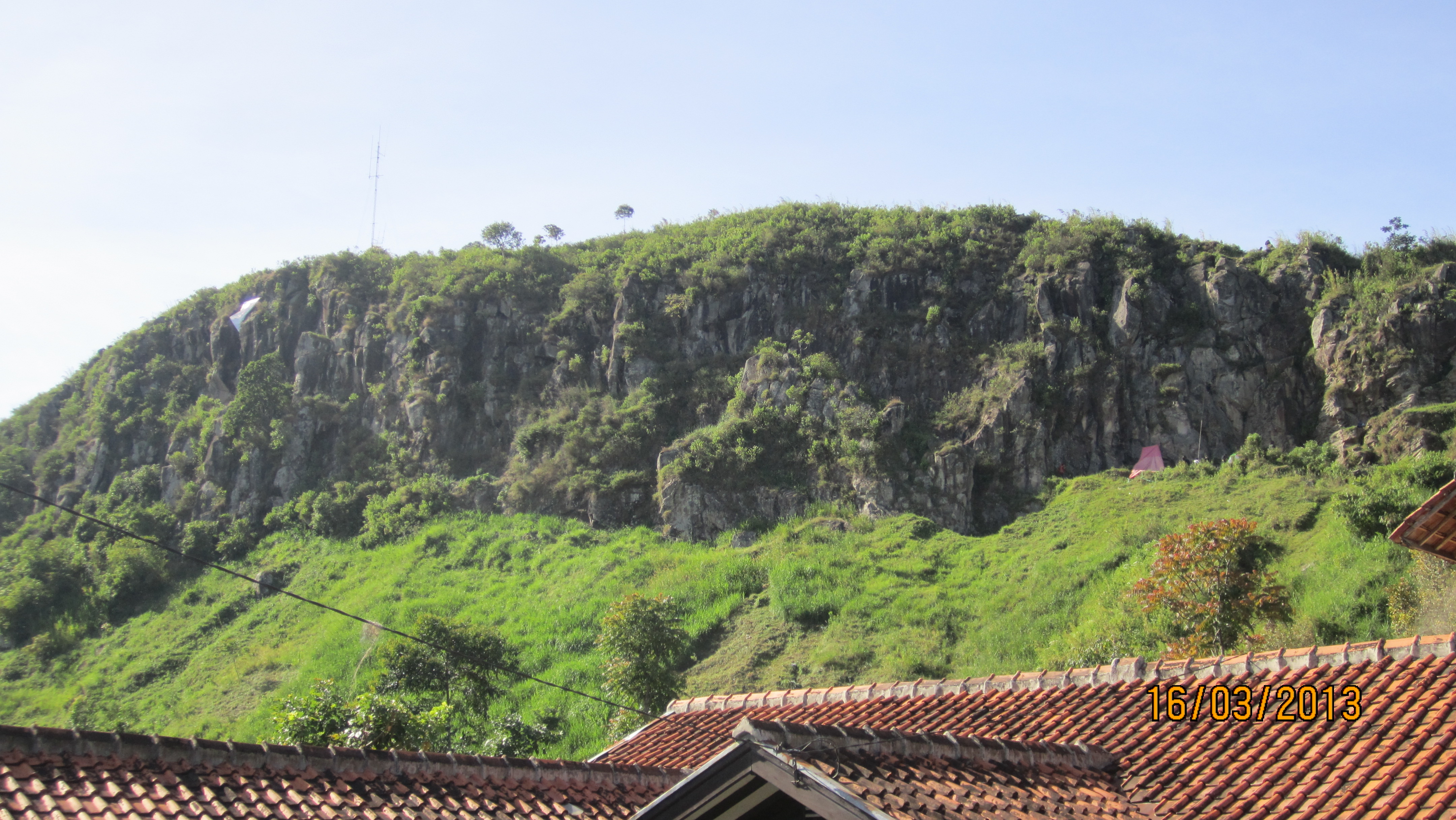
The Sleeping Fracture Beneath Bandung
No one alive has felt the Lembang Fault move. That is not reassuring -- it is terrifying. Running 29 kilometers through the hills 10 kilometers north of Bandung on the Indonesian island of Java, this sinistral slip fault sits beneath tea plantations, hot springs resorts, and the expanding suburbs of a metropolitan area home to millions. Paleoseismic trenching has revealed that the fault has ruptured before, repeatedly, with enough force to reshape the landscape. The question seismologists are asking is not whether it will rupture again, but when -- and whether the city below is ready.
Written in the Trench Walls
The Lembang Fault kept its secrets until scientists started digging. A 2019 paleoseismic study -- published in the journal Tectonophysics -- cut trenches across the fault trace and found evidence of three major earthquakes buried in the sediment layers. The most recent struck during the 15th century, another between 2300 and 60 BCE, and the oldest dates to roughly 19,620-19,140 years before present. These events suggest a recurrence interval of 170 to 670 years. The 15th-century earthquake, the youngest confirmed rupture, occurred more than 500 years ago. By the fault's own rhythm, another event falls within the plausible window. What makes the Lembang Fault particularly dangerous is not just its capacity -- estimated at magnitude 6.5 to 7.0 -- but its proximity. The fault runs directly through populated areas on the northern fringe of one of Indonesia's largest cities.
The Damage Scenario
Indonesian disaster modeling puts the potential consequences in stark terms. A major earthquake on the Lembang Fault could cause an estimated 51 trillion Indonesian rupiah -- approximately $3.5 billion -- in damage, a figure that would exceed the economic impact of the 2004 Indian Ocean earthquake and tsunami on Indonesian infrastructure. Around 2.5 million homes would be affected: one million lightly damaged, another million seriously damaged, and roughly 500,000 collapsed entirely. An estimated four million people would be displaced from their homes. The human toll could reach 180,000 injured and 80,000 killed. These numbers reflect the fault's shallow depth and its position directly beneath dense urban and suburban development -- the kind of geometry that concentrates seismic energy where it does the most harm.
Listening for the First Tremor
Indonesia's Meteorology, Climatology and Geophysics Agency, known by its Indonesian acronym BMKG, has taken the threat seriously enough to build a dedicated monitoring network around the fault. In 2019, the agency announced the installation of 22 seismic monitoring devices along the fault trace, designed to detect even minor movements and provide early warning data. The challenge is considerable. Unlike faults that produce frequent small earthquakes -- offering seismologists a constant stream of data -- the Lembang Fault has been essentially silent throughout Indonesia's modern instrumental record. This silence complicates hazard assessment. Active faults that do not produce small quakes can still store enormous strain energy, releasing it all at once in a single catastrophic event. The monitoring network aims to catch the subtle signals that might precede such a rupture: changes in microseismicity, ground deformation, or stress patterns along the fault plane.
Living Above the Line
From the air, the Lembang Fault is invisible. The hills north of Bandung look like any other stretch of the West Java highlands -- volcanic slopes terraced with tea, dotted with resort hotels, creased by roads climbing toward the crater of Tangkuban Perahu. The town of Lembang itself sits directly on the fault trace, a popular weekend escape for Bandung residents drawn by cooler temperatures and mountain scenery. Development has accelerated in recent decades, pushing housing and commercial construction across terrain that seismologists have flagged as high-risk. Indonesia, more than most nations, understands earthquakes. The archipelago straddles multiple tectonic plate boundaries, and destructive quakes are a regular feature of life from Sumatra to Papua. But that familiarity has not always translated into effective building codes or land-use planning, particularly in areas where the seismic threat comes not from distant subduction zones but from a local fault running silently beneath the neighborhood.
From the Air
Located at 6.83°S, 107.64°E in the highlands north of Bandung, West Java, Indonesia. The fault runs roughly east-west for 29 km through the Lembang area on the northern slopes below Tangkuban Perahu volcano. The fault trace itself is not visible from the air, but the linear escarpment and change in terrain elevation along the fault line may be discernible at lower altitudes. Nearest major airport is Husein Sastranegara International Airport (WICC) in Bandung, approximately 15 km to the south. The densely developed Bandung basin to the south provides visual context for the seismic risk. Best viewed at 8,000-12,000 ft for the regional geological context.