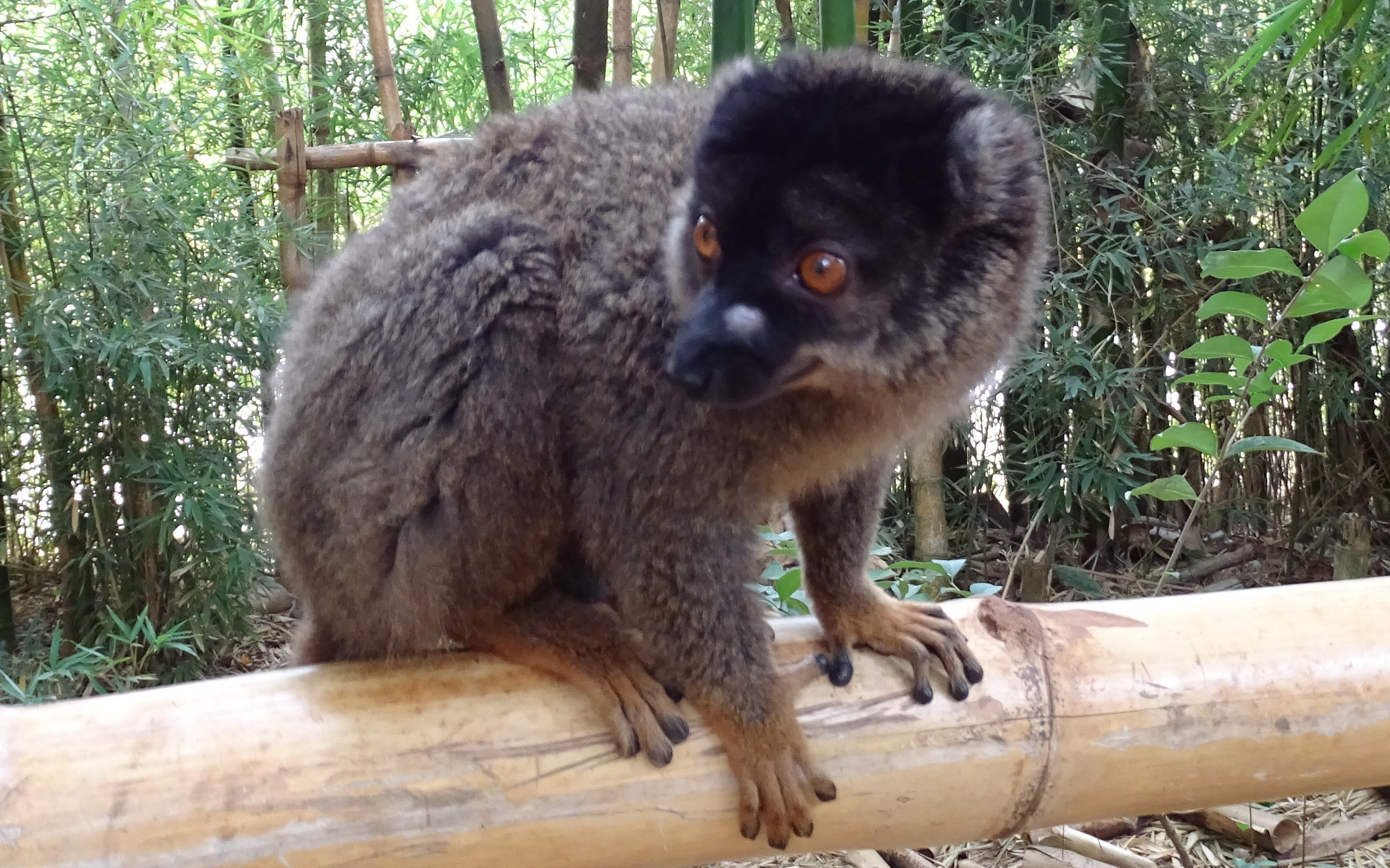
Lemurs' Park
Most of the lemurs at this park were once somebody's pet. Confiscated by Madagascar's Ministry of Water and Forests, they were brought to a five-hectare patch of pine forest and bamboo along the Katsaoka River, 22 kilometers southwest of Antananarivo, to learn how to be wild again. Lemurs' Park was founded around 2000 by Laurent Amouric and Maxime Allorge, the latter a grandson of Pierre Boiteau, who established the Tsimbazaza Zoo in the capital. It is a small place with an outsized purpose: rehabilitating captive lemurs, breeding endangered species, and giving schoolchildren from the surrounding communities their first encounter with free-ranging primates.
Second Chances in Pine and Bamboo
Nine lemur species live within the park, seven active during the day and two nocturnal. Most arrived as confiscated pets, animals that had been kept in homes and lost the skills needed for survival in the wild. The park's staff work to rehabilitate these lemurs and gradually reintroduce captive-born animals into natural habitats. Since 2007, Lemurs' Park has successfully bred Coquerel's sifakas, one of the more charismatic and endangered species, a quiet achievement that speaks to the quality of care in a facility that could easily be dismissed as a tourist attraction. Featured feeding times occur every two hours between 10 a.m. and 4 p.m., when visitors can watch the free-ranging lemurs interact at close quarters. The park also maintains a vivarium housing chameleons, radiated tortoises, iguanas, and other reptiles.
Six Thousand Trees
The botanical side of Lemurs' Park is substantial. Nearly 6,000 trees and more than 70 endemic plant species fill the grounds, organized into separate climatic zones that represent Madagascar's ecological diversity. Saplings of baobabs and other endemic plants from the spiny thickets of southern Madagascar have been transported to the park and planted alongside rosewood, Terminalia, and amontana trees. This is not just landscaping. Madagascar has lost the vast majority of its original forest cover, and every surviving patch of endemic vegetation, even a small cultivated one, contributes to the genetic reservoir that reforestation depends on. The park sits between the villages of Fenoarivo and Imerintsiatosika along Route Nationale 1, positioned where the capital's urban sprawl begins to thin into the countryside.
Thirty-Seven Thousand Students
Between December 2008 and May 2013, approximately 37,163 students and 1,270 teachers from public primary schools around Antananarivo visited Lemurs' Park to plant native trees and participate in environmental education. For many of these children, the visit was their first time seeing free-ranging lemurs. That number matters in a country where deforestation has made lemurs increasingly rare outside of protected areas, and where the urban population has limited access to the natural heritage their island is famous for. The reforestation program, supported by Colas Madagascar and Total Madagascar, has planted more than 11,000 trees as of 2013. The corporate partnership has also helped the park retain its staff during economic downturns, with over 90 percent of employees drawn from the surrounding communities. Conservation in Madagascar often depends on these kinds of pragmatic alliances between international companies, local institutions, and the communities that live closest to the forests.
A Short Drive from the Capital
Lemurs' Park is open year-round, seven days a week, and does not require advance booking for walk-in visitors. A park shuttle departs from the heart of Antananarivo at Analakely at 9 a.m. and 2 p.m., with the shuttle fare including park admission. Guided tours are mandatory, and stays are limited to 90 minutes, a constraint that keeps foot traffic manageable in a small space. The park has a restaurant, though it requires 48-hour advance booking. The accessibility is the point. Madagascar's most famous wildlife reserves, places like Andasibe-Mantadia or Ranomafana, require hours or days of travel from the capital. Lemurs' Park puts the experience of walking among free-ranging lemurs within reach of anyone with a morning to spare. That proximity to Antananarivo, home to more than two million people, makes it as much an educational institution as a conservation one.
From the Air
Located at 18.95S, 47.36E, just 22 km southwest of Antananarivo along Route Nationale 1. The park sits between the villages of Fenoarivo and Imerintsiatosika next to the Katsaoka River. Nearest airport is Ivato International Airport (FMMI) in Antananarivo. From the air, the park's five hectares of forest along the river are visible as a green patch amid the agricultural landscape of the central highlands. Recommended viewing altitude: 2,000-4,000 ft AGL.