Leningrad Hero City Obelisk
On 6 November 1983, in a quarry near Vyborg, a controlled explosion separated a single 2,200-tonne piece of grey granite from its source. The color had been chosen with care: it matched the grey of a Soviet soldier's overcoat. The monolith was hauled to Leningrad, finished and polished on site, and on Victory Day 1985 it was raised in Vosstaniya Square as the Leningrad Hero City Obelisk. The monument stands 36 meters tall, weighs 750 tonnes with its base, and was dedicated to a single 872-day siege that killed more than a million civilians. Behind every meter of polished granite are the people who didn't make it, the residents of Leningrad who starved, froze and died under German shelling between September 1941 and January 1944.
872 Days
The German army reached the outskirts of Leningrad on 8 September 1941. They didn't take the city. They surrounded it instead, cutting the rail lines and the roads, and tried to starve it into surrender. The siege lasted 872 days. By the time Soviet forces broke it open in January 1944, more than one million inhabitants of Leningrad had died from starvation, exposure and German shelling. Three hundred thousand soldiers had been killed in the defense and the relief of the city. The bread ration during the worst winter of 1941-1942 fell to 125 grams per person per day, less than a slice. People ate sawdust, boiled leather, the wallpaper paste from their own walls. Diaries from the siege describe families burning furniture for warmth, then floorboards, then doors, while parents watched children die. Some of those diaries, like the one kept by 11-year-old Tanya Savicheva, survive.
The Road of Life
Through the worst of the siege, one supply route remained: across the frozen surface of Lake Ladoga to the east. Trucks moved at night to avoid German aircraft, on ice that sometimes cracked beneath them. Drivers kept their cab doors open so they could jump out if the truck went through. The Road of Life, as it was called, brought food in and evacuated civilians out. About 1.5 million people were evacuated across Ladoga during the siege; an estimated 700,000 of them died from the conditions of the journey. In summer the route ran by boat. In the worst weeks of winter, when the ice was uncertain and the German air attacks heaviest, the city was effectively alone. Each truck that made it across, each child who reached the eastern shore alive, was a small refusal to let the city die.
First City to Be Called Hero
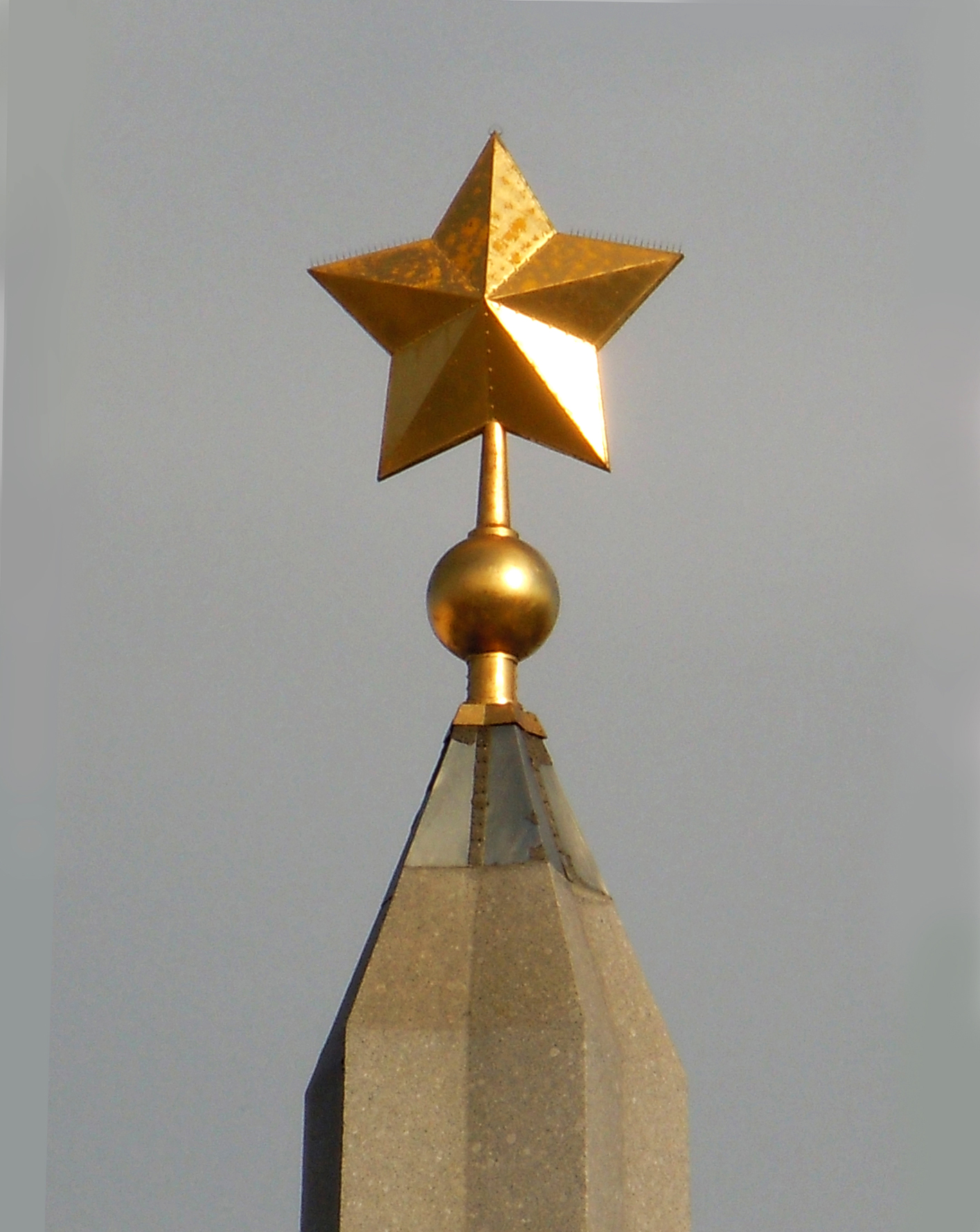
In 1945 Leningrad was awarded the title Hero City, the first city to receive that designation. The honor was eventually extended to twelve other Soviet cities that had endured catastrophic battles, including Stalingrad, Sevastopol, Kyiv and Brest. But Leningrad was first. The 36-meter obelisk that finally rose in 1985, on the 40th anniversary of victory, was designed by architects Vladimir Lukyanov and A. I. Alymov. Its cross-section is pentahedral, a five-pointed star in profile, encircled near the base with a bronze wreath. Bronze high-relief panels around the lower portion show scenes from the siege defense. A stainless-steel gold star, 1.8 meters in diameter, sits at the top. After the Alexander Column on Palace Square, the Leningrad Hero City Obelisk is the highest stone monument in Saint Petersburg.
Vosstaniya Square
The square where the obelisk stands sits at the eastern end of Nevsky Prospekt, in front of the Moskovsky Railway Station, the busiest train station in the city. Most travelers arriving by rail from Moscow walk out into Vosstaniya Square and see the obelisk first. The placement was deliberate: a granite welcome that tells you, before you reach the city center, what this city had endured. Vosstaniya means uprising, the square named for the February Revolution of 1917, so the obelisk also stands at a site already heavy with Soviet history. Choosing grey granite from the Vyborg quarry, the same region just to the northwest where some of the siege's hardest fighting took place, gave the monument a geographic specificity. The stone came from the same ground the soldiers had defended.
Numbers, Faces
More than one million civilians is the official figure, though some historians put the toll higher. The number is too large to picture clearly, which is the difficulty with sieges: the dead become a statistic, the suffering compressed into a phrase like during the blockade. The bronze reliefs on the obelisk try to put faces back: defenders, mothers, wounded soldiers, factory workers. The square in front of the obelisk fills every 9 May with veterans and families carrying portraits of grandparents who lived through the siege or didn't. Saint Petersburg, which dropped the name Leningrad in 1991, kept the title Hero City. The obelisk kept its name too. To stand in front of it on a winter evening, when the cold has the same edge it had in 1942, is to feel in the body for one moment what the city remembers in stone.
From the Air
The Leningrad Hero City Obelisk stands at 59.931 degrees north, 30.362 degrees east, in Vosstaniya Square at the eastern end of Nevsky Prospekt in central Saint Petersburg. From altitude, look for the open square in front of the long-roofed Moskovsky Railway Station, with the obelisk's slender vertical mass rising at the square's center. Pulkovo Airport (ULLI) lies 17 km south. The obelisk is best identified at 1,500 to 3,000 feet, when its 36-meter height casts a recognizable shadow across the surrounding plaza.