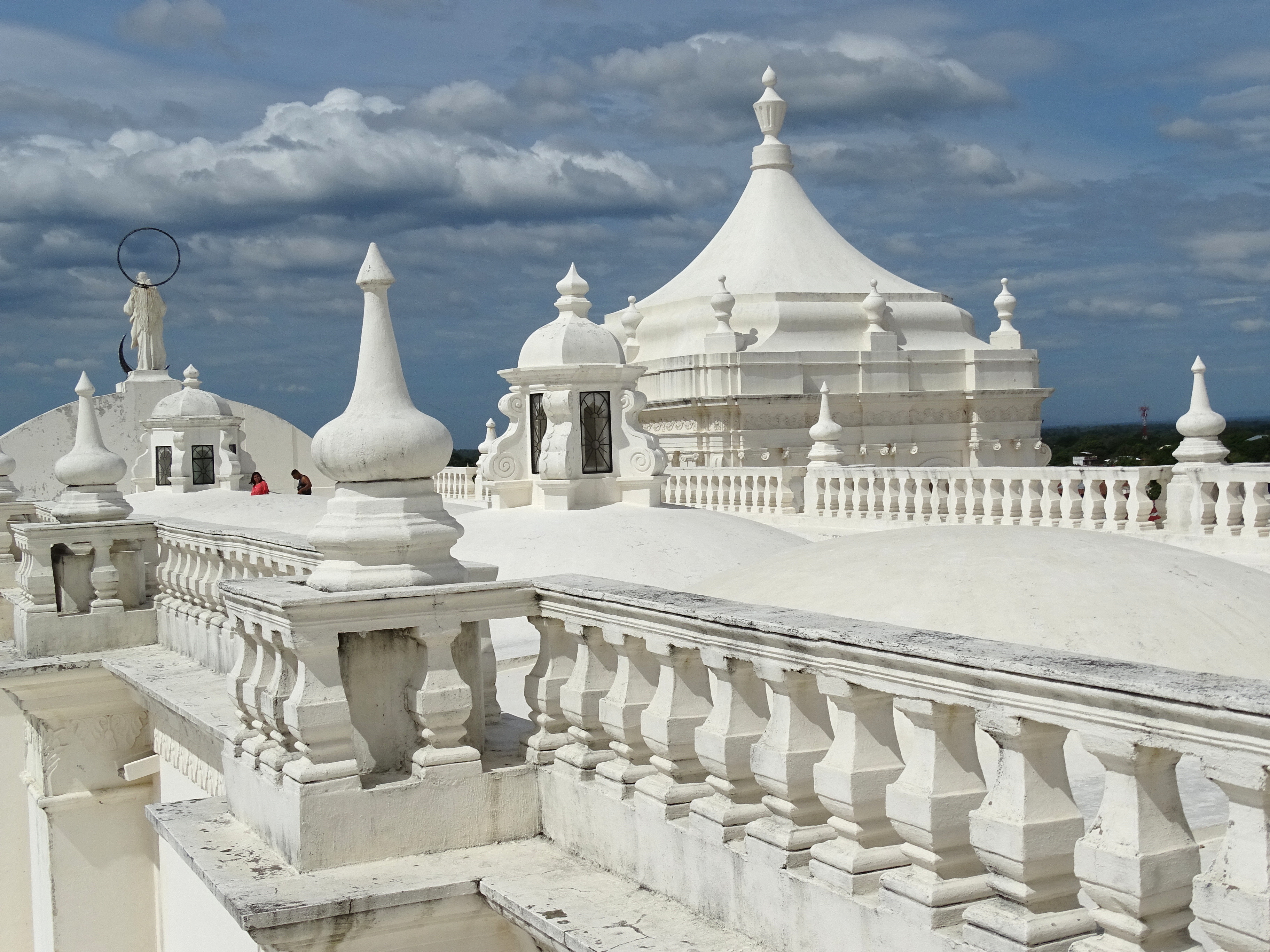
Leon Cathedral, Nicaragua
Seven tunnels run beneath the Cathedral of the Assumption in Leon, Nicaragua. Each one leads to a different church in the city. Nobody is entirely sure why they were built -- defense, escape, or some pragmatic consideration lost to the centuries -- but their existence hints at the ambition of a building that took 67 years to complete and outlasted everything that tried to destroy it. Earthquakes, volcanic eruptions from nearby Cerro Negro, and wars have all failed to bring down walls that Guatemalan architect Diego Jose de Porres Esquivel designed in 1762 to be, above all else, robust. UNESCO granted it World Heritage status, Nicaragua's third cultural landmark after the ruins of Leon Viejo and the satirical drama El Gueguense.
Sixty-Seven Years of Stone
Construction began in 1747 and was not completed until 1814. Pope Pius IX consecrated the cathedral in 1860. In an era when many colonial churches were modest affairs, the Cathedral of the Assumption was built to the scale of cathedrals in Lima and Cuzco -- a rectangular plan with a nave and four aisles, ten arched bays, and two towers flanking a central round pediment. Porres Esquivel blended Baroque and Neoclassical styles with traces of Gothic, Renaissance, and Mudejar influence, creating what architectural historians categorize as Eclecticism. The facade, elevated on a terrace, combines Baroque ornamentation with Neoclassical restraint. The towers are capped with Chinese domes. Inside, cruciform columns divide the central nave from the lateral aisles, and a great dome crowns the crossing. The result is the largest cathedral in Central America, a distinction it has held since the nineteenth century.
The Poets Below
Beneath the cathedral, in crypts engineered to survive the earthquakes that constantly threaten this region, the remains of 27 people rest. Among them are 10 bishops, 5 priests, a leader of the independence movement, three poets, a musician, six civic notables, and one enslaved person. The most famous occupant is Ruben Dario, father of the Modernist movement in Spanish-language literature, honored during his lifetime as the Prince of Castilian Letters. His tomb lies at the foot of a statue of Saint Paul, guarded by a sculpted lion that the Granadan artist Jorge Navas Cordonero modeled after the Lion of Lucerne in Switzerland. Also buried here are poets Salomon de la Selva and Alfonso Cortes, and the musician Jose de la Cruz Mena. Independence figure Miguel Larreynaga, whose face appears on Nicaraguan currency, rests in the same crypts. The cathedral is not merely a place of worship -- it is a national mausoleum.
A Sculptor's Commission
At the turn of the twentieth century, Bishop Simon Pereira y Castellon -- the same cleric who would preside over Dario's funeral on February 13, 1916 -- commissioned Navas Cordonero to decorate the cathedral's interior and exterior. Cordonero carved the statue of the Virgin Mary that crowns the central pediment, the Atlantes figures positioned between the pediment and the towers, and Neoclassical statues of the Twelve Apostles flanking the columns of the central nave. His lion at Dario's tomb became one of the cathedral's most recognized elements. Inside, the cathedral holds a Flemish altar and fourteen paintings of the Stations of the Cross by Nicaraguan artist Antonio Sarria. UNESCO noted the building's sobriety of interior decoration alongside its abundance of natural light -- a combination that lets the artwork breathe rather than compete with gilded excess.
Built to Endure
Leon sits in one of Central America's most seismically active corridors. Cerro Negro, the youngest volcano in the region, last erupted in 1999, and the broader Maribios volcanic chain has been burying and shaking the area for centuries. The cathedral's survival through all of this is no accident. Its walls are enormously thick, designed to absorb lateral forces that would topple a lighter structure. The crypts beneath the nave were specifically engineered for earthquake resistance. When UNESCO evaluated the building, they described a structure that expresses the transition from Baroque to Neoclassical architecture -- but they might equally have described a fortress disguised as a church. The diocese it houses, founded in 1531, is one of the oldest in the Americas. Five centuries of faith and geology have tested it. The walls hold.
From the Air
Located at 12.43N, 86.88W in the heart of the colonial city of Leon, Nicaragua. The cathedral's white facade and twin towers are visible from altitude against the surrounding low-rise cityscape. Leon sits on a flat plain northwest of Lake Managua, with the Maribios volcanic chain visible to the north and east. Cerro Negro volcano is approximately 20 km to the northeast. Nearest airport: Augusto C. Sandino International (MNMG) in Managua, approximately 50 nm southeast.