Leon Trotsky House Museum
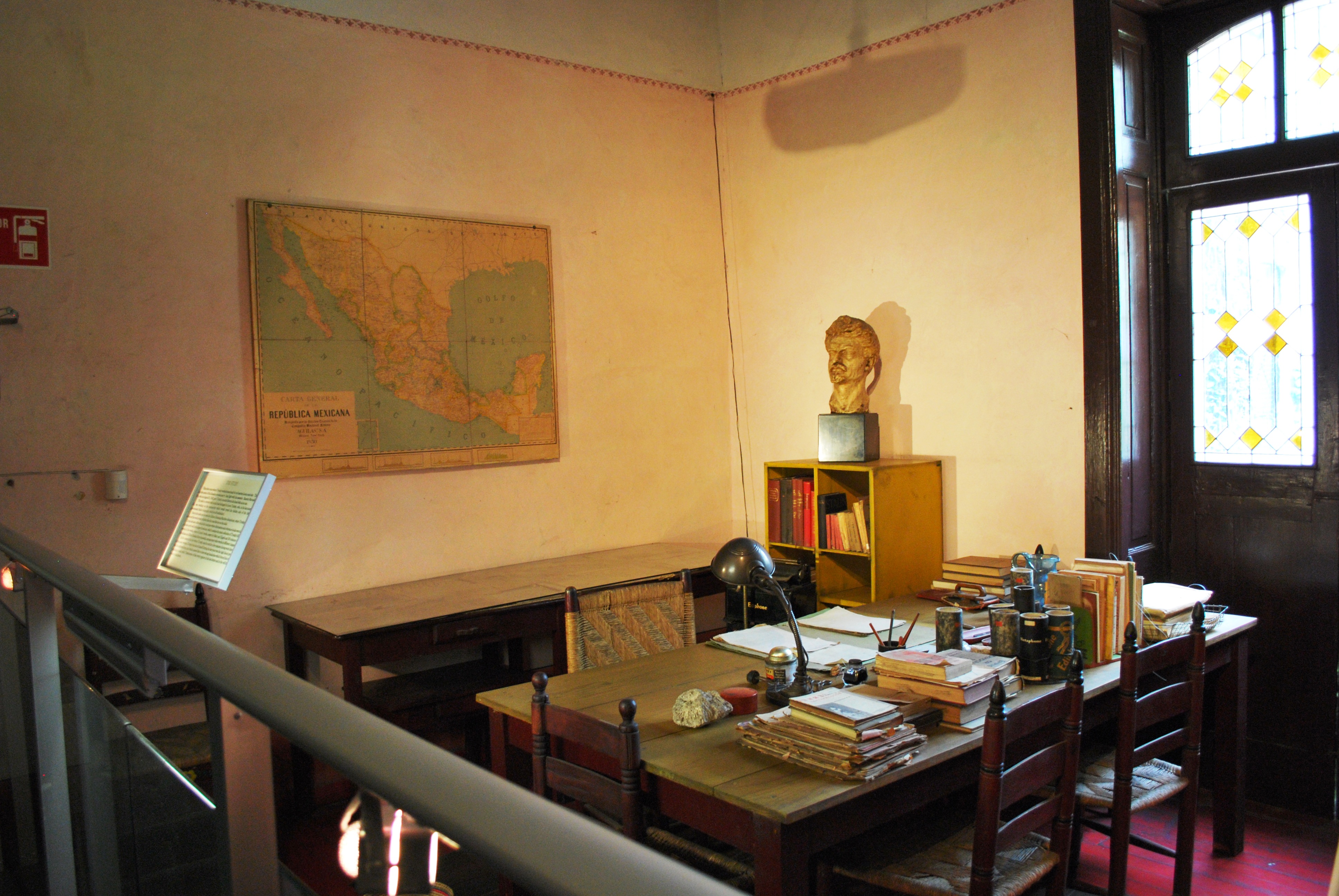
The ice axe is still there. Not the original, but in the study where it happened, the desk remains as Leon Trotsky left it on August 20, 1940 -- papers scattered, books open, a life interrupted mid-sentence. The Leon Trotsky House Museum in Mexico City's Coyoacan neighborhood is not a grand memorial. It is a modest house with high walls and guard towers, a place that looks more like a small fortress than a home. That is because, by the end, it was both.
The Blue House and the Falling Out
Trotsky arrived in Mexico in January 1937, granted asylum by President Lazaro Cardenas after being expelled from the Soviet Union, then from France, then from Norway. His first home was La Casa Azul, the famous Blue House of Frida Kahlo and Diego Rivera, who had championed his cause. For two years, the arrangement held. Then it collapsed. The reasons are disputed -- some accounts point to ideological disagreements between Rivera and Trotsky, others to a rumored affair between Trotsky and Frida, and still others to some combination. Whatever the cause, by April 1939 the Trotskys had moved to a house on nearby Viena Street, accompanied by Trotsky's second wife, Natalia Sedova, and eventually his grandson, Esteban Volkov, who joined them in August 1939.
Machine Guns at Midnight
On May 24, 1940, a group led by NKVD agent Iosif Grigulevich and the Mexican muralist David Alfaro Siqueiros -- one of the most famous painters in the country -- arrived at the house disguised as police officers. They overpowered the guards, set up machine guns in the inner courtyard, and opened fire on the bedrooms. The Trotskys survived by diving under furniture. Young Esteban Volkov was wounded in the foot. Robert Sheldon Harte, a bodyguard, was abducted and later murdered. The attack failed to kill its target, but it transformed the house. The high concrete walls and watchtowers that give the property its fortress-like appearance today were built in direct response to that night. Three months later, the walls would prove insufficient against a single man with an ice axe.
August 20, 1940
Ramon Mercader had spent months cultivating a cover identity as a Belgian businessman sympathetic to Trotsky's politics. On August 20, he arrived at the house carrying a concealed ice axe beneath his raincoat. In the study, while Trotsky reviewed a manuscript Mercader had brought, Mercader struck him in the back of the head. Trotsky fought back, biting Mercader's hand and struggling with him before guards rushed in. He was taken to a hospital, where he survived surgery but died the following day from blood loss and shock. Mercader was arrested, convicted, and spent twenty years in a Mexican prison. Upon his release in 1960, he reportedly made his way to Moscow, where the Soviet government awarded him the Order of Lenin.
A House Frozen in Time
Walking through the museum today feels less like visiting an exhibit and more like trespassing. The rooms are preserved as they were in 1940 -- Trotsky's books on the shelves, personal effects on the nightstands, bullet holes still visible from the Siqueiros attack. La Jornada newspaper described the atmosphere as "real, tense, not with abundance and not always happy." In the garden, a simple stele marks the spot where Trotsky and Sedova's ashes are interred beneath the Soviet hammer and sickle he spent his final years opposing. A former handball court behind the house has been converted into the Rafael Galvan library, which holds over 6,000 volumes on social sciences and politics, along with an auditorium and gallery space. The complex was declared a historic monument in 1982.
Asylum as Mission
The museum's official name is the Instituto del Derecho de Asilo -- the Right of Asylum Institute. This is deliberate. Trotsky's story is inseparable from the question of political refuge: a man expelled from country after country who found safety, however briefly, in Mexico. The institution that now bears his name works to promote the principle that made his final years possible. Located on a quiet residential street in Coyoacan, just a short walk from Frida Kahlo's Blue House, the museum draws visitors who come for the history and leave thinking about the fragility of sanctuary. The address is Rio Churubusco 410, and the neighborhood around it has changed far less than you might expect.
From the Air
Located at 19.3577N, 99.1596W in the Coyoacan borough of southern Mexico City. From the air, the property is identifiable by its walled compound in a residential neighborhood near the Rio Churubusco. Nearest major airport is Mexico City International (MMMX/MEX), approximately 12 km northeast. Chapultepec Park and the historic center are visible to the northwest. Best viewed at 2,000-3,000 ft AGL.