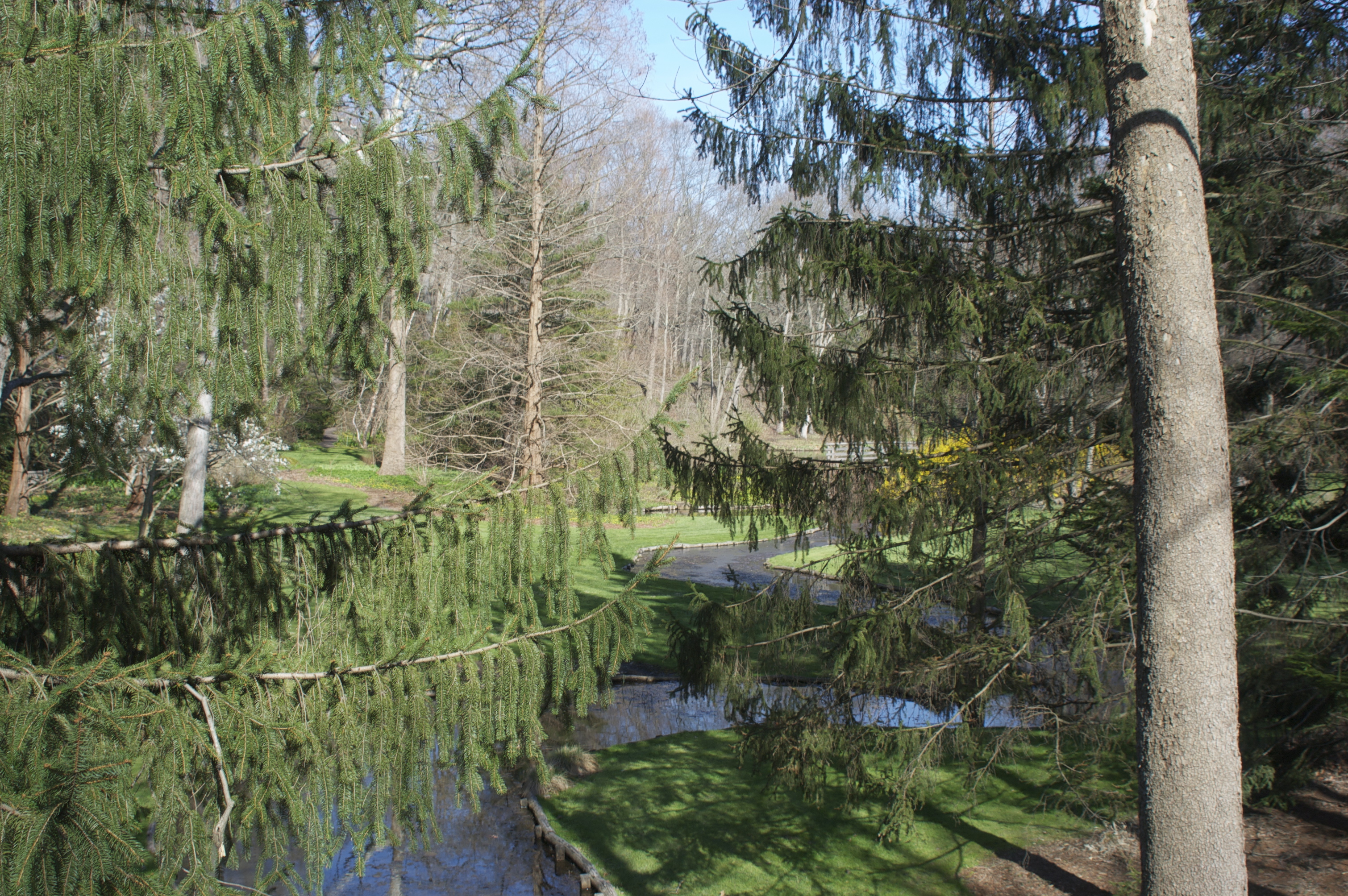
Leonard J. Buck Garden
They never drew a single plan. Leonard J. Buck, a geologist and trustee of the New York Botanical Garden, and Zenon Schreiber, a landscape architect, worked entirely by eye and proportion as they transformed a glacial stream valley in Far Hills, New Jersey, into what would become one of the nation's premier rock gardens. The collaboration began in the 1930s and continued for decades, with Schreiber designing the plantings and Buck working the rock. Their medium was not paper but the landscape itself: a ravine called Moggy Hollow, where ancient waterfalls had once cascaded and left behind rock faces, outcroppings, ponds, and a stream.
Sculpting Moggy Hollow
The garden occupies 33 acres of a glacial stream valley known as Moggy Hollow Natural Area, a terrain shaped by ice and water long before Buck and Schreiber arrived. The valley's rock faces and outcroppings provided the architecture; the two men provided the vision. Buck understood stone the way a geologist does: as structure, as history, as the scaffolding on which everything else rests. Schreiber understood plants the way a painter understands pigment: as texture, as color, as something that changes with the seasons and the light. Together, they created varying exposures and microclimates within the ravine, tucking shade-loving wildflowers beneath overhangs and positioning sun-tolerant shrubs on exposed ledges. The result is not a garden imposed on a landscape but a garden grown from one, each planting responding to the specific conditions of its microsite.
A Catalogue of Living Things
The plant list reads like a poet's inventory: bloodroot and Virginia bluebells in spring, rhododendrons and mountain laurel through summer, Japanese maples and shagbark hickories in their autumn colors. Dawn redwoods stand alongside native dogwoods. Siberian squill carpets ground beneath birches. Aconite, azalea, cyclamen, trillium, and dozens of other species fill niches that Buck and Schreiber identified across the ravine's varied terrain. The diversity is not random. Each planting was chosen for a specific exposure, soil type, and moisture level, then positioned to create visual compositions that shift through the year. Spring is the peak season, when wildflowers and flowering trees overlap in waves of bloom, but the garden rewards visits in every season. Even in winter, the bare rock and the architecture of deciduous trees reveal the underlying structure that the two men spent decades refining.
From Private Vision to Public Garden
Leonard Buck died in 1974, after more than four decades of work on the garden. His wife, Helen Buck, donated the property to the Somerset County Park Commission, and it opened to the public in 1977. The transition from private passion project to public garden preserved the essential character of Buck and Schreiber's creation. The garden asks for a small donation rather than charging admission, maintaining the accessible spirit of a place that was built to be experienced rather than admired from a distance. The adjacent Moggy Hollow Natural Area is accessible through the garden by request, extending the sense of a landscape that flows from cultivated to wild without a sharp boundary. The Somerset County Park Commission has maintained the garden's plantings and infrastructure while honoring the design philosophy of its creators: no drawing, no master plan, just careful attention to rock and water and the things that grow between them.
Rock, Water, and Time
What makes the Leonard J. Buck Garden unusual among American botanical gardens is its insistence on naturalism. Most rock gardens, even celebrated ones, feel constructed. The stones are placed. The waterfalls are engineered. At Buck Garden, the rocks were already there, deposited by glaciers and exposed by millennia of erosion. The waterfalls are gone, but the rock faces they carved remain, and the plantings occupy the spaces that water created. Walking through the garden's individual garden rooms, connected by paths along the stream, you move through a series of compositions that feel discovered rather than designed. That feeling is the achievement. It took a geologist who understood stone, a landscape architect who understood plants, and decades of patient work to make something this complex look this effortless.
From the Air
Located at 40.67°N, 74.62°W at 11 Layton Road in Far Hills, Somerset County, New Jersey. The garden occupies a wooded ravine in the Watchung Mountains foothills. Nearest airports include Somerset Airport (KSMQ, 6 nm SE) and Morristown Municipal Airport (KMMU, 14 nm NE). Best viewed at 2,000-3,000 ft AGL. The garden is tucked into a ravine and heavily canopied, so it blends into the surrounding woodland from the air. The nearby Far Hills village and open fields provide orientation.