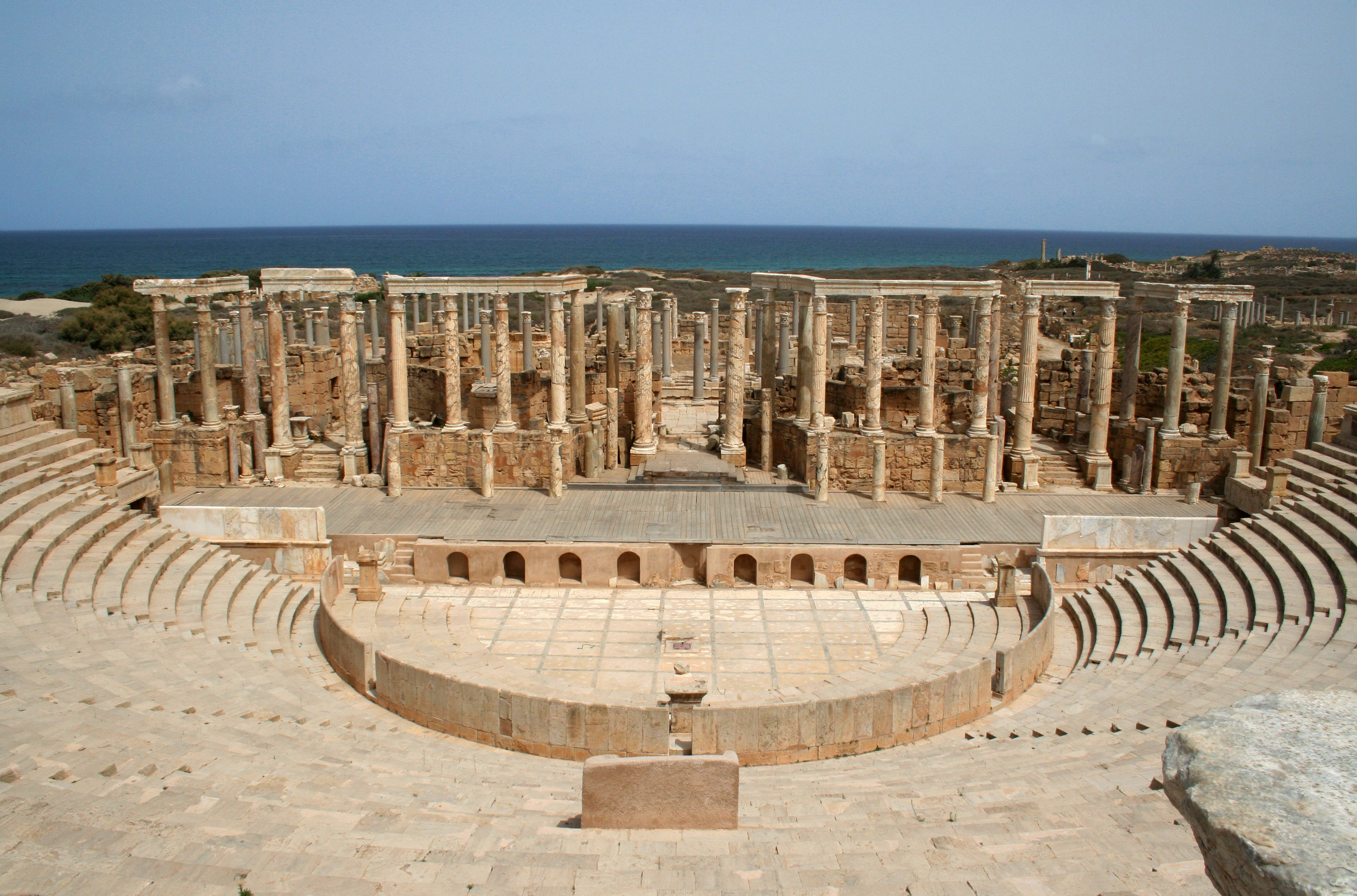
Leptis Magna
By 46 BC, the city of Leptis Magna was producing three million pounds of olive oil annually, enough to pay its tax to Julius Caesar in liquid gold. Situated at the mouth of the Wadi Lebda on Libya's Mediterranean coast, this was no provincial backwater. Founded by Phoenician settlers in the 7th century BC, enriched by trans-Saharan trade in ivory, gold dust, and ostrich feathers, and eventually elevated to one of the Roman Empire's great African cities, Leptis Magna thrived for over a thousand years before vanishing beneath the sand. Its rediscovery in the 1920s revealed a city so well preserved that walking its streets feels less like visiting ruins and more like stepping into a Roman world that simply stopped.
Phoenician Roots, Roman Ambitions
The city began as a Punic settlement in the second half of the 7th century BC, powerful enough to repel a Greek attempt to establish a colony nearby around 515 BC. After Carthage's defeat in the Punic Wars, Leptis fell under Roman control but retained considerable independence. Its coins tell the story of a place caught between cultures: Punic inscriptions on one side, images of Hercules and Dionysus on the other. Italian merchants arrived and built a profitable trade with the Libyan interior, while the surrounding farmland produced olive oil in staggering quantities. Under Emperor Tiberius, Leptis was formally incorporated into the Roman province of Africa. The city grew rapidly. An amphitheater went up during Nero's reign. By AD 64, Leptis had been elevated to municipium, and under Trajan it became a full colonia. Its first known bishop, Victor, became pope in AD 189 -- evidence of how deeply connected this African city was to the wider Roman world.
The Emperor Who Came Home
Everything changed in AD 193, when Leptis Magna's most famous son, Septimius Severus, became emperor. Severus lavished his hometown with buildings and wealth that transformed it into the third-most important city in Africa, rivaling Carthage and Alexandria. In AD 205, the imperial family visited and bestowed honors that included a magnificent new forum and a complete rebuilding of the docks. The ambition was not entirely practical. The natural harbor had a tendency to silt up, and the Severan renovations actually made the problem worse -- the eastern wharves are among the best preserved at the site precisely because they were barely used after construction. But the point was grandeur, not utility. Severus was an African emperor making a statement to the empire: this city mattered.
Decline into Sand
The 3rd Augustan Legion had defended Leptis against Berber raids, but when the legion was dissolved in AD 238, the city became increasingly vulnerable. Diocletian restored it as a provincial capital, and prosperity returned briefly, but the larger pattern was one of decline. In 439, the Vandals took the city. The Byzantine Empire recovered it in 533, yet Berber raids continued, and Leptis never regained its former importance. The Muslim conquest of the Maghreb delivered the final blow; the city was abandoned. What happened next was an accident of geography that would prove to be one of archaeology's great gifts: the Saharan winds buried Leptis Magna beneath layer upon layer of sand dunes, sealing its buildings, streets, and monuments in a near-airless tomb.
Unearthed by Italian Hands
In the 1920s, during Italy's occupation of Libya, Italian archaeologists began clearing the dunes and discovered a Roman city of astonishing completeness. The forum, the basilica, the market with its original measure converters, the amphitheater, the Severan arch -- all had survived beneath the sand in conditions that Mediterranean coastal sites rarely enjoy. Decorative columns inside the Basilica of Septimius Severus retained their carved detail. A mosaic from the Villa of the Nile depicted fishermen angling in the 1st century AD with a liveliness that fifteen centuries of burial had not diminished. UNESCO designated Leptis Magna a World Heritage Site, though it now carries the additional designation of a site in danger, threatened by Libya's political instability and, in the longer term, by rising sea levels along the Mediterranean coast.
A City Between Worlds
What makes Leptis Magna extraordinary is not any single monument but the completeness of the urban picture. Here is a city where Punic, Greek, Roman, and Berber cultures intersected for over a millennium, where trans-Saharan caravans met Mediterranean shipping, where an African boy could grow up to become the most powerful person in the Western world. The market still has its ancient measurement standards. The amphitheater still has its seats. The harbor still silts up, just as it did when Severus tried to fix it. From the theater wall, the view extends across the entire site to the sea -- the same view that Leptis Magna's residents saw when their city was alive. The sand preserved it. Whether the modern world can do the same remains an open question.
From the Air
Located at 32.64N, 14.29E on Libya's Mediterranean coast near Al Khums, about 120 km east of Tripoli. The archaeological site is extensive, spreading along the coastline at the mouth of the Wadi Lebda. From altitude, the Roman street grid and major structures are clearly distinguishable against the surrounding terrain. Nearest airport is Mitiga International Airport (HLLM) in Tripoli. Best viewed at 3,000-8,000 feet to appreciate the full scale of the site, or lower for individual structures like the amphitheater and forum.