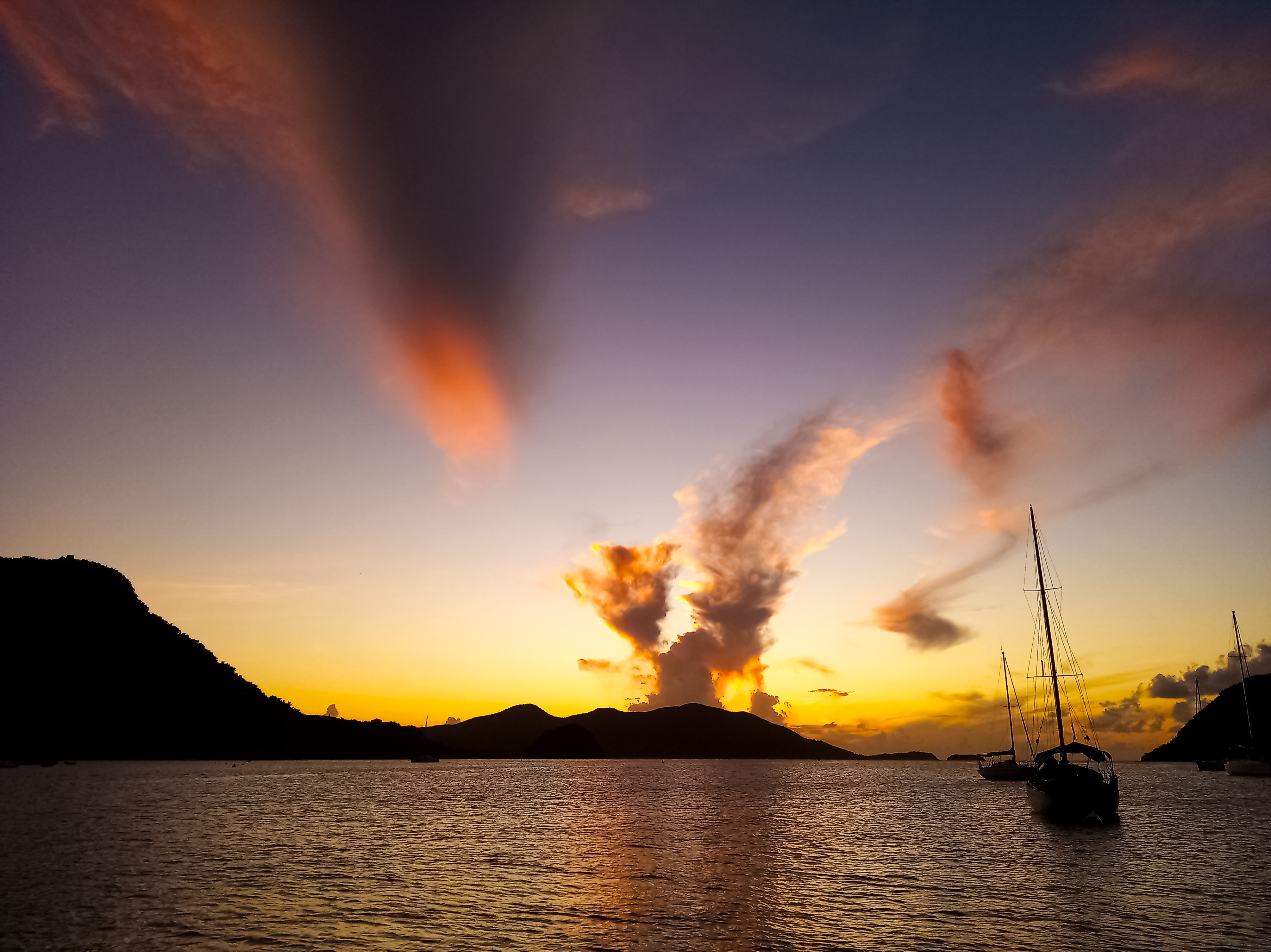
Les Saintes
The wives of Les Saintes fishermen used to bake a small pastry every evening - a shortcrust shell filled with coconut jam and topped with sponge cake - to welcome their husbands home from the sea at dusk. They called it Tourment d'Amour, the torment of love, and if that name sounds melodramatic for a dessert, consider the context: your husband left before dawn in a small boat, the Caribbean can kill without warning, and every sunset you watch the harbor mouth wondering if he'll come back. The pastry still greets visitors the moment they step off the ferry at Terre-de-Haut, offered by Saintoise women on the pier. It is Les Saintes in miniature - French, Creole, maritime, romantic, and impossible to resist.
Two Islands, Two Temperaments
Les Saintes is an archipelago of small islands belonging to Guadeloupe, France's overseas department in the eastern Caribbean. Two islands dominate: Terre-de-Haut and Terre-de-Bas, separated by a narrow channel and connected by ferry. Terre-de-Haut draws the tourists. Its bay - ranked as one of the most beautiful in the world - curves beneath volcanic hills studded with forts, batteries, and a lighthouse. Scooters and electric carts buzz through streets too narrow and too steep for conventional traffic. Fort Napoleon houses a museum and botanical garden on a hill overlooking the harbor. The Cemetery of the Sailors holds generations of fishermen who did not come home. Terre-de-Bas is quieter, more residential, its pleasures less curated: the ruins of an old pottery at Grand-Baie, the Saint-Nicolas Church, the picturesque neighborhood of Mapou where houses cluster on steep lanes above the water. Both islands were shaken by the earthquake of November 21, 2004, which damaged buildings and, for a time, dampened the tourism that Terre-de-Haut depends on.
The Creole Table
Les Saintes' cuisine is what happens when Breton, Norman, Saintongeais, African, and Arawak cooking traditions collide on islands surrounded by some of the richest fishing grounds in the Caribbean. Fish dominates, as it must when your fishermen are reputed to be among the best in the West Indies. The results include fish sausages, queen conch pies, breaded fish crepes filled with stuffing and bechamel, and blaf - a broth so simple it barely qualifies as a recipe and so good it barely needs one. The bokit, a round bread roll fried in oil and stuffed with whatever you choose, is the street food of choice, sold from bakeries that double as fast-food counters. Colombo powder - the local curry spice blend - flavors meats, fish, and vegetables alike. For dessert, beyond the Tourment d'Amour, there are limbes: sweet confections from Terre-de-Bas made with tamarinds, sugar, and condensed milk. Eating here is not a break from sightseeing. It is the sightseeing.
Forts and Basalt Columns
Les Saintes' strategic position in the channel between Guadeloupe and Dominica made it a military prize for centuries, and the fortifications remain its most dramatic landmarks. Fort Napoleon, built on the heights of Terre-de-Haut, overlooks the bay where the Battle of the Saintes raged in 1782. Fort Josephine perches on the islet of Cabrit, alongside the atmospheric ruins of a lazaret - a quarantine station from the age when ships carried plague as readily as cargo. The Battery of Modele crowns Morne du Chameau, the highest point on Terre-de-Haut, while the Battery Caroline guards the approach to Pompierre beach. Below these military works, at Pain de Sucre, basalt columns rise from the sea like the pipes of an enormous organ - a geological spectacle that predates every human claim on the islands by millions of years. Walking the Trace des Cretes trail along the ridgeline connects many of these sites, offering views that swing from the open Atlantic to the sheltered bay and back.
Island Time, French Rules
Les Saintes operates on a paradox familiar to France's overseas territories: it is fully French - euros in the pocket, Carte Vitale for healthcare, civil security helicopters for medical evacuation to Basse-Terre hospital - yet thoroughly Caribbean in rhythm and character. Getting here means a 15-minute ferry from Trois-Rivieres or a 90-minute ride from Pointe-a-Pitre. There is a small airstrip on Terre-de-Haut with no scheduled flights, only private charters. Cruise ships anchor in the bay - Costa, Ponant, Star Clippers - but the islands absorb visitors without losing their character. Cars are rare; the roads belong to pedestrians, cyclists, and the occasional gendarmerie vehicle. Cash machines work around the clock. The garbage is collected efficiently. And from a hillside above the harbor, watching the ferry pull away toward Guadeloupe as the sun drops behind Terre-de-Bas, you might eat a Tourment d'Amour and understand exactly how it got its name.
From the Air
Located at 15.86°N, 61.60°W, Les Saintes is a small archipelago visible south of Guadeloupe's Basse-Terre island. From altitude, the two main islands (Terre-de-Haut and Terre-de-Bas) and several smaller islets are clearly visible, with the distinctive crescent-shaped bay of Terre-de-Haut a notable landmark. Terre-de-Haut has a small airstrip (TFFS) suitable for light aircraft only - no scheduled service. Nearest major airport: Pointe-a-Pitre Le Raizet (TFFR) on Guadeloupe, approximately 35 nm north. Basse-Terre is the closest large landmass, roughly 8 nm north. Best viewed from 3,000-6,000 ft for the full archipelago perspective. Clear tropical conditions typical; afternoon showers common. The channel between Guadeloupe and Dominica can produce gusty winds.