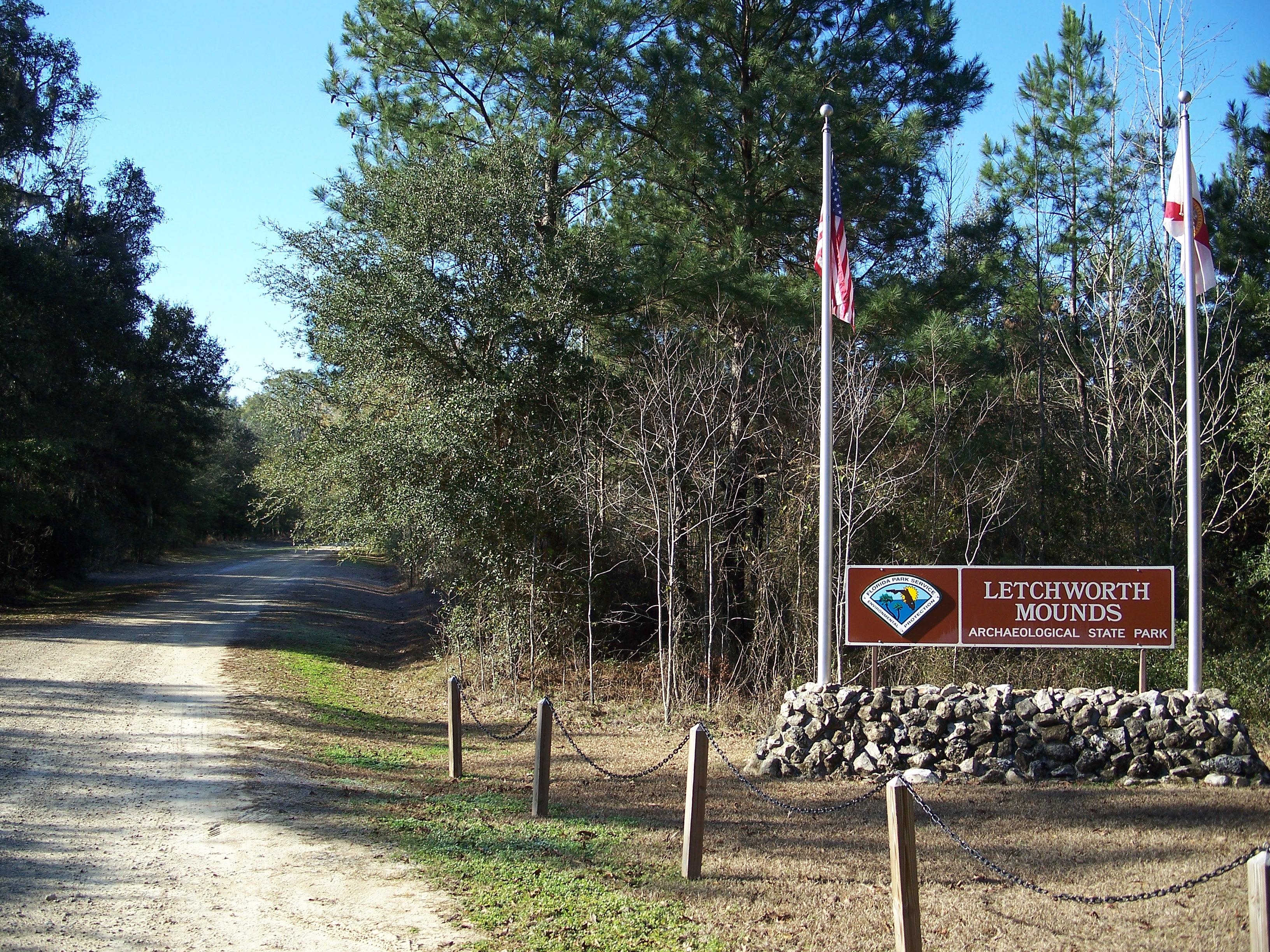
Letchworth-Love Mounds Archaeological State Park
Fifty feet of hand-carried earth, shaped into a perfect ceremonial platform, rises from the pine flatwoods of Jefferson County. No machines built this. No draft animals hauled the soil. Sometime between 200 and 900 AD, the people of the Swift Creek culture carried baskets of carefully selected dirt, shell, and clay up the growing slope, load after load, until the mound reached the height of a five-story building. Letchworth-Love Mounds Archaeological State Park preserves the tallest prehistoric Native American earthwork in all of Florida, and the story it tells stretches back nearly 10,000 years.
Basket by Basket
The numbers alone stagger the imagination. The great mound measures 300 feet across at its base and stands between 46 and 50 feet tall. Every cubic yard of that mass was transported by human hands, carried in woven baskets from surrounding areas to this chosen spot six miles west of present-day Monticello. The builders were not improvising. They combined different types of soil and shells with engineering precision, layering materials for structural stability. They finished the surface with smooth clay, creating prepared sides that gleamed in the subtropical sun. When completed, the mound would have risen clean and bare above flat, intentionally leveled plazas, a commanding presence visible across the surrounding landscape. These plazas served as gathering places for rituals, games, and ceremonies that drew communities from across the region.
The Swift Creek Legacy
The builders belonged to the Swift Creek culture, a sophisticated society of Native Americans who inhabited North Florida between roughly 200 and 450 AD. Theirs was a hierarchical civilization with the organizational capacity to plan and execute monumental construction projects. The mound was not simply a burial site or a pile of refuse. It was a deliberate expression of religious and political power, a centerpiece around which an entire community organized itself. Surrounding the mound, workers lived in nearby dwellings. Communal fields and gardens spread outward, planted with maize and other crops to feed the population density that such ambitious construction demanded. The Letchworth site is one of only three major surviving mound complexes in the Florida Panhandle, the other two belonging to the later Fort Walton culture that flourished between 1100 and 1550 CE.
Ten Thousand Years of Footprints
The great mound may be the park's most dramatic feature, but the human story here reaches far deeper into time. Archaeological evidence at this 188-acre site documents nearly 10,000 years of continuous human presence. Long before the Swift Creek people conceived their monumental earthwork, earlier inhabitants hunted, gathered, and made their lives along this stretch of the Florida Panhandle. Artifacts recovered from the site trace an arc of human adaptation across millennia, from the earliest Archaic period inhabitants through the mound-building era and beyond. Today the park's exhibits interpret this deep timeline, connecting the physical evidence of stone tools and pottery fragments to the lives of the people who left them behind.
Reclaimed by the Forest
Walk the trails at Letchworth-Love Mounds today and the great earthwork presents a different face than the one its builders intended. Trees and underbrush have colonized its slopes, softening the once-smooth clay surfaces into a wooded hillside that could almost pass for a natural landform. The forest has reclaimed what human hands once kept bare. But the mound's sheer scale still registers through the canopy. At nearly 50 feet, it dominates the surrounding flatwoods in a way that no natural feature in this terrain would. The 188 acres of preserved land support a rich natural community. Birders work the trails for warblers and woodpeckers. Hikers find the terrain gentle but the history underfoot anything but ordinary. The park sits quietly along Sunray Road South, a half mile off U.S. Route 90, in a stretch of northwest Florida where the pace of modern life has not yet erased the patience that built this place.
From the Air
Located at 30.52°N, 83.99°W in Jefferson County, approximately six miles west of Monticello in the Florida Panhandle. The mound site sits in a flat pine landscape, so the earthwork's 50-foot rise is distinctive from low altitude. Best viewed below 2,000 feet AGL. Nearest airports include Tallahassee International (KTLH), approximately 25 nm to the west, and Monticello-Jefferson County Airport. The surrounding terrain is low and flat, typical of the north Florida coastal plain.