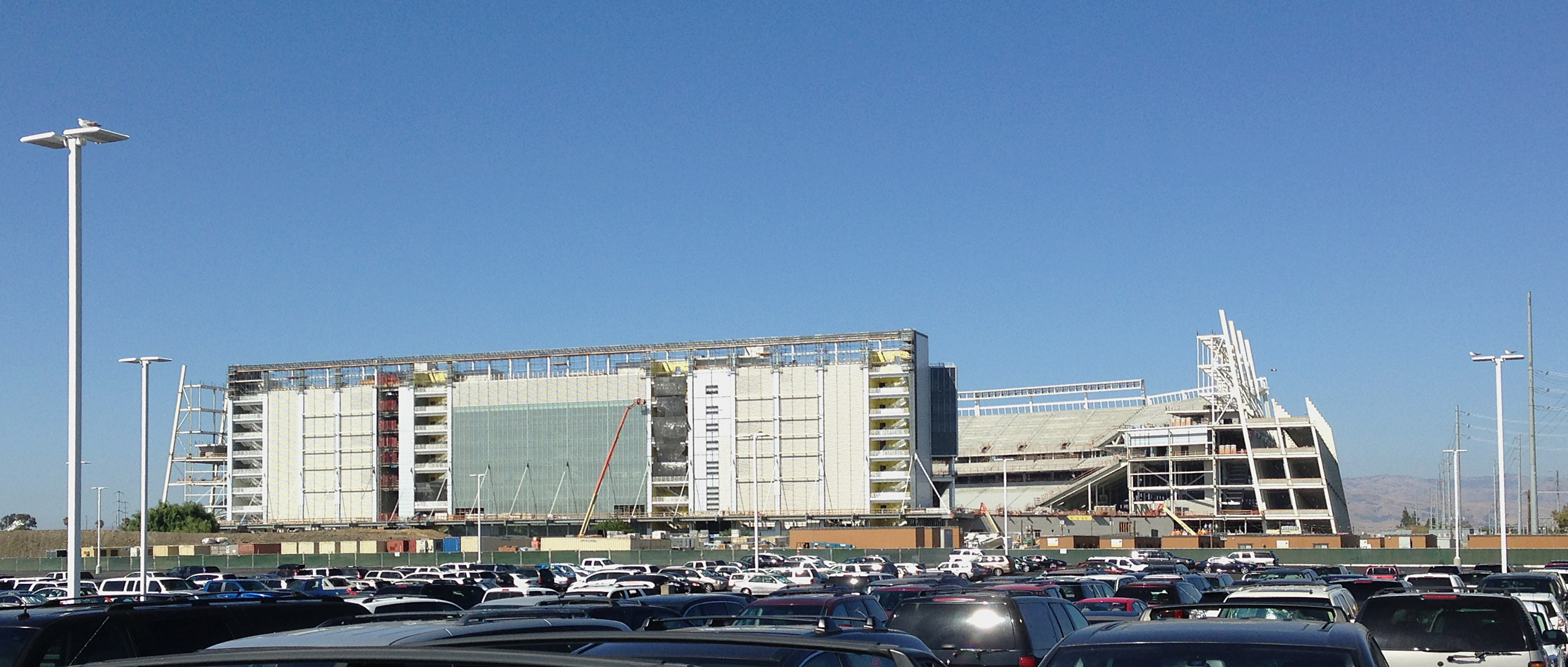
Levi's Stadium
Forty-three complaints. That is how many times pilots landing at nearby San Jose International Airport reported being blinded or disoriented by the lights of Levi's Stadium in its first two years of operation. The stadium sits directly beneath a runway approach path, its light towers and scoreboards blazing into cockpit windows on game nights. It is the kind of problem that could only arise in Silicon Valley, where a $1.3 billion football venue landed not in the city whose name the team carries but in suburban Santa Clara, wedged between a theme park and an airport, on a former parking lot that once served overflow visitors to California's Great America.
A Team Without a City
The San Francisco 49ers spent years trying to stay in San Francisco. In 1997, voters approved $100 million in city funds for a new stadium at Candlestick Point, but ownership turmoil -- Eddie DeBartolo Jr.'s legal troubles forced him to surrender the team to his sister Denise and her husband John York -- derailed the project before it broke ground. A second attempt in 2006 envisioned a $916 million stadium tied to a Summer Olympics bid, with the Olympic Village converted into low-income housing after the games. Infrastructure costs killed it. By November 2006, the Yorks announced they were shifting their attention to Santa Clara, home to the team's training facility since 1987. A state senator introduced a bill to bar the 49ers from building within a hundred miles of San Francisco if they left. The bill died. The 49ers stayed in name only.
Measure J and the Dirt-Moving
Santa Clara voters decided the stadium's fate in June 2010. Measure J passed with 58 percent approval, authorizing the creation of a tax-exempt Stadium Authority to build and own the facility on city land. The financing was elaborate: an $850 million construction loan from Goldman Sachs, Bank of America, and U.S. Bank, plus a $200 million NFL loan approved by team owners in February 2012. Groundbreaking came on April 19, 2012. Construction was not without tragedy -- on June 11, 2013, a mechanic working on an elevator was struck by a counterweight and fell down the shaft to his death. Work resumed two days later after state safety officials cleared the site. The stadium opened on July 17, 2014, and the first game played there was a surprise: not football, but an MLS match on August 2 in which the San Jose Earthquakes defeated Seattle Sounders FC 1-0 before a crowd of 48,765.
Spectacle and Sunburn
Levi's Stadium was built for spectacle. Super Bowl 50 arrived on February 7, 2016, with Coldplay, Beyonce, and Bruno Mars sharing the halftime stage as the Denver Broncos defeated the Carolina Panthers 24-10. WrestleMania 31 set a stadium attendance record of 76,976. The Copa America Centenario brought four matches in 2016, and the venue is slated to host multiple 2026 FIFA World Cup matches. But spectacle comes with an asterisk. The stadium was designed with the foggy, cool Candlestick Point site in mind. When the team moved the project to Santa Clara -- where summer afternoons regularly hit the high eighties and nineties -- they kept the original orientation rather than delay construction. Two-thirds of the 68,500 seats sit in a lower bowl fully exposed to afternoon sun, with no overhangs. Fans suffered heat exhaustion during early-season games. FAA regulations prevent adding height to the structure because of the nearby airport, making the shade problem nearly impossible to fix.
Where Jeans Meet Green Roofs
Levi Strauss & Co. paid $220.3 million over twenty years for the naming rights, and the stadium has leaned into its corporate identity in ways both criticized and creative. The venue earned LEED Gold certification as one of the largest green-certified buildings in the country, with solar panels and a green roof that, in 2016, sprouted something unexpected: a working farm. The Faithful Farm, named after the 49ers' devoted fanbase, covers a quarter-acre of rooftop where forty rotational crops -- herbs, tomatoes, peppers, leafy greens, edible flowers -- supply dishes served in club spaces during games and at more than 200 private events annually. The farm was the brainchild of team CEO Jed York and his wife Danielle, a former science teacher. Long-tenured fans, however, have been less charmed by the stadium's personality. They describe a corporate atmosphere that replaced the raucous, blue-collar energy of Candlestick Park -- the most expensive tickets in the league during the inaugural season priced out many season-ticket holders, and those who did get in often found themselves watching from bars and lounges rather than their seats.
The Parking Lot Diplomacy
Nothing revealed the tensions between stadium and city quite like the parking battles. With limited space in the immediate vicinity, officials repurposed the fairways of the city-owned Santa Clara Golf and Tennis Club across Tasman Drive, modeling the arrangement on the Rose Bowl's longstanding deal with Brookside Golf Course in Pasadena. In 2015, the 49ers offered $15 million to take over the adjacent Youth Soccer Park and convert its fields into parking lots. When young soccer players showed up at a city council meeting to protest, the team withdrew the offer and countered with an unsolicited $3 million gift for youth athletics. The council turned that down too. Nearby Mountain View imposed three-hour parking limits on downtown streets during game days to keep stadium traffic from swallowing the town. For a venue built to seat 75,000 in an expanded configuration, the challenge of moving that many people through suburban streets remains the stadium's most persistent headache.
From the Air
Located at 37.40N, 121.97W in Santa Clara, California. The stadium is immediately recognizable from the air -- a large open-air venue adjacent to California's Great America theme park, with the green roof visible on the west side. Caution: the stadium sits directly under the approach path for San Jose International Airport (KSJC, 2nm SE), and its light towers have generated pilot complaints. Nearest airports: KSJC (2nm SE), Moffett Federal Airfield (KNUQ, 5nm NW), Palo Alto (KPAO, 10nm NW). Best viewed at 2,000-3,000 feet AGL. On game days, expect significant road traffic and TFR restrictions in the area.