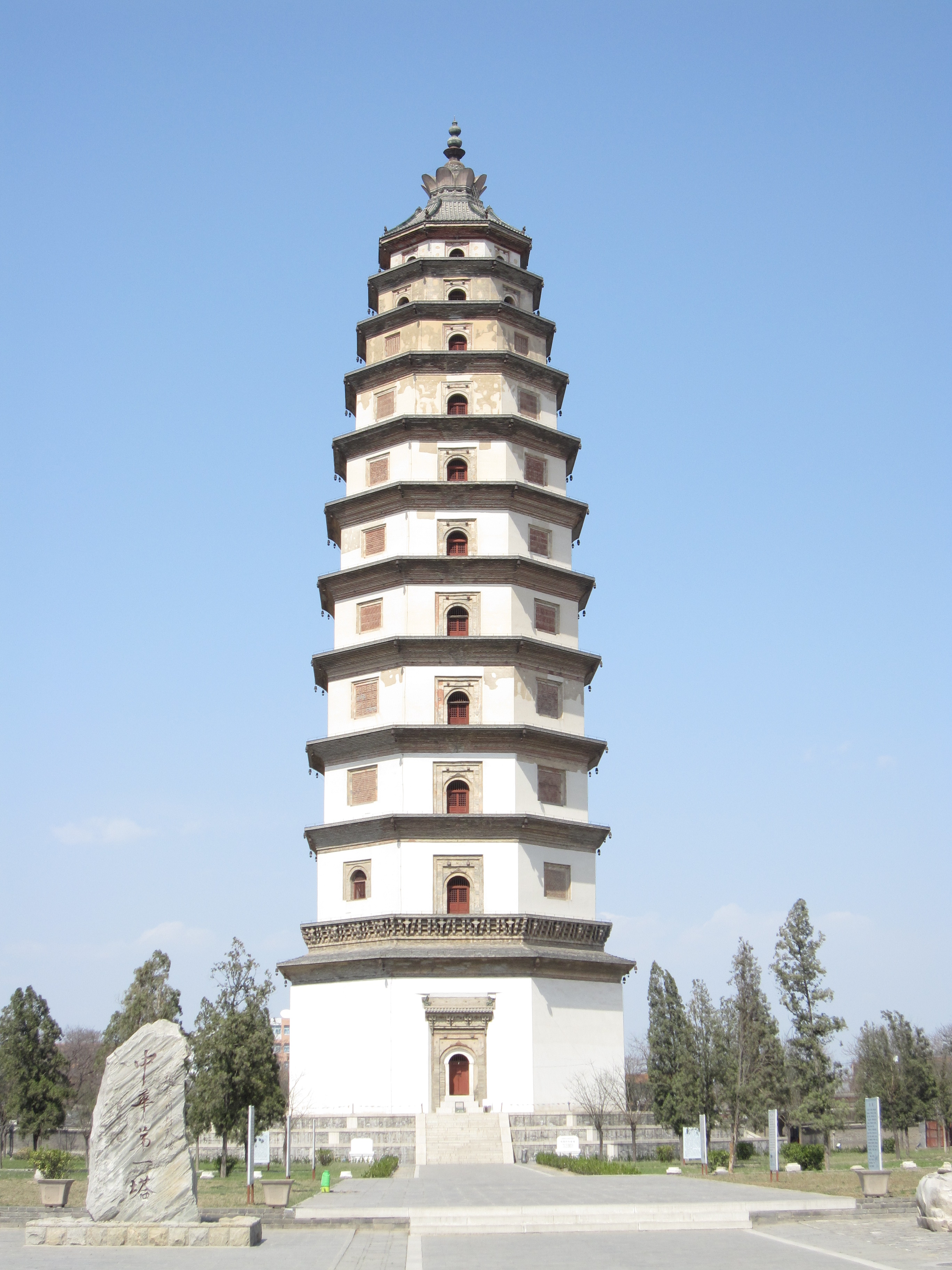
Liaodi Pagoda
Its name means 'foreseeing the enemy's intentions.' At 84 meters, the Liaodi Pagoda in Dingzhou, Hebei Province, is the tallest surviving pre-modern Chinese pagoda and the tallest brick pagoda in the world. But this tower was not built for spiritual contemplation alone. Dingzhou sat along the Song dynasty's tense northern border with the Liao dynasty, whose Khitan warriors were a constant threat. The pagoda that Emperor Zhenzong commissioned in 1001 served a dual purpose: a repository for Buddhist scriptures brought from India, and a watchtower tall enough to spot enemy cavalry movements across the flat North China Plain.
Fifty-Four Years of Construction
Construction began in 1001 during the reign of Emperor Zhenzong of Song. The original impetus was religious -- the emperor wanted a proper home for Buddhist scriptures gathered from India by the monk Huineng. But Dingzhou's strategic position near hostile territory gave the pagoda a military dimension that eventually overtook its spiritual purpose. The tower was initially called the Kaiyuan Pagoda, after the monastery that housed it. As its military utility became apparent, the name shifted to Liaodi -- a compound meaning roughly 'to observe the enemy.' Construction took 54 years, concluding in 1055 during the reign of Emperor Renzong. When completed, it surpassed the 69-meter central tower of the Three Pagodas in Yunnan, becoming the tallest pagoda in China, a record it has held for nearly a millennium.
Engineering in Brick and Stone
The Liaodi Pagoda rises from a large platform on an octagonal base. Each of its eleven stories features gradually tiered stone eaves, doors, and windows -- though four sides of the octagon contain false windows rather than real ones. The first floor is encircled by a balcony. Inside, a large staircase with landings at each floor winds from bottom to top. Brick brackets support the landings on the lower floors, but from the eighth story upward the vaulted ceiling is unsupported by brackets, a structural challenge the Song builders solved with careful weight distribution. A unique feature is visible within: a large internal pillar shaped like a pagoda within the pagoda, a structural element that doubles as an aesthetic statement. At the very top, a crowning spire of bronze and iron catches the light. The walls are thick enough that a split section has been left open, allowing visitors to see the actual construction -- the layered brick and stone that have kept the tower standing through earthquakes, wars, and nearly a thousand northern Chinese winters.
One of Hebei's Four Treasures
The Liaodi Pagoda is counted among the Four Treasures of Hebei, alongside three other celebrated cultural artifacts of the province. Song-era painted murals and stone steles inscribed with Chinese calligraphy still decorate the interior, fixed in place since the tower's completion. Only one other pre-modern pagoda approaches its height: the Chongwen Pagoda in Shaanxi Province, completed in 1605 during the Ming dynasty at 79 meters -- still five meters shorter than the Liaodi. The tallest pagoda in all of Chinese history was a 100-meter wooden tower built in Chang'an in 611 by Emperor Yang of Sui, but that structure vanished centuries ago. The Liaodi Pagoda endures, its dual identity as monastery tower and military watchtower preserved in the very name that locals gave it when they realized what it was really for.
From the Air
The Liaodi Pagoda stands at 38.51°N, 115.00°E in Dingzhou, Hebei Province. At 84 meters, it is a prominent vertical feature visible from considerable distance across the flat North China Plain. The pagoda is within the Kaiyuan Monastery complex in central Dingzhou. Nearest major airport is Shijiazhuang Zhengding International Airport (ICAO: ZBSJ), approximately 80 km southwest. The pagoda is best appreciated from 2,000-4,000 feet AGL, where its height relative to the surrounding flat terrain is most dramatic.