Liberation Pavilion
The gilded characters spelling "Liberation Pavilion" were not designed by a calligrapher. They were traced from the handwriting of Marshal Chen Yi, the commander who led the Eastern China Field Army's capture of Jinan during the Chinese Civil War. Completed in September 1986, the pavilion rises 34 meters above the southeastern corner of Jinan's old city moat, standing on the very ground where Chen Yi's troops breached the city wall on September 24, 1948. The wall itself is gone now, demolished in the decades after the revolution. What remains is this monument -- classical Chinese architecture built on a pedestal of Socialist Realist stone carvings, a structure that holds two eras in deliberate tension.
Where the Wall Fell
The Battle of Jinan lasted eight days, from September 16 to September 24, 1948. By the time the Communist Eastern China Field Army breached the southeastern section of the city wall, the Kuomintang garrison had been isolated for months, its railway links severed, its reinforcement routes cut. The breach point at the southeastern corner of the moat was not chosen for its symbolism -- it was chosen because it was where the assault succeeded. But in the decades that followed, the spot accumulated meaning. The city wall was removed, the moat became a public waterway, and in 1986, nearly four decades after the battle, the Liberation Pavilion was erected to mark the point of entry.
Classical Form, Revolutionary Content
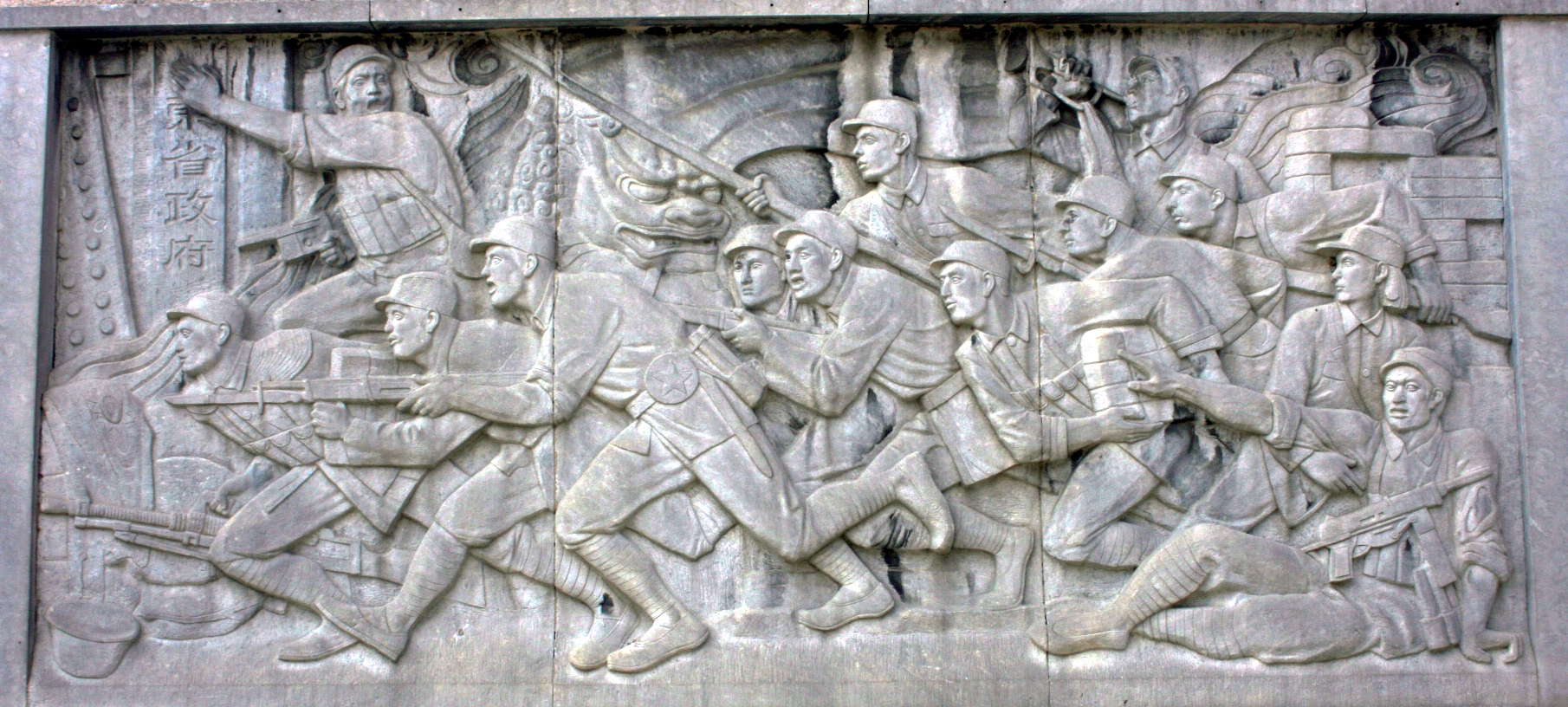
The pavilion's architecture creates a deliberate collision between old and new China. The structure itself follows classical Chinese patterns: a two-story pavilion capped with an eaved roof, set on a broad stone pedestal, the proportions and lines recognizably traditional. But the sides of that pedestal are carved with bas-relief scenes from the 1948 battle, rendered in the muscular, idealized style of Socialist Realism. Soldiers charge forward; banners fly; the storming of the provincial government plays out in stone. The gilded inscriptions appear both on the pedestal and on the pavilion proper, the characters taken from Chen Yi's personal handwriting. Inside, an exhibition tells the story of the battle in photographs, maps, and artifacts. The whole structure occupies 617 square meters -- modest by monument standards, but its 34-meter height ensures it dominates the southeastern approach to the old city.
A Monument Between Springs
The Liberation Pavilion stands on the north bank of the old city moat, directly across the water from Black Tiger Spring -- one of Jinan's most famous artesian springs, where water pours from three carved tiger mouths into a square pool. The proximity is coincidental but evocative. The spring has been flowing since before written records of the city; the pavilion commemorates an event from 1948. Between them, the moat carries water that has been circulating through Jinan's karst aquifer since before either natural feature or political monument existed. Locals walk the moat promenade between the two landmarks, filling bottles at the spring and posing for photographs at the pavilion, treating both as ordinary features of their daily landscape rather than as symbols of geological time or political history.
From the Air
Located at 36.66N, 117.03E at the southeastern corner of Jinan's old city moat. Jinan Yaoqiang International Airport (ZSJN) is approximately 30 km northeast. The pavilion is a 34-meter structure visible along the moat near Black Tiger Spring. Daming Lake is to the north. From the air, the moat traces a rectangular path through the old city, and the pavilion marks its southeastern corner.