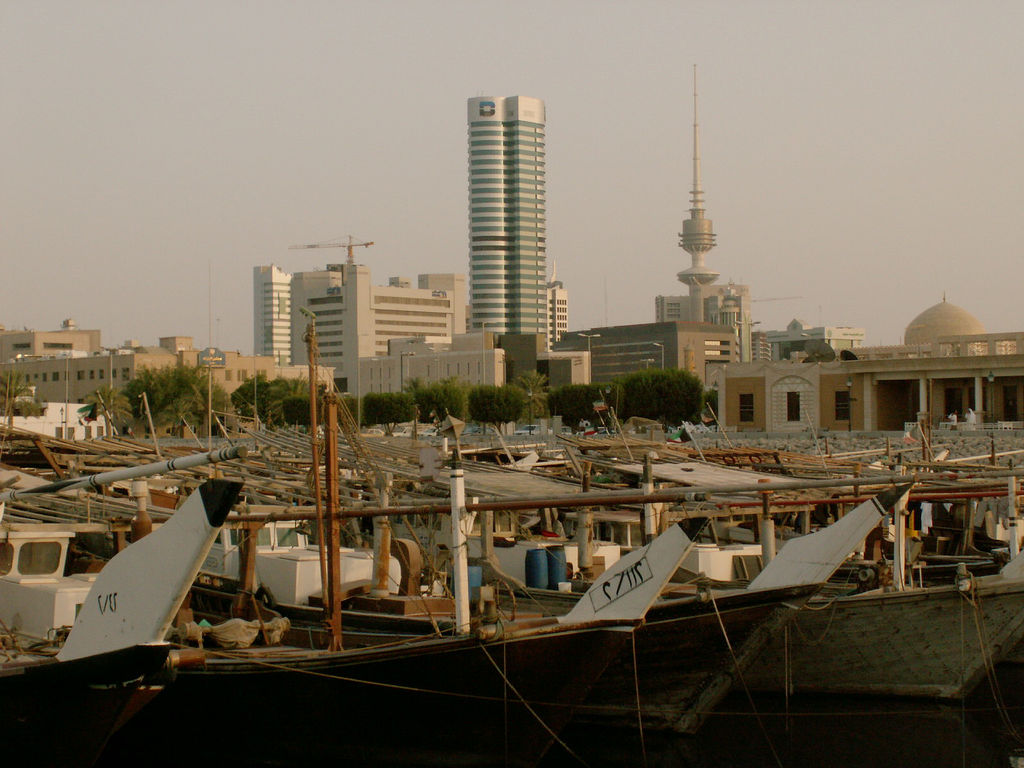
Liberation Tower
Construction was roughly half finished when Iraqi tanks rolled into Kuwait City on August 2, 1990. The crane went silent. The concrete skeleton of what was supposed to be a routine telecommunications tower stood exposed to an occupation that would last seven months. When the last Iraqi soldiers were expelled on February 27, 1991, the unfinished tower was still standing -- undamaged, waiting. Kuwait resumed building it, and when the structure was completed in 1993, the government gave it a new name. The Kuwait Telecommunications Tower became the Liberation Tower.
A Concrete Statement
Rising 372 meters above Kuwait City, the Liberation Tower is the second-tallest structure in the country. Construction began in April 1987 as a straightforward infrastructure project -- a broadcast tower to transmit radio and television signals across the nation. The design uses a vertical cantilever structure of prestressed, cast-in-place reinforced concrete, engineered to withstand both seismic loads and the fierce Persian Gulf winds. But the tower's significance has always exceeded its engineering. By the time it opened to the public on March 10, 1996, three years after structural completion, it had become something Kuwait never originally intended: a monument to survival.
Invasion and Aftermath
The Iraqi occupation transformed a construction site into a symbol. Remarkably, the half-built tower sustained no structural damage during the invasion, despite the destruction visited on much of Kuwait's infrastructure. While oil wells burned and the city suffered, the tower's concrete core endured. The decision to rename it after liberation was not merely ceremonial. For Kuwaitis who lived through the occupation, the tower's silhouette against the skyline carries a weight that no telecommunications function can explain. It is a vertical timeline: the lower half built in peacetime, the upper half built in defiance of what had happened.
Above the Gulf
The tower houses an observation deck at roughly 165 meters, offering panoramic views of Kuwait City and the Persian Gulf beyond. A revolving restaurant was originally part of the design, though public access to upper sections has been restricted in recent years for security reasons. The complex at the tower's base serves a more bureaucratic purpose, housing the Communication and Information Technology Regulatory Authority and government service offices handling everything from civil identification to foreign affairs. Ceramic tiles clad the lower sections, while the upper structure gleams with metallic elements, giving the tower a two-toned appearance that shifts with the light.
Kuwait City's Vertical Axis
The Liberation Tower anchors Kuwait City's skyline alongside the better-known Kuwait Towers, the trio of blue-and-white spheres that have served as the country's visual emblem since 1979. But where the Kuwait Towers represent the optimism of the oil boom, the Liberation Tower carries a harder story. It stands on Ahmed Al Jaber Street, in the heart of a city that has rebuilt itself since 1991 with a velocity that can make the invasion feel distant. The tower does not allow that distance. Its name, chosen deliberately, ensures that every weather forecast broadcast from its antenna, every government form processed in its base, carries a reminder of what was lost and recovered.
From the Air
Located at 29.368N, 47.975E in central Kuwait City. The tower is 372 meters tall and clearly visible as the second-tallest structure in the country. Look for it alongside the distinctive Kuwait Towers (the spherical structures) to the northeast along the waterfront. Nearest major airport is Kuwait International Airport (ICAO: OKBK), approximately 16 km south. Best viewed from 2,000-5,000 feet AGL approaching from the Persian Gulf to the east, where the full Kuwait City skyline is visible.