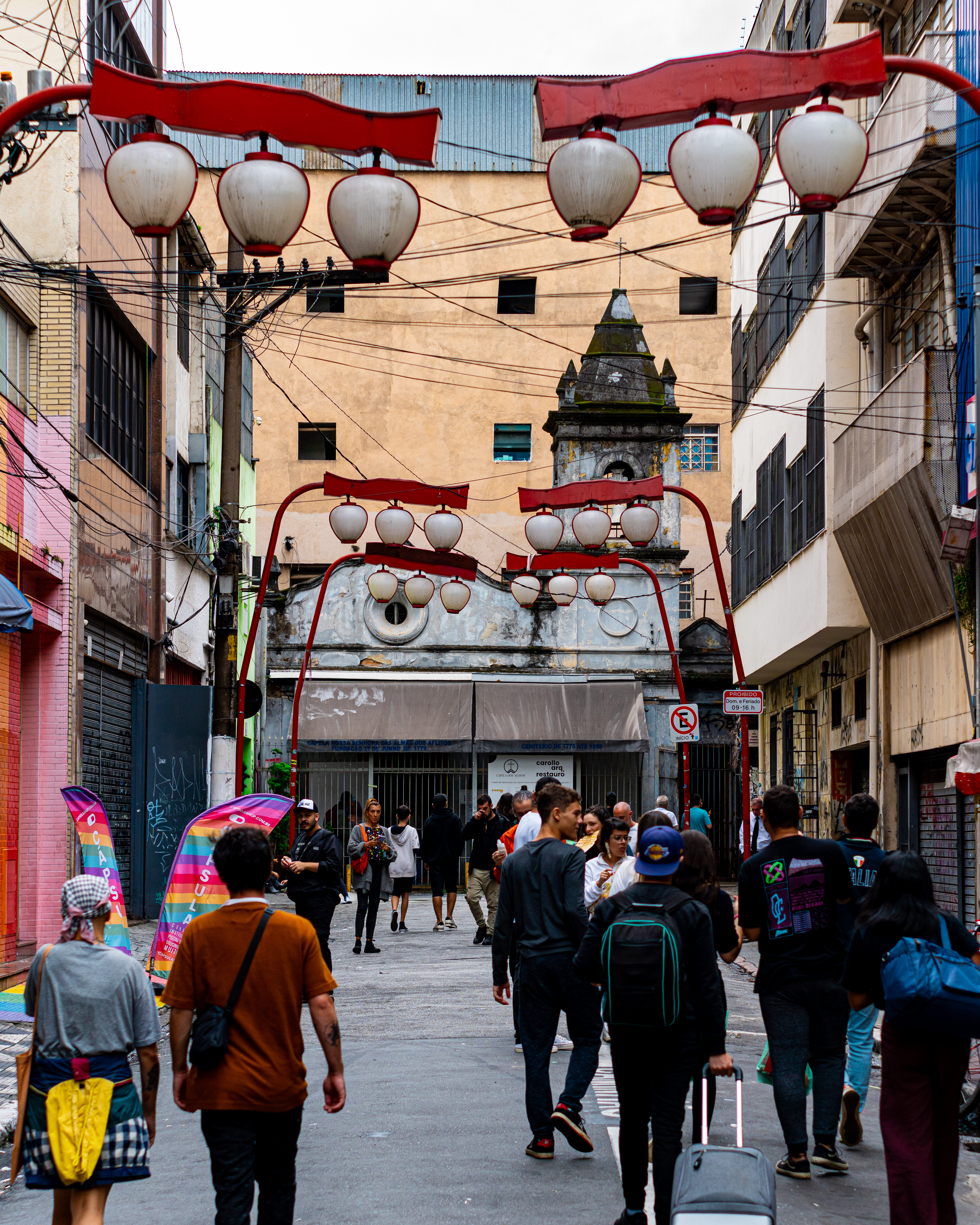
Liberdade (district of São Paulo)
The nine-meter red torii on Rua Galvão Bueno marks the entrance to one of the most unexpected neighborhoods in the Americas. Liberdade looks, sounds, and smells like a district of Tokyo transplanted into the concrete sprawl of São Paulo -- paper lanterns strung along the streets, signs in Japanese and Portuguese, the scent of yakisoba drifting from storefronts. But the name on the street signs tells an older, darker story. Liberdade means liberty. The neighborhood earned that name not from any celebration of freedom, but from the grim arithmetic of slavery: for the enslaved people who were marched here to die, death was the only liberty available.
The Field of the Gallows
Until the late 19th century, this district was called Campo da Forca -- the Field of the Gallows. It was the place where São Paulo executed enslaved people and convicted criminals. The condemned were led first to the Igreja Nossa Senhora da Boa Morte, the Church of Our Lady of Good Death, where they offered a final prayer for a rapid and painless end. Then they were taken to the Largo da Forca, the public square where the gallows stood. The Cemitério dos Aflitos, the Cemetery of the Afflicted, was established in 1774 to bury those the city had killed -- executed enslaved people, those who had died by suicide, anyone denied burial elsewhere. Most of the cemetery was demolished for housing in the 20th century. The small Capela dos Aflitos on Rua dos Estudantes is all that remains. Executions continued at Campo da Forca until 1891, six years after abolition. Then the square was renamed Praça da Liberdade, and the neighborhood took a new name for a new century. The Igreja da Santa Cruz das Almas dos Enforcados -- the Church of the Holy Cross of the Souls of the Hanged -- still stands at the south edge of the square, its name a refusal to let the dead be forgotten.
Basement Rooms and New Beginnings
Japanese immigrants began arriving in Liberdade in 1912. They came not from Japan directly but from the coffee plantations in the interior of São Paulo state, where many had struggled to adapt to agricultural labor and the terms of their contracts. Liberdade offered something practical: basements. Nearly every property in the district had one, and landlords rented them cheaply. Multiple families packed into subterranean rooms, enduring poor conditions in exchange for proximity to the city center and its job opportunities. A community took root. By the early 20th century, small businesses appeared to serve it -- hostels, markets selling imported goods, a shop that made tofu, another that made manjū, a Japanese confection. In 1915, the Taisho Shogakko primary school opened to educate the approximately 300 Japanese children then living in São Paulo. By 1932, the community had grown to about 2,000. They called themselves Nikkei -- people of Japanese descent -- and Liberdade became their anchor in a vast, unfamiliar city.
A Community Rebuilds After War
The end of World War II did not bring immediate peace to São Paulo's Japanese community. Brazil had sided with the Allies, and the Nikkei population faced suspicion and hostility. Recovery came through culture, not politics. In 1946, the São Paulo Shimbun newspaper began publication -- the first postwar Japanese-language periodical in Brazil. That same year, the Sol Bookstore, known as Taiyodo, opened its doors and still operates today, its shelves lined with Japanese-language books. In March 1947, an orchestra organized by Professor Masahiko Maruyama performed the first postwar concert in the auditorium of the Paulista Teacher's Center on Avenida Liberdade. In 1953, Yoshikazu Tanaka built a five-story complex on Rua Galvão Bueno that included a 1,500-seat cinema called Cine Niterói. The Japanese Cultural Association of São Paulo, known as Bunkyô, inaugurated its building in 1964. Each institution was a declaration: we are here, we are staying, and we are building something that will outlast us.
The Torii and the Subway
Two arrivals in the 1970s transformed Liberdade from an immigrant enclave into a citywide destination. In 1974, the nine-meter red torii was erected on Rua Galvão Bueno, giving the neighborhood a gateway and a symbol. The following year, the Japão-Liberdade metro station opened on Line 1, São Paulo's first subway line, connecting Liberdade to the rest of the city. Commerce exploded. Today, the station handles 21,000 passengers daily, many of them heading to the weekend street fair in Praça da Liberdade, where vendors sell handmade crafts, Japanese street food, and goods that blur the line between souvenir and staple. The district has also diversified. While Japanese Brazilians established the neighborhood's identity, Chinese, Taiwanese, Korean, and Okinawan immigrants have since settled alongside them. Most Japanese descendants have moved to other parts of the city, maintaining businesses in Liberdade but no longer living above the shops. In 2008, the neighborhood was revitalized to mark the centennial of Japanese immigration to Brazil, with Crown Prince Naruhito visiting São Paulo for the celebration. The Historical Museum of Japanese Immigration, housed in the Bunkyô building, preserves the full arc -- from the first ships to the present day.
What a Name Carries
Liberdade holds two histories in a single name. There is the Campo da Forca, where enslaved people and convicts met their deaths, and there is the Japantown, where immigrants built lives from basement rooms and tofu shops. The connection between them is not metaphorical. It is geographic. The same square where gallows stood now hosts a weekend fair selling takoyaki and origami. The church commemorating the souls of the hanged faces a street lined with paper lanterns. Neither history erases the other. The Capela dos Aflitos still draws visitors who come to remember the enslaved dead. The torii still marks the entrance to a neighborhood that smells of soy sauce and incense. Liberdade's name was meant to mark an ending -- the end of executions, the end of an era. Instead, it became a beginning, a place where the word liberty stopped being about death and started being about the stubborn, incremental work of making a home in a foreign city.
From the Air
Located at 23.57°S, 46.63°W in central São Paulo, immediately south of the historic Sé district. From altitude, Liberdade is identifiable by its dense urban fabric in the city center, near the Sé Cathedral and Praça da Liberdade. Nearest airport is São Paulo/Congonhas (SBSP), approximately 7 km to the south. São Paulo/Guarulhos International (SBGR) lies 28 km to the northeast. The neighborhood sits along São Paulo Metro Line 1 (Blue), with the Japão-Liberdade station at its heart. Best viewed at 3,000-5,000 ft as part of São Paulo's historic core. Look for the dense cluster of mid-rise buildings south of the cathedral district.